Archive for October 30, 2011

Netanyahu: We do not seek a deterioration

October 30, 2011

Netanyahu: We do not seek a deterioration – Israel News, Ynetnews.

PM says Israel’s policy in Gaza includes two main principles: ‘Kill or be killed’ and ‘Hurt us – on your own head be it’. Unaware army changed its version, Netanyahu mistakenly says terror cell gunned down Saturday was same cell that fired at Ashdod Wednesday

Ahiya Raved

Published: 10.30.11, 14:01 / Israel News
As a fragile cease-fire began to take effect on Sunday, Prime Minister Benjamin Netanyahusaid that Israel’s policy in the Gaza Strip included two main principles: “Kill or be killed” and “Hurt us – on your own head be it”.Speaking at a ceremony dedicating Bar-Ilan University’s new medical faculty in Safed, Netanyahu stressed that while Israel does not seek to deteriorate the security situation, “we will defend ourselves according to these principles.”

Netanyahu and Peres in Safed on Sunday (Photo: Avihu Shapira)

The prime minister noted that the terrorist cell that was gunned down on Saturday in Gaza “was the same cell that fired the Grad rocket at Be’er Tuvia (Regional Council) on Wednesday”.

However, it appears Netanyahu did not receive the IDF Spokesperson’s latest update which asserted that the targeted cell was not involved in the launching of the Gradat Ashdod Wednesday. The army said that the cell had only used the same technology that was applied by the terrorists that fired the rocket on Wednesday.

Netanyahu added, “Anyone who prepares to fire at Israel and we have information about it, we will target him in order to foil the shooting. It is a standard directive that is used whenever there is information.”

Netanyahu called the IAF strike “a precision operation that only targeted Islamic Jihad operatives. In return, the group began randomly shooting at population centers in Israel.”

Damaged house in Ashkelon (Photo: Eliad Levy)

The prime minister sent his condolences to the family of Moshe Ami, who was killed late Saturday by a rocket that struck the city of Ashkelon.

Hamascontrols Gaza. It is responsible for preventing rocket fire from Gaza and for maintaining order in Gaza, even if the perpetrators were Jihad members. I recommend to all factions not to test our resolve to implement the two principles I mentioned earlier,” the prime minister said.

President Shimon Peres, who also attended the ceremony in Safed, blamed Hamas for the rocket fire from Gaza and said that the group “bears full responsibility for everything happening in the south.”

According to Peres, the firing of rockets from Gaza was a “declaration of war.”

“Hamas claims that it controls Gaza and so the direct responsibility for everything that happens there lies with the group. The writing is on the wall, and they will bear the harsh consequences of their actions,” Peres added.

PM, Barak warn Hamas over rocket fire: Don’t test us

October 30, 2011

PM, Barak warn Hamas over rocket … JPost – Diplomacy & Politics.

Prime Minister Binyamin Netanyahu

    Prime Minister Binyamin Netanyahu on Sunday reiterated the Israeli government’s policy of strict retaliation against those that harm Israelis, warning both Islamic Jihad and Hamas not to test Israel. His comments came the day after an Israeli man was killed by shrapnel when a Grad rocket hit Ashdod, and nine Palestinians were reported dead in IAF strikes on terror targets in the Strip.

Speaking at the opening of a medical school in Safed, Netanyahu went on to stress the importance of remembering that “Hamas is the ruling power in Gaza, and it is [the organization’s] responsibility to preserving the quiet and to prevent [rocket] fire” from the Strip,” even if those launching the rockets are from Islamic Jihad.


“It’s not worthwhile for anybody to test our resolve” to invoke the government’s defense principles. “We will prevent every attempt to shoot at Israel and we will hurt everyone who nevertheless succeeds” at launching rockets.

Defense Minister Ehud Barak also warned Islamic Jihad and Hamas leaders “not to test our abilities,” following a meeting with security and intelligence chiefs on Sunday.

During the meeting, Barak examined plans for continued IDF operations in Gaza to stop the rocket attacks on Israel. The defense minister added, “We will do everything to protect the citizens of Israel.”

Also speaking at the medical school in Safed, President Shimon Peres said “the government and the IDF will do everything necessary in order to secure residents of the South and to put an end to this intolerable situation.”

Any country would respond as Israel does to indiscriminate rocket fire on its citizens, he added.

In a message to “our Arab neighbors,” the president said, “neither we nor you want war, but [the] rockets from Gaza are [a borderline] declaration of war. Reckless groups cannot be allowed to endanger our peace.”

“While the majority of Arabs are trying to end oppression and poverty,” Peres said, “Hamas is bringing oppression and poverty to the Gaza Strip.”

Islamic Jihad is ‘committed’ to Gaza Strip cease fire

October 30, 2011

Islamic Jihad is ‘committed’ to Gaza Strip cea… JPost – Defense.

Islamic Jihad terrorists in Gaza

    Islamic Jihad, which has taken responsibility for the majority of some 39 rockets fired at Israel from the Strip in the past 24 hours, said late Sunday morning that it committed to a cease fire agreement, although it asserted it reserved the right to respond to any Israeli attacks, Palestinian news agency Ma’an reported.

Following the 6 a.m. deadline for an earlier cease fire attempt, four rockets were fired from the Gaza Strip into Israel. Two of the rockets exploded in open areas causing no damage and two were intercepted by the Iron Dome rocket defense system. The last rocket was fired at 6:40 a.m, the IDF Spokesman’s Office said.

Ami Moshe, 56, was killed by shrapnel from a Grad rocket in Ashdod that struck him while he was in his vehicle Saturday night. Four others were wounded over the weekend in the barrage of rocket and mortar fire.

Responding to the rocket fire, the IAF struck six targets in the Gaza Strip on Saturday night. In the northern Gaza Strip it hit a terror tunnel and three rocket launch sites, and in the southern Strip it attacked two centers of terrorist activity. Nine Palestinian terrorists were killed in the strikes.

“The IDF will not hesitate to act decisively and forcefully against anyone who uses terror against the citizens of Israel, until quiet returns to area. Hamas is a terrorist organization and bears the responsibility,” anot;250″ />

Some 200,000 school children will stay at home as classes in Ashdod, Beersheba and Kiryat Malachi were canceled by local officials.

In light of the rocket fire, schools, learning institutions and day care centers located between seven and 40 kilometers from the Gaza Strip will be closed Sunday, the Ministry of Industry, Trade and Labor said.

Studies in locations between zero and seven kilometers from the Strip will be held, but only in protected rooms. In addition, the Home Front Command prohibited any public gatherings with more than 500 people. The Home Front Command also asked people who live within 40 kilometers of the Gaza Strip to stay near structures protected against rockets.

On Saturday, 35 projectiles, including Grads and mortar shells, were fired at southern communities, hitting built-up areas in Ashdod, Ashkelon and regional councils across the region. A number of the rockets caused extensive damages to buildings.

The wave of rockets came after the IDF, working with the Shin Bet (Israel Security Agency), identified and struck an Islamic Jihad rocket cell in Gaza earlier on Saturday, killing five terrorists, including senior Islamic Jihad commander Ahmed Sheikh Khalil, who was responsible for the group’s considerable rocket production facilities.

Army sources said the cell was the same one that fired the unprovoked long-range Grad that struck near Rehovot last week. That rocket was supposedly launched to mark the anniversary of the 1995 assassination in Malta of Islamic Jihad leader Fathi Shikaki, the first person to publish a booklet that legitimized suicide in jihad.

“The cell was preparing to fire another rocket into Israel,” an IDF spokesman said. Other reports added that the cell was targeted at an Islamic Jihad training camp. The terrorist organization vowed a major response to the air strike.

Knesset Foreign Affairs and Defense Committee chairman MK Shaul Mofaz said Sunday that Israel should continue striking Islamic Jihad in the Gaza Strip, saying it must restore its deterrence capabilities.

“Israel must bring back its deterrence capabilities that it lost,” Mofaz told Israel Radio. Doing so, he said, “is the only way to stop the rocket fire.”

Israel cannot allow terror organizations in the Gaza Strip to take southern Israel’s residents hostage whenever it feels like it, he added.

Iran and Israel’s Armageddon Option

October 30, 2011

IsraCast: Iran and Israels Armageddon Option.

Prominent Israeli Commentator Nahum Barnea Warns That Prime Minister Binyamin Netanyahu & Defense Minister Ehud Barak Are Pushing For Israeli Preemptive Strike On Iran’s Nuclear Weapons Sites Maybe ‘Even Before Winter’ (December)

IDF Gen. Amos Gilad:’There Is No Immediate Iranian Nuclear Threat But Iranians Have Great Determination To Acquire The Bomb’

IsraCast Assessment: Israel Will Not Consider Armageddon Decision On Attacking Iran Until Irrefutable Evidence That Iranians Are About To Acquire Nuclear Weapons’

Is Israel about to launch a preemptive military strike against Iran’s nuclear weapons facilties possibly before winter? Nahum Barnea, a leading commentator for the Yediot Ahronot newspaper answers his own question by writing that Prime Minister Binyamin Netanyahu and Defense Minister Ehud Barak are pushing for such an operation, against the advice of their own senior military and intelligence advisers. How much credence should be given the Yediot Ahronot story?

Columnist Nahum Barnea presented this startling assessment of how Israel’s decision-makers are monitoring Iran’s drive to acquire nuclear weapons and the implications for the Jewish state that the Iranian leadership wants ‘to wipe off the map’.

‘Israel’s political-military leadership is split into several camps. One camp contends: the cost-effectiveness of a military operation against Iran is limited, the risk is insane. The Iranians will respond by launching missiles from their territory and also from Lebanon by Hizbollah and by Hamas in Gaza. A regional war would break out that would dessimate Israel. It was advisable to depend on international sanctions and hope for the best. If Iran did acquire nuclear weapons this would not spell the end of the world’.

Iranian President Ahmadinejad

‘The second camp argues: why rush? The Iranians require at least another two years, or two-and-a-half years before the project ripens. Meanwhile there will be a presidential election in the U.S. Obama during his second terms, or a Republican in his first, might taken upon themselves an operation againt Iran. Moreover the Iranian regime may change. Many things can happen within the space of two years.’?

‘The heads of the military arms are graouped in a third camp- IDF Chief of Staff Benny Gantz, Mossad Chief Tamir Pardo, IDF intelligence commander Aviv Kochavi and Shabak Chief Yoram Cohen’. As far as is known, the views of the current top four military and intelligence advisers coincide with those of their predecessors; apparently all four reject an Israeli military strike at present. The difference is their readiness to oppose it: their predecessors arrived at the consultations after years of personal success in each of their organizations, and enjoyed substantial public prestige. They faced the political leadership with considerable determination and self-confidence. However the current military – intelligence echelon is less well known, less determined and less coordinated’.

‘This brings us to the fourth camp – Binyamin Netanyahu and Ehud Barak who act as Siamese twins on the Iranian issue. Netanyahu and Barak appear to be pushing for a military strike. The Prime Minister formulated his stand at the start of his term in office; Ahmadenijas was Hitler and if he was not not stopped in time there would be another Holocaust. There are those who describe Netanyahu’s fervor on the question as an obsession: all his life he has dreamt of being Churchill and Iran provides the opportunity. Barak does not use the same superlatives but he also pushes for a military strike. The Defense Minister is convinced that in the same manner that Israel thwarted nuclear projects in the past, it must now defuse the Iranian nuclear weapons program’.

The Iranian Missile Range


However just now when the international perception is that Iran’s progress has been slowed down, rumors tell of pressure for a military operation. One of the factors is the weather: winter is approaching with its limitations’.

So much for the Yediot Ahronot front page of Oct.28th.

Hours later, Maj. Gen. Amos Gilad, the Director of Political-Military Affairs in Israel’s Defense Ministry presented the official position. Gilad is very close to Barak and is often sent by him on delicate missions abroad. In a public address, Gilad said: ‘There is no immediate Iranian nuclear threat at the moment but Iran has a great deal of determination to acquire nuclear weapons.’ And Gilad noted that it was not only Ahmadenijad but even more important that Supreme leader Al Khamenei has also declared: ‘There is no room for Israel in the Middle East!’ As for the current threat, Iran had now acquired hundreds of missiles with a range of 1500 kilometers capable of reaching Israel. Those missiles were theoretically capable of delivering nuclear warheads. The general summed up: ‘ Although the Iranians have the uranium and the technology they have not produced nuclear weapons in order to avoid the international repercussions’.

Iranian nuclear reactor in Bushehr

One obstacle that has set back the Iranian project has been the the exposure of their clandestine nuclear sites. So there was no doubt Iran could go nuclear; it was simply a question on when they would take the polical decision to do so. In Gilad’s opinion the whole world now opposed Iran’s nuclear weapons program. The international sanctions were proving to be effective but that has not deterred the Iranians from proceeding with the project. And this appeared to be Israel’s bottom line: ‘ If Iran produces the bomb it will be a major game-changer and as far as Israel is concerned and all the options are open’.

For the record, successive Israeli PMs have declared that Iran’s nuclear project poses a threat to Israel’s existence and therefore all options were on the table. Moreover, Israel has made no secret that Israel Air Force has continually trained for such an exceedingly complex operation. Over the Mediterranean Sea in June 2008, Israeli pilots reportedly conducted a simulated attack on Iranian nuclear targets. Although most foreign experts seem to think that Iran’s nuclear facilities, which are spread underground, would prove to be impregnable, several Israeli experts, including two former Air Force commanders, have indicated that it could be accomplished. President Obama apparently thinks Netanyahu is serious about going it alone as a last resort; he has dispatched several envoys to Jerusalem urging Netanyahu to act with restraint and give sanctions every chance. As for the Yediot Ahronot depiction of the situation, it would be well-nigh impossible for Netanyahu and Barak to order a military strike in the face of stiff opposition from the military-intelligence echelon. There is little doubt that Israel would pay dearly from the lambasting it would take from Iranian, Hizbollah and Hamas missile barrage on her towns and cities. And what might Syria’s beleagured President Basher Assad do? It is possible he might also join the fray in order to deflect the intense internal pressure that threatens to topple his regime.

Benyamin Netanyahu (Photo: Amit Shabi)

Although Saudi Arabia, as revealed by Wikileaks, has actually appealed to the U.S. to attack Iran, an Israeli solo attack would likely arouse the ire of the Arab League and possibly jeopardize the Israeli-Egyptian peace treaty. So despite, the sensational Yediot Ahronot report of an approaching Armageddon, it is doubtful that Netanyahu and Barak would order a military strike on Iran, unless some irrefutable intelligence surfaced. There are rumors that the International Atomic Energy Agency in Vienna will present more damning data on Iran next month. (This amid counter reports of pressure on the IAEA to sanitize some of the evidence in order not to provoke Israel). Although Iran has announced plans to step up its production of enriched uranium it has not broken out to the 90% enrichment required for nuclear weapons. The other key aspect is the development of a nuclear warhead that could be carried on Iran’s missiles. At the same time, there have been fresh reports recently that Iran’s nuclear computers have been running into more hitches, attributed to the U.S. and Israel, that have further set back the weapons program.

On his retirement last year, former Mossad chief Meir Dagen estimated that Iran would not be capable of producing nuclear weapons before 2014. Therefore Dagen concluded that an Israeli solo strike in the near future would trigger a ‘foolish war’, a dig that was apparently intended for Netanyahu and Barak. In Dagen’s view: ‘Israel should never attack Iran unless the Iranian nuclear sword was on Israel’s neck and beginning to cut into the flesh!’ Barring unforeseen circumstances, that metaphor is the more likely to hold sway. But in the event that Israel’s military- intelligence establishment reaches the conclusion, on the basis of future evidence, that the Islamist fanatics are on the verge of acquiring the bomb, the Armageddon dilemma will have to be weighed in a different light.

David Essing

Hamas seems wary of escalation with Israel, despite increased rocket fire

October 30, 2011

Hamas seems wary of escalation with Israel, despite increased rocket fire – Haaretz Daily Newspaper | Israel News.

Harel and Issacharoff argue that Hamas has an interest in halting the rocket fire due to its increasingly close relationship with Egypt and the fear that fighting will prolong the second phase of the Shalit deal.

By Amos Harel and Avi Issacharoff


Let’s start with the conspiracy theories: The renewed escalation in the south was not aimed at disrupting the renewal of the social protests. It’s highly unlikely that the Islamic Jihad militants who fired a Grad rocket at the Ashdod area Wednesday night took last night’s demonstration in Rabin Square into consideration. The Shin Bet security service officials who recommended Saturday afternoon’s strike on the Islamic Jihad cell also presumably failed to ask about Daphni Leef’s weekend plans. The Shin Bet identified preparations to launch more Katyushas from a training camp in what used to be the settlement of Atzmona, and the Israel Air Force launched a sortie. The result of that strike – five Jihad militants killed, including one relatively high-ranking area official – is what dictated the force of the current escalation.

So far the round that began on Saturday resembles the previous one, which was prompted by the August 18 terror attack near Eilat and lasted a few days. Now, too, neither Israel nor Hamas wants an extended conflict. Hamas has not yet exhausted the show of force that followed the Shalit deal, in which more than 1,000 Palestinian prisoners were freed. For a few months the IDF has complied with the policy of restraint and containment dictated to it from above. Even if they toy with the idea of restoring the deterrence effect vis-a-vis the Gaza Strip, Israel’s civilian leaders do not seem eager for a military adventure with vague objectives and an indeterminate conclusion.

Firefighters extinguishing Ashdod blaze - Eliahu Hershkovitz - 30102011 Firefighters extinguishing a blaze caused by rocket fire on Ashdod Saturday night.
Photo by: Eliahu Hershkovitz

Islamic Jihad responded to the killing of its men with massive force, firing more than 20 rockets and mortar shells that injured two Israelis. The IAF focused on the launch teams, but presumably will soon initiate strikes against Hamas and Jihad headquarters and positions as well. Similar cycles in the past lasted less than a week. If Israeli casualties mount, however, the military response will heighten.

The position of Hamas will also affect the chain of events. In the last cycle, in August, Hamas joined the firing relatively late, only after it sensed it was losing the popularity contest against the smaller and more extremist faction. But whenever the organization’s leaders fear that things are spinning out of control and that Israel might jeopardize their great Islamic-rule project in Gaza, they stepped on the brakes. This time there will be even more incentives to do so: the increasingly close relationship with Egypt’s provisional government and the fear that prolonged fighting would delay the second phase of the Shalit deal, in which an additional 550 Palestinian prisoners are to be released.

Hamas officials were not surprised by Islamic Jihad’s firing of the Grad after weeks of relative quiet. Had the lull in the fighting gone on much longer Jihad risked fading from the public eye in Gaza. The organization, and especially its Iranian handlers, have no such intentions. Jihad is now squarely back in the forefront of the rejectionist (muqawama ) camp, to which Hamas has mainly been playing only lip service of late. In order not to be seen as having turned its back completely on the ideology, for the sake of convenience, Hamas must let Islamic Jihad respond to the killing of its members with rockets, but only for a limited period.

Foreign Minister Avigdor Lieberman, who last week called Palestinian President Mahmoud Abbas the main obstacle to peace, said during a visit to Bosnia on Saturday that he hoped the PA, together with the international community, would help end the rocket attacks. Perhaps Lieberman needs to be reminded that the PA has no pull in Gaza nor, in light of his recent remarks, any will to help.

Inert Iron Dome

Saturday’s events also raised the issue of the performance of the Iron Dome batteries. During the previous cycles, in April and August, the antimissile system did very well. On Saturday, there was one successful intercept, above Be’er Sheva, but the Katyushas fired at Ashdod and Ashkelon were not shot down. This might be connected to the deployment of the batteries and the radar systems in the areas north of the Strip. Photographs issued by Jihad last night show five rockets being fired simultaneously, and that too might make interception more difficult,

The Palestinians are keeping their “Doomsday weapon” warehoused, for now. The Katyushas being fired have a range of about 40 kilometers, to Be’er Sheva in the east and Gedera in the north, but the militant factions also have rockets capable of hitting Tel Aviv and Herzliya. Either way, last night around one million Israelis found themselves hostage to the decision of the leaders of the military wings of the organizations in the Gaza Strip.

IDF: Technical glitch is behind Iron Dome failure

October 30, 2011

IDF: Technical glitch is behind Iron Dome fail… JPost – Defense.

Part of the Iron Dome rocket shield system

    IDF Spokesman Brig.-Gen. Yoav Mordechai addressed the failure of one of the Iron
Dome batteries to intercept rockets over Ashdod. The IDF spokesman described the failure as a “technical failure.” The error has reportedly been repaired. The system did reportedly intercept Grads fired at Beersheba.

Addressing the situation in the south, Mordechai said, “Hamas is the ruling element in Gaza, but at this stage it has remained passive.”

“Through various ways, direct and indirect, we are checking to see how it is working to stop the escalation,” Mordechai added.

“As of now, Islamic Jihad absorbed a painful blow from the IDF’s response. It has been hit and it is feeling under pressure. Until now, they have had ten [members] killed, including Sheikh Ahmed Khalil, a member of Islamic Jihad’s supreme military council. They also have a number of injured,” he said.

However, the length of the current escalation was unknown, and it could last 24 hours or longer, Mordechai said. “If a number of dead is suffered by one of the sides, the round could extend beyond the middle of next week,” he warned. “The current situation has no effect on the Gilad Shalit trade with Hamas,” Mordechai added.

According to Egyptian officials, however, Israel and Palestinian factions in Gaza had agreed upon a ceasefire, set to begin at 6 a.m. on Sunday.

Prime Minister Binyamin Netanyahu speaking Saturday night with the mayors of Ashkelon, Ashdod and Beersheba, promised that “the IDF’s harsh response, that hit three rocket launcher cells on Saturday, will be even harsher if necessary.”

He also requested that the mayors transmit to the residents of the South, his appreciation of their steadfastness in light of the rocket fire from Gaza.

Terrorists Present Video of Missile Fire – Defense Security – News – Israel National News.flv – YouTube

October 30, 2011

Terrorists Present Video of Missile Fire – Defense Security – News – Israel National News.flv – YouTube.

Jihad missile offensive goes into second day. What Egyptian ceasefire?

October 30, 2011

DEBKAfile, Political Analysis, Espionage, Terrorism, Security.

DEBKAfile Special Report October 30, 2011, 7:23 AM (GMT+02:00)

Jihad Islami ready for action

Sunday morning, Oct. 30, Jihad Islami denied knowledge of a truce Egypt called for 0600 Sunday morning. By 0700 hours it had launched seven Grad missiles and two mortar rounds from the Gaza Strip at Ashdod, Gan Yavne, Lahavim, Ashkelon and Shear Hanegev on the second day of its massive assault.

Saturday night, after more than 35 Palestinian missiles had battered eight Israeli towns, Egyptian sources reported Israel and the Palestinian organizations of the Gaza Strip had accepted a truce starting 0600 Sunday morning.  Earlier, one of those missiles hit an Ashkelon home and killed Moshe Ami, 59.  Seven people were injured and dozens of people were treated for shock. The damage was substantial.

Saturday night, six more missiles hit Beersheba, Lahavim, Shear Hanegev and Ashkelon.  Israeli air strikes hit six Palestinian terrorist targets – a tunnel and three missile launch pads in northern Gaza and two more in the south. There was no discernible deterrent effect on the missile assault. Schools were ordered to stay closed Sunday in eight southern Israeli towns
Cairo’s ceasefire initiative leaves Israel with two major concerns:

1. The Jihad Islami, which takes its orders and funding from Iran, will ignore the ceasefire and redouble its missile offensive against Israel to show Cairo and Jerusalem who has the whip hand.. A sharp Israeli response would place the truce breakdown at Israel’s door.

2.  Jihad will decide whether or not to continue its attacks depending on its orders from Damascus and Tehran rather than Cairo. They will decide if it is worth their while for Egypt’s rulers to walk off with the success of damping down a major escalation.
Syrian ruler Bashar Assad hardly signaled a pacific intent when, in an interview to the Sunday Telegraph of October 30, he warned the West against intervening in the popular uprising raging against his regime:

“Syria is the hub now in this region. It is the fault line, and if you play with the ground you will cause an earthquake … Do you want to see another Afghanistan, or tens of Afghanistans?

“Any problem in Syria will burn the whole region.”

Therefore the chances of Egypt’s ceasefire initiative taking hold are tenuous at best. Iran will no doubt take the chance of muscle-flexing in support of Assad. The Jihad confrontation with Israel suits both their plans.

debkafile reported Saturday:

Of the eight people injured by the massive Jihad Israeli missile offensive against Israeli towns Saturday, Oct. 29, one man died of wounds sustained when his home in Ashkelon was hit. Schools in southern Israel and Beersheba University will stay closed Sunday and people living within range of missile fire from Gaza told to stay near fortified buildings. The missile assault included 25 heavy Grads launched in several rounds at Ashdod, Ashkelon, Ofakim, Gan Yavneh, Kiryat Malachi  and Eshkol farm district, causing substantial damage.
The fifth Grad missile to explode in Ashdod port town caused a fire between two high-rise residential buildings and after an empty school yard was hit. Three more landed in the Western Negev, another in Gan Yavneh causing minor injuries to one person and several shock cases, and two hits on empty ground in Ofakim. As Beersheba went on missile alert, three mortar rounds hit the Eshkol farm district.

From the first debkafile report:

An Israeli air strike against a Palestinian Jihad Islami camp near Rafah, southern Gaza, Saturday Oct. 29, killed Ahmad Sheikh Halil, head of its missile engineering and production arm and foiled another planned attack.

“Abu Khader” ranked high in the Jihad’s Al Qods unit. The Israel raid also killed five of his team members who Wednesday fired three Grad missiles from Hamas-ruled Gaza at Beer Tuvia and Gan Yavne.

Although only one Grad attack was reported in that first assault last Wednesday, our sources report that at least three missiles were actually aimed at undisclosed towns and at least one strategic site in southern Israel. debkafile‘s military sources calculate that the first barrage was a range-finding run in preparation for a major offensive from a launching pad west of Rafah – probably against targets near Beersheba.
Those sources report that Saturday’s air strike was to have foiled this attack. The Jihad Islami’s immediate response was to hit back hours later with a massive missile offensive “deep inside Israel.”

According to debkafile‘s sources, Jihad Islami is acting on orders from Tehran and Damascus to make trouble and provoke a fresh Hamas-Israel confrontation for the purpose of derailing the deal behind the Shalit prisoner swap which provides for the transfer of Hamas’ political headquarters out of the Syrian capital to Cairo and Amman.
The top-level Hamas desertion of Damascus would seriously undermine Bashar Assad at a time when he needs all the help he can get against the popular uprising against him. It would also deprive Iran of a strong Palestinian asset under its control.

The Israeli-Egyptian border north of Eilat is also on terror alert against the large Jihad Islami cell standing by in Sinai for some weeks waiting for the chance for a multiple-casualty-cum-abduction attack.

Rockets fired from Gaza continue to fall in South

October 30, 2011

Rockets fired from Gaza continue to fall in So… JPost – Defense.
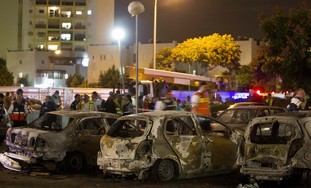
Cars damaged in Ashkelon from Gaza Rockets

    Cairo mediated a truce between Israel and Palestinian factions in Gaza, set to take effect at 6 a.m. on Sunday, according to reports from Egyptian officials late on Saturday night. Meanwhile however, rockets continue to be fired into Southern Israel. Islamic Jihad claimed not to have known about the ceasefire, Israel Radio reported.

A man was killed and four people were wounded when southern Israel was bombarded with long-range Grad rockets fired by Islamic Jihad from Gaza on Saturday.

The rocket casualty was later named as Ami Moshe, 56, of Ashkelon. Moshe was on his way home to his family when the air raid siren went off. He left his vehicle and ran for cover, but was mortally injured by flying shrapnel from the rocket fired at a residential neighborhood in Ashkelon. He was rushed to the Barzilai Medical Center in the city, but doctors were unable to save his life. Moshe was able to answer a call from his concerned wife and tell her that he had been injured before being evacuated to hospital.

Security chiefs searched for a way to contain the situation on Saturday, as the Air Force went into action to strike terror cells preparing rockets for launch in northern and southern Gaza. The IAF attacked six targets in the Gaza Strip on Saturday night, the IDF declared in a press release. In the northern Gaza Strip it attacked three terror tunnels and three rocket launchers, and in the northern Gaza Strip it attacked two centers of terrorist activity.

“The attack was a response to a barrage of rockets fired over Israel,” the IDF stated.

“The IDF will not hesitate to act decisively and forcefully against anyone who uses terror against the citizens of Israel, until quiet returns to area. Hamas is a terrorist organization and bears the responsibility.”

IDF confirmed killing 10 Islamic Jihad members on Saturday. It struck four terror targets in Gaza between 9 p.m. and 10:30 p.m. Saturday night. The targets included a terror cell in southern Gaza planning to fire a projectile, a terrorist planning a rocket strike, and two rocket launch sites in northern Gaza. An additional terrorist in southern Gaza planning a rocket attack was also struck from the air on Saturday night. Furthermore, a cell in northern Gaza was also hit by the Air Force.

Some 200,000 school children will stay at home as classes in Ashdod, Beersheba and Kiryat Malachi were canceled by local officials, and the IDF Home Front Command asked people who live within 40 kilometers of the Gaza Strip to stay near structures protected against rockets.


On Saturday, 35 projectiles, including Grads and mortar shells, were fired at southern communities, hitting built-up areas in Ashdod, Ashkelon and regional councils across the region. A number of the rockets caused extensive damages to buildings.

The IDF struck a rocket-launching cell in Rafah, in the southern Strip, following the upsurge in attacks, reportedly killing two terrorists.

“Hamas is responsible for what takes place in Gaza,” the army said.

Ashdod bore the brunt of the attacks, and was targeted by at least three Grad rockets. One slammed into an empty school, and a second struck in the nearby Gan Yavne Regional Council, moderately wounding a man who was searching for his son.

TV footage showed bloodstained pavement where the man had been injured before running indoors and contacting paramedics.

A third rocket slammed into a parking lot between two multi-story residential buildings in Ashdod. It set several vehicles on fire and left behind extensive wreckage. The flames were doused by Israel Fire and Rescue crews, who also broke into homes in nearby buildings to rescue residents.

“This was a miracle, it could have been much worse,” Magen David Adom director-general Eli Bin said.

“Ashdod is under attack, without a doubt,” Mayor Yehiel Lari said.

A rocket fired at Ashkelon sent shrapnel flying that moderately wounded a man.

He was taken by MDA paramedics to the city’s Barzilai Medical Center. A second rocket fired at Ashkelon scored a direct hit on a home, setting gas canisters on fire.

Fire crews doused the flames.

The wave of rockets came after the IDF, working with the Shin Bet (Israel Security Agency), identified and struck an Islamic Jihad rocket cell in Gaza earlier on Saturday, killing five terrorists, including senior Islamic Jihad commander Ahmed Sheikh Khalil, who was responsible for the group’s considerable rocket production facilities.

Army sources said the cell was the same one that fired the unprovoked long-range Grad that struck near Rehovot last week. That rocket was supposedly launched to mark the anniversary of the 1995 assassination in Malta of Islamic Jihad leader Fathi Shikaki, the first person to publish a booklet that legitimized suicide in jihad.

“The cell was preparing to fire another rocket into Israel,” an IDF spokesman said. Other reports added that the cell was targeted at an Islamic Jihad training camp. The terrorist organization vowed a major response to the air strike.

Islamic Jihad’s propaganda wing released a video on the Internet on Saturday showing a multi-rocket launcher mounted on a truck and firing several projectiles in succession.

The video is part of a boast by the Iranian-backed group that its rocket launching capabilities have improved over recent years.

The group’s claim that the video was taken on Saturday in Gaza could not be confirmed.

But the organization has been the recipient of large-scale Iranian support, both military and financial.

Late Saturday night, Islamic Jihad’s Quds Brigades said the first wave of rockets was its “initial response” to the strike on its rocket cell, adding that “the enemy should expect the worst in the coming hours,” Channel 10 reported.

The organization’s leader in Syria, Ramadan Abdullah, recently attended a conference in Iran calling for Israel’s destruction.

During the conference, Abdullah said Iran’s supreme leader Ayatollah Ali Khamanei’s “plan is a road map to the liberation of the occupied territories,” referring to the whole of Israel.

Islamic Jihad has long been Iran’s closest proxy in the Palestinian territories.

In the past, the organization’s leadership described itself as “one of the many fruits on our leader [former Iranian supreme leader Ayatollah Ruhollah] Khomeini’s tree.”

A spokesman for Robert Serry, the UN’s special envoy for the Middle East peace process, said in a statement, “The recent escalations are very worrying. It’s vital to deescalate now, without any delay. We strongly appeal for calm and an end to violence and bloodshed.”

Prime Minister Binyamin Netanyahu was receiving regular briefings on the security situation, officials said.

Foreign Minister Avigdor Lieberman, who was on a trip to Bosnia-Herzegovina on Saturday, warned that “if the rocket fire isn’t halted, there will be serious consequences in the coming days.”

Lieberman said that Israel hasn’t been insisting that its security needs must be met in any final-status agreement with the Palestinians without good reason.

“Just today we have seen why this is necessary,” he said.

“We are not seeking violence with the Palestinians and we do not want to ‘heat up’ the situation, but we won’t suffer one rocket barrage after another without a response. Therefore I hope that already tonight, the rocket barrages will stop with the intervention of neighboring countries, the international community and the Palestinian Authority,” he said.

Opposition leader Tzipi Livni (Kadima) visited Gan Yavne, where one of the rockets stuck, on Saturday evening.

“I will support any action the government chooses in order to stop the attacks,” she said. “Residents of the South bravely deal with constant attacks, and we will all try to support them.”

The rockets “remind everyone that the South is full of terrorist extremists, whom Israel must weaken directly and by negotiating with moderates who do not use violence,” Livni wrote on her Facebook page.

“Now, when Hamas feels strong following the Schalit deal, we must be aggressive in order to bring back Israel’s deterrence,” MK Tzipi Hotovely (Likud) said. “We must make the residents of the towns surrounding Gaza, and all of Israel’s citizens, feel safe again.”

MK Arye Eldad (National Union) said, “After avoiding a military attack on the heads of terrorist organizations and instead surrendering to Hamas and freeing hundreds of murderers, we will now have to act.

“The excuse that Schalit will be hurt can no longer disguise the disgrace of our capitulation,” Eldad said.

“Now Israel must stop reacting and start preventing.

Only methodically wiping out the heads of terrorist organizations, especially [Hamas’s Ahmed] Jabari who held Schalit, will bring back our deterrence that was worn out by the deal [for Schalit’s release].”

Police have gone on the second highest level of alert, and have called on members of the public to refrain from gathering at rocket impact zones, to avoid additional injuries.

Tovah Lazaroff and Reuters contributed to this report

‘Israel, Palestinian factions agree upon ceasefire’

October 30, 2011

‘Israel, Palestinian factions agree upon cease… JPost – Defense.

    According to reports from Egyptian officials late on Saturday night, Cairo mediated a truce between Israel and Palestinian factions in Gaza, set to take effect at 6 a.m. on Sunday.

A man was killed and four people were wounded when southern Israel was bombarded with long-range Grad rockets fired by Islamic Jihad from Gaza on Saturday.

The rocket casualty was later named as Ami Moshe, 56, of Ashkelon. Moshe was on his way home to his family when the air raid siren went off. He left his vehicle and ran for cover, but was mortally injured by flying shrapnel from the rocket fired at a residential neighborhood in Ashkelon. He was rushed to the Barzilai Medical Center in the city, but doctors were unable to save his life. Moshe was able to answer a call from his concerned wife and tell her that he had been injured before being evacuated to hospital.

Security chiefs searched for a way to contain the situation on Saturday, as the Air Force went into action to strike terror cells preparing rockets for launch in northern and southern Gaza.

IDF confirmed killing 10 Islamic Jihad members on Saturday. It struck four terror targets in Gaza between 9 p.m. and 10:30 p.m. Saturday night. The targets included a terror cell in southern Gaza planning to fire a projectile, a terrorist planning a rocket strike, and two rocket launch sites in northern Gaza. An additional terrorist in southern Gaza planning a rocket attack was also struck from the air on Saturday night. Furthermore, a cell in northern Gaza was also hit by the Air Force.

Some 200,000 school children will stay at home as classes in Ashdod, Beersheba and Kiryat Malachi were canceled by local officials, and the IDF Home Front Command asked people who live within 40 kilometers of the Gaza Strip to stay near structures protected against rockets.

On Saturday, 35 projectiles, including Grads and mortar shells, were fired at southern communities, hitting built-up areas in Ashdod, Ashkelon and regional councils across the region. A number of the rockets caused extensive damages to buildings.

The IDF struck a rocket-launching cell in Rafah, in the southern Strip, following the upsurge in attacks, reportedly killing two terrorists.

“Hamas is responsible for what takes place in Gaza,” the army said.

Ashdod bore the brunt of the attacks, and was targeted by at least three Grad rockets. One slammed into an empty school, and a second struck in the nearby Gan Yavne Regional Council, moderately wounding a man who was searching for his son.

TV footage showed bloodstained pavement where the man had been injured before running indoors and contacting paramedics.

A third rocket slammed into a parking lot between two multi-story residential buildings in Ashdod. It set several vehicles on fire and left behind extensive wreckage. The flames were doused by Israel Fire and Rescue crews, who also broke into homes in nearby buildings to rescue residents.

“This was a miracle, it could have been much worse,” Magen David Adom director-general Eli Bin said.

“Ashdod is under attack, without a doubt,” Mayor Yehiel Lari said.

A rocket fired at Ashkelon sent shrapnel flying that moderately wounded a man.

He was taken by MDA paramedics to the city’s Barzilai Medical Center. A second rocket fired at Ashkelon scored a direct hit on a home, setting gas canisters on fire.

Fire crews doused the flames.

The wave of rockets came after the IDF, working with the Shin Bet (Israel Security Agency), identified and struck an Islamic Jihad rocket cell in Gaza earlier on Saturday, killing five terrorists, including senior Islamic Jihad commander Ahmed Sheikh Khalil, who was responsible for the group’s considerable rocket production facilities.

Army sources said the cell was the same one that fired the unprovoked long-range Grad that struck near Rehovot last week. That rocket was supposedly launched to mark the anniversary of the 1995 assassination in Malta of Islamic Jihad leader Fathi Shikaki, the first person to publish a booklet that legitimized suicide in jihad.

“The cell was preparing to fire another rocket into Israel,” an IDF spokesman said. Other reports added that the cell was targeted at an Islamic Jihad training camp. The terrorist organization vowed a major response to the air strike.

Islamic Jihad’s propaganda wing released a video on the Internet on Saturday showing a multi-rocket launcher mounted on a truck and firing several projectiles in succession.

The video is part of a boast by the Iranian-backed group that its rocket launching capabilities have improved over recent years.

The group’s claim that the video was taken on Saturday in Gaza could not be confirmed.

But the organization has been the recipient of large-scale Iranian support, both military and financial.

Late Saturday night, Islamic Jihad’s Quds Brigades said the first wave of rockets was its “initial response” to the strike on its rocket cell, adding that “the enemy should expect the worst in the coming hours,” Channel 10 reported.

The organization’s leader in Syria, Ramadan Abdullah, recently attended a conference in Iran calling for Israel’s destruction.

During the conference, Abdullah said Iran’s supreme leader Ayatollah Ali Khamanei’s “plan is a road map to the liberation of the occupied territories,” referring to the whole of Israel.

Islamic Jihad has long been Iran’s closest proxy in the Palestinian territories.

In the past, the organization’s leadership described itself as “one of the many fruits on our leader [former Iranian supreme leader Ayatollah Ruhollah] Khomeini’s tree.”

A spokesman for Robert Serry, the UN’s special envoy for the Middle East peace process, said in a statement, “The recent escalations are very worrying. It’s vital to deescalate now, without any delay. We strongly appeal for calm and an end to violence and bloodshed.”

Prime Minister Binyamin Netanyahu was receiving regular briefings on the security situation, officials said.

Foreign Minister Avigdor Lieberman, who was on a trip to Bosnia-Herzegovina on Saturday, warned that “if the rocket fire isn’t halted, there will be serious consequences in the coming days.”

Lieberman said that Israel hasn’t been insisting that its security needs must be met in any final-status agreement with the Palestinians without good reason.

“Just today we have seen why this is necessary,” he said.

“We are not seeking violence with the Palestinians and we do not want to ‘heat up’ the situation, but we won’t suffer one rocket barrage after another without a response. Therefore I hope that already tonight, the rocket barrages will stop with the intervention of neighboring countries, the international community and the Palestinian Authority,” he said.

Opposition leader Tzipi Livni (Kadima) visited Gan Yavne, where one of the rockets stuck, on Saturday evening.

“I will support any action the government chooses in order to stop the attacks,” she said. “Residents of the South bravely deal with constant attacks, and we will all try to support them.”

The rockets “remind everyone that the South is full of terrorist extremists, whom Israel must weaken directly and by negotiating with moderates who do not use violence,” Livni wrote on her Facebook page.

“Now, when Hamas feels strong following the Schalit deal, we must be aggressive in order to bring back Israel’s deterrence,” MK Tzipi Hotovely (Likud) said. “We must make the residents of the towns surrounding Gaza, and all of Israel’s citizens, feel safe again.”

MK Arye Eldad (National Union) said, “After avoiding a military attack on the heads of terrorist organizations and instead surrendering to Hamas and freeing hundreds of murderers, we will now have to act.

“The excuse that Schalit will be hurt can no longer disguise the disgrace of our capitulation,” Eldad said.

“Now Israel must stop reacting and start preventing.

Only methodically wiping out the heads of terrorist organizations, especially [Hamas’s Ahmed] Jabari who held Schalit, will bring back our deterrence that was worn out by the deal [for Schalit’s release].”

Police have gone on the second highest level of alert, and have called on members of the public to refrain from gathering at rocket impact zones, to avoid additional injuries.


