Archive for October 2011

Netanyahu at Knesset: Nuclear Iran is still major threat

October 31, 2011

Netanyahu at Knesset: Nuclear Ira… JPost – Diplomacy & Politics.

Netanyahu addresses a special Knesset session, Mon

    Prime Minister Binyamin Netanyahu said Monday at the beginning of the Knesset’s winter session that Iran continues to seek nuclear weapons and this will threaten the whole world and Israel.

“We must continue building Israel’s strength in order to counter the challenges that lie ahead,” he told the plenum.

Netanyahu stressed that he hopes in the future Turkey and Israel will find a way to improve ties.

“Even though divisions exist between us, both states have been there to help each other,” the prime minister said.”Just as Turkey was there to offer aid during the Carmel Fire, we were there to help in rescue efforts after the devastating earthquake that hit last week.”

Netanyahu expressed the need to return to the negotiating table and called on Palestinian Authority President Mahmoud Abbas to stop making unilateral moves, such as requesting statehood at the UN.

Opposition leader Tzipi Livni (Kadima) slammed Netanyahu, saying he needed to stop making excuses and talk to the Palestinian Authority, instead of helping strengthen Hamas.

Livni said that the current government thinks it needs to deal with Hamas and treats the terror group as if it is legitimate army.

President Shimon Peres, during a speech moments earlier, focused on the social justice movement and said that social justice is for all sectors of society. He called on haredim (ultra-Orthodox) to join the workforce.

Peres also spoke about Gilad Schalit and noted the nation’s excitement that the captive IDF solider had returned home after being held by Hamas for over five years.

On new governments formed as a result of the Arab Spring, Peres said, “We hope the young people in the Middle East will get free elections and freedom every day of the year after the elections.”

“Our vision must bring peace. MKs can and must be the engine for this journey, and look the future in the eyes,” he added.

Knesset Speaker Reuven Rivlin (Likud), who opened the session, said that this summer’s social protest movement caught the Knesset off guard.

Rivlin said that the summer will go down in history as time when the people started to fight for their rights and stated the new Israeli is smarter and understands more while feeling responsibility more than pride.

Daphni Leef and members of the social justice movement were present at the Knesset session.

Rocket fired from Gaza explodes south of Ashkelon

October 31, 2011

Rocket fired from Gaza explodes south of Ash… JPost – Headlines.


    A rocket fired from the Gaza Strip exploded in an open area south of Ashkelon Monday afternoon. A warning siren was sounded before it landed.

No injuries or damages were reported in the latest attack, the first since shortly after midnight Sunday night.

Missile-battered Israeli towns in first civilian mutiny against IDF

October 31, 2011

DEBKAfile, Political Analysis, Espionage, Terrorism, Security.

DEBKAfile Special Report October 31, 2011, 11:01 AM (GMT+02:00)

A missile fired from Gaza

Israel is seeing its first ever crisis of confidence between a large normally docile civilian population and the heads of the armed forces.Mayors and local council heads representing the three quarters of-a-million inhabitants of the southern towns of Beersheba, Ashkelon, Ashdod, Kiryat Gat and Gan Yavneh, announced Sunday night, Oct. 31, that they don’t believe the army’s claim the missile offensive besetting them since Saturday is over.

Their schools stayed closed Monday, Oct. 31, in defiance of Home Front Command orders to lift the security restrictions that were imposed Saturday, when eight Israeli towns were pounded by scores of missiles, causing one death, dozens of injuries, substantial damage and the disruption of lives.

After a decade of missile violence from Gaza, the people still living there are saying enough is enough. They are fed up with being told that the military and powers-that-be know best how to handle the terrorism from the Gaza Strip. The missiles start flying whenever it pleases the Gazan Palestinians, a recurring blight which has seriously stunted the region’s development.
debkafile‘s analysts attribute this newfound combativeness to seven causes.

1. Conflicting statements from Prime Minister Binyamin Netanyahu and the army chiefs. Whereas Netanyahu stated Sunday that there is no ceasefire, army officers informed the South that a truce is in force and only needs time to take hold.
2.  An Egyptian-brokered ceasefire was announced as going into effect Sunday morning, Oct. 30 at 0600 hours (after more than 35 missiles were fired Saturday). That whole day, the Palestinians continued their attacks which they divided into two stages: Soon after the 0600 deadline, they shot 15 Grads and mortar rounds into Israel and paused. In the evening, other round of 9 Qassam missiles hit Ashkelon regional council and Eshkol district.
3.  The Iron Dome batteries, designed by Israel to intercept short-range rockets, failed to stop any Sunday, starting a wave of rumors across the South.
Few heeded the words of ex-security officers turned pundits who explained that even wonder systems have mechanical breakdowns. After the IDF issued a bulletin asserting the Jihad Islami had used “innovative firing technology” – without specifying what it was – many assumed that the Iron Dome had been neutralized – not by the technologically-challenged Palestinian extremists, but by specialist officers sent to Gaza but their masters in Tehran.
4. The brief television appearance of Chief of Staff Lt. Gen. Benny Gantz, answering a question with the words: “We shall do what needs to be done.” As he spoke, sirens sounded and missiles and mortar shells exploded  in Ashkelon, Sderot and other locations abutting on the Gaza Strip.
5.  As Sunday wore on, the lack of clarity over government intentions deepened . The population realized that no substantial military operation was planned and their trouble was there to stay.  A new truce deadline was said to be scheduled for  2200 Sunday night. The Palestinians chose that hour to resume their attacks on Ashkelon regional council and Eshkol district.
6. As Monday morning, Oct. 31 dawned with no sign that the radical jihad Islami intended to hold its fire, Home Front Minister Mattan Vilnai aired his first message to the South:

“This round is over,” he said. “It was the work of the Jihad Islami alone. Hamas, which as Gaza Strip rulers are responsible, stood aside.”

debkafile‘s military sources: This is a further Netanyahu government step to relieve Hamas of the burdens of responsibility for the violence emanating from its territory.

This anomalous situation arose from an unsatisfactory exchange between Jerusalem and Cairo. Egypt informed Jerusalem it had managed to persuade Jihad Islami to halt its missile offensive but not to stop its fellow radical Palestinian groups in the Gaza from shooting or even withhold the missiles for them to continue their assaults.
The prime minister and defense minister were reluctant to admit to the public that they had placed their reliance for the security of southern Israel on the military rulers of Egypt – and then only with partial success.
7.  Community leaders in the south are preparing to take a leaf out of two popular campaigns which managed in recent weeks to shock the Netanyahu government out of its complacence: This week, 19 new bills were put before the Knesset’s winter session in response to the demands of the Social Justice movement; and last week, the Israeli soldier Gilad Shalit’s release was achieved, partly as a result of popular pressure.

Several community leaders warned that the South is now on the march to finally break the devastating cycle of ceasefires imposed and violated at the convenience of the Palestinian aggressors and force the government and army to root out the plague of the Palestinian missiles once and for all.

Report: Israel seeking to upgrade its nuclear weapons capabilities

October 31, 2011

Report: Israel seeking to upgrade its nuclear weapons capabilities – Haaretz Daily Newspaper | Israel News.

Israel is extending the range of its Jericho 3 missiles and upgrading its sea-based cruise missiles, according to an independent U.K. commission report published in the Guardian.

By Haaretz

Israel is working on improving its nuclear weapons capabilities, according to a report by the independent Trident commission in the United Kingdom that was published in the Guardian newspaper on Monday.

According to the report in the Guardian, Israel is extending the range of its Jericho 3 land-to-land missiles so they will have the capabilities of transcontinental missiles.

Navy submarine 2008 Tomer Appelbaum One of Israel’s submarines off the Israeli coast, 2008.
Photo by: Tomer Appelbaum

Transcontinental missiles are generally thought of as missiles with ranges of about 5,000 miles.

The Guardian also reported that Israel is also striving to improve and expand the capabilities of its cruise missiles, designed to be launched from submarines. Israel currently has three submarines and two more are under construction in Germany. Israel and Germany are holding talks about the construction of a sixth submarine.

According to foreign media reports, Israel’s submarines are meant to give Israel a “second strike” nuclear option, meaning that Israel can strike back with nuclear weapons from submarines at hidden locations at sea even if its nuclear weapons stored on land are harmed in an enemy nuclear strike.

According to the report in the Guardian, the world’s nuclear states are planning to spend more than $800 billion in the coming years to modernize and upgrade their nuclear arsenals. The United States itself will spend $700 billion dollars on such projects. Other countries that will reportedly invest in upgrading their nuclear arsenals are Russia, China, Pakistan, India, Israel, France and Britain.

US fears unilateral Israeli strike on Iran

October 31, 2011

US fears unilateral Israeli strike on Iran – Israel News, Ynetnews.

Washington concerned Israel will mount military operation against Islamic Republic without coordinating move first, State Department official says. US consequently putting greater pressure on Security Council to impose harsher sanctions on Iran

Alex Fishman

Published: 10.31.11, 10:24 / Israel News
The United States is working on several levels to pressure the UN’s Security Council into imposing harsher sanctions on Iran, Yedioth Ahronoth reported Monday.A senior US State Department official said there is growing fear among Obama administration officials ahead of an IAEA report indicating considerable progress in Tehran’s development of its military nuclear program which is set to be published in November.

The US is concerned that the report may trigger Israeli actions against the Islamic Republic which may not necessarily be in line with US interests in the region.

Netanyahu and Barak. Planning attack? (Photo: Ariel Hermoni, Defense Ministry)

 The official said that Washington’s reevaluation of an Israeli strike in Iran is based on various maneuvers Israel has performed in the past few years.

The US administration is now bent on exercising more pressure on Tehran in order to dissuade Israel from this path, the source said.

Washington is therefore pressing China and Russia who are currently opposed to the publication of the IAEA report. The report may cause embarrassment to both countries who are strongly against harsher sanctions on Iran.

According to the US official, it is possible that the report, coupled with the exposure of the US evaluation of Israeli potential to strike Iran, will encourage Russia and China to support the US initiative to aggravate penal measures against Tehran.

Pressing UN

US concern over an Israeli move is so great, the official said, that Washington is working on several levels to pressure the Security Council.

This includes appealing to the Security Council to condemn Iran for its attempt to assassinate the Saudi ambassador to Washington.

Last week, it was reportedthat many Israelis are concerned that Prime Minister Benjamin Netanyahu and Defense Minister Ehud Barak decided on an attack on Iran’s nuclear reactors. The US is naturally also concerned over such plans which may send the entire region into a whirlwind.

On Saturday, the New York Times reported that the United States plans to bolster its military presence in the Gulf after the withdrawal of its troops from Iraq.

Citing unnamed officials and diplomats, the newspaper said the repositioning could include new combat forces in Kuwait able to respond to a collapse of security in Iraq or a military confrontation with Iran.

Orly Azoulay and AFP contributed to this report

Barak: Israel has not already decided to strike Iran

October 31, 2011

Barak: Israel has not already decided to strike Iran – Haaretz Daily Newspaper | Israel News.

Defense Minister Ehud Barak tells Army Radio that all options are on the table in terms of dealing with Iran; says that Israelis should not fear the Iranian threat.

By Haaretz

Amidst a flurry of recent reports regarding a possible Israeli attack against Iran, Defense Minister Ehud Barak said on Monday that he and Prime Minister Benjamin Netanyahu have not already decided that Israel will conduct such a strike.

“It does not take a genius to understand that in Israel in 2011 two people cannot decide to do something on their own,” Barak said in an interview on Army Radio. “That may have been appropriate in Israel in 2006. In the Defense Ministry, there are thousands of pages of discussion on this subject, in the presence of dozens of ministers, military personnel and experts.”

Netanyahu with Barak - Emil Salman - 14082011 Benjamin Netanyahu and Ehud Barak
Photo by: Emil Salman

Regarding the question as to why there was no public debate on a matter so fateful to Israel, Barak said, “the Iranian nuclear program has been publicly debated for years in Israel. There are countless interviews and public debates. We do not conceal our thoughts. However, there are operational matters that we do not discuss publicly, as that would make them impossible to carry out.”

Barak reiterated that Iran poses a threat to stability in the Middle East and the world. He said that all options are on the table in terms of dealing with Iran.

“I think that one has to use diplomatic pressure and sanctions on Iran,” Barak said.

He added that Iran has been a central issue that Israeli leaders have discussed with other world leaders in recent years.

“There is great convergence between us and the Americans regarding the diagnosis and the characterization of the operation in Iran,” Barak said. “We know the Iranian leadership’s goals, its determination and how it evades the world. We know what happened in Pakistan, we know what happened in North Korea and we see the immunity they have because of it. One should ask: Would Europe have intervened in Libya if Gadhafi had possessed nuclear weapons? Would the U.S. have toppled Saddam Hussein if he had nuclear weapons?”

Barak said that the Israeli public should not be concerned about the Iranian threat.

“I refuse to be intimidated, as if Iran could destroy Israel, ” Barak said. “Israel is the most powerful country, from Tripoli to Tehran. There is no reason to be afraid of anything.”

Also in the interview, Barak denied that Israel had negotiated a cease-fire with Islamic Jihad following the violence in southern Israel and the Gaza Strip in recent days. He also said that he views Hamas as responsible for all that occurs in Gaza.

Analysis: Crippling Iran’s Central Bank

October 31, 2011

Analysis: Crippling Iran’s Centr… JPost – Iranian Threat – News.

Iranian Flag

    David S. Cohen, the US Treasury department’s under secretary for terrorism and financial intelligence, took a whirlwind tour last week of Paris, London, Berlin and Rome in an effort to convince Europe to ratchet up the pressure on Iran.

The Iranian government’s plot to murder the Saudi ambassador in a high-end Washington restaurant, which could have caused the deaths of many Americans, has added fresh urgency to the next round of Iran sanctions.

The Obama administration might target the Central Bank of Iran (CBI), Cohen told Reuters.

“Iran needs to be held accountable for this plot,” he said. “We are going to continue to look at those financial institutions that are involved with proliferation activity for Iran, and continue to try to isolate them from the international financial sector.”

The US government will undoubtedly face an uphill mission to persuade the European Union’s 27 member states to turn the financial screws on the Central Bank. Take the example of the Revolutionary Guard Corps, which may control as much as 75 percent of Iran’s economy and oversees Tehran’s illicit nuclear program. While the Bush administration sanctioned the IRGC in 2007 as a “global terrorist” entity, the EU, particularly Germany, has vehemently resisted penalizing the IRGC.

Dr. Wahied Wahdat-Hagh, an expert on Iran’s terror operations and a senior fellow at the Brusselsbased European Foundation for Democracy, told The Jerusalem Post on Sunday that “all state banks are involved with the nuclear business” in Iran. There “are no independent banks in Iran,” he said.

Sanctioned Iranian banks “fall under the Central Bank,” Wahdat- Hagh added. “The CBI cannot be clean when its children are not,” he said.

Europe and the United States have sanctioned a number of Iran’s banks — Melli, EIH and Saderat – because of their immersion in its nuclear weapons and ballistic missile programs.

Given Europe’s addiction to Iranian trade, and the crucial financial role of the Central Bank of Iran in conducting energy and non-oil transactions for the EU, the Obama administration will have to strongly twist Europe’s economic arms. The EU’s members’ trade with Iran exceeded 25 billion euros in 2010, making the EU as a whole Iran’s most important trade partner.

Roughly 90 percent of Europe’s imports from Iran are energyrelated, and payments for Iranian crude oil take place through the CBI.

The New York Times in 2007 reported on Nasrin Amirsedghi, a German-Iranian author and public intellectual, who was one of the first of a group of critics in the Federal Republic to expose how Germany’s business ties with Tehran are propping up its regime.

“The largest artery of the IRGC is Iran’s Central Bank,” Amirsedghi wrote in an e-mail to the Post on Sunday. “From day to day the financial power of the IRGC is enormously strengthened. Aside from the domestic and foreign terror conducted through this organization, according to intelligence information, Iran is experimenting with nuclear weapons technology.”

She said that “to stop the weapons program and the terror ambitions of Iran, you have to cut the artery. That can only happen through a ban of CBI’s financial transactions. Then we win twofold: The end of Islamic terrorism and the collapse of the regime.

Without these all of the sanctions up until now will be ineffective.”

All this explains why The Wall Street Journal wrote that “many US officials view the imposition of sanctions on Iran’s central bank, Bank Markazi, as the ‘nuclear option’ in its financial war against Tehran, with the potential to freeze Iran out of the global monetary system.”

The sanctions writing is plainly on the wall in Washington, and Iran’s Foreign Minister Ali Akbar Salehi sensed earlier this month that a shot of economic pain is on its way. “Iran is facing the toughest political and economic sanctions in the past 32 years,” said Salehi.

The influential US senator and Iran expert Mark Kirk (R-Illinois) told Foreign Policy’s website The Cable that “What the administration should do is prepare to move against Bank Markazi in response to the bomb plot.”

The knotty problem remains Europe’s economic ties with Iran.

The EU refuses to sanction the IRGC. Can the US influence a dramatic change in the EU’s posture toward the IRGC and the Central Bank of Iran? Wahdat-Hagh said the IRGC is involved in terrorism in Afghanistan and Iraq and against NATO troops. He cited the running list of IRGC attacks against Kurdish dissidents in Berlin and Vienna, Argentineans, Israelis and Americans, and Western troops in the Afghanistan and Iraqi war theaters.

Wahdat-Hagh sees the flourishing trade relations between Europe and the Islamic Republic as blocking meaningful and robust sanctions targeting Iran’s core financial interests.

The advocates of pulling the plug on Iran’s financial oxygen to the IRGC understand the conflict being waged by Iran against the West. The question is, will Europe and the Obama administration flex their financial muscles and shut down Iran’s terror lifeblood, the IRGC and the Central Bank of Iran?


The Region: Why Obama can’t tame the Islamists

October 31, 2011

The Region: Why Obama can’t tame the … JPost – Opinion – Op-Eds.
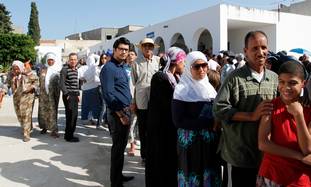
Voters line up in Tunisia

    Many people find it hard to comprehend what the Obama administration thinks it’s doing in the Middle East. One liberal friend of mine has called my analysis “mind reading.” But it’s really very simple if you know the history of the arguments, read the speeches and documents of Obama administration officials carefully and observe their actions.

Leaving aside a number of points I’ve made in previous articles (which would be good to read in conjunction with this one), I want to focus on the idea that the US government has outsmarted the Islamists.

After all, it has “lured” them into sharing power openly by participating in elections and a share of power, so now, it is argued, the Islamists have to play by the rules of the electoral and democratic game. They must produce policies that please and benefit the people if they want to remain in power, since if they fail to do so, they will just lose the next election.

Having accepted democratic norms, the US administration’s expectation is that the Islamists will be locked into the system and have no choice but to compromise ideologically or hand over power with a show of good sportsmanship.

Western officials and experts generally and genuinely believe radical Islam cannot produce material results.

They believe the Islamists will have to water down their “impractical” beliefs to be effective in government. To remain in power they will gradually abandon their radical ideologies. In short, the Obama administration believes it’s got the Islamists where it wants them.

THERE ARE just a few problems with that view.

1. No Arab nationalist regime (even those pretending to be democratic) or monarchy in the Middle East has ever let itself be voted out of office. There are ways of persuading the masses to keep supporting a regime even if in Western eyes that government has “failed.” There are also many ways to win “elections” – by manipulation, selective repression, media control, using patronage to buy votes, etc.

Together, instead of “one man, one vote, one time” you can get “one man, one vote, one result.”

For example, consider Turkey, where the regime has steadily increased its base of support among voters; or Egypt and Jordan, where the regime always wins the election.

Once in office, there is no reason to think the Islamists can’t last as long as the Arab nationalists in Egypt, Tunisia, Libya, Iraq and Syria – that is, for decades.

In addition, as a last resort elections can always be canceled, as they were in Algeria, or results can be repressed if the incumbents think they’ll lose. Another example is the Islamist regime in Iran, which finally lost popularity after three decades of mismanagement but remained in power by simply quashing internal resistance, and faced no external costs due to the stolen election.

2. Don’t underestimate the power of ideology and demagoguery, which can be more powerful than material pay-offs. The history of the modern Arab world is full of examples where ideology and demagoguery trumped material political achievement. Look at the history of the PLO and of Yasser Arafat’s leadership.

(Yes, I know Hamas won the 2006 elections and rules in Gaza, but Fatah still runs the more important West Bank to this day).

And let’s not forget the use of foreign scapegoats, which will be as important for the Islamists as it was for the nationalists. Consider how the Turkish Islamist regime has made Israel and the West into an enemy in order to mobilize both nationalist and religious fervor at home. This can also lead to foreign adventures – wars and terrorism – that are popular at home, even if they are lost.

3. The elected regimes can use the educational system, religious institutions and media to indoctrinate the public and ensure continued support. They can use jobs and the economy to control patronage and votes; create or control trade unions and professional associations.

By controlling the religious institutions, Islamists can get rid of traditionalist Islam and entrench their own interpretations.

And let’s not forget the greatest prize of all: control over the military, a plan that might include creating separate elite units (Islamic Revolutionary Guard Corps in Iran, Revolutionary Guards in Iraq, Republican Guards in Syria, etc.)

4. The intrinsically radical nature of the Islamists themselves: if you’re taking your orders directly from the Supreme Being and in accord with the most sacred religion, you’re unlikely to change your views. Western materialist cynicism goes too far in thinking Islamists will sell out for luxury and power. Besides, they can enjoy luxury and power (see Iran) without having to throw away their principles.

Moreover, we are not dealing with Communism in the era of Leonid Brezhnev here. The Islamists are a relatively young movement, unbowed by failure and not jaded by long possession of power. They genuinely believe the future belongs to them. Maybe they will become tired and lose their confidence in 30 or 40 years, but not now.

5. Knowing that they confront such idiots in the West, the Islamists can use the credulity of their enemies to play moderate when necessary and get lots of benefits and concessions. How about the idea of massive US aid to Islamist regimes? That’s about to happen, isn’t it? Played on by Middle Eastern con men and eager to avoid confrontation, it’s easy to understand how those with no real understanding of the region make the mistake of believing they can “tame” radical Islam.

Yet they will surely fail in this endeavor. Those who are wise will avoid paying the price for this foolishness.

The writer is director of the Global Research in International Affairs (GLORIA) Center.

Barak: IDF doesn’t heed empty calls for cease fires

October 31, 2011

Barak: IDF doesn’t heed empty calls for cease … JPost – Defense.

Defense Minister Ehud Barak

    Defense Minister Ehud Barak said the IDF does not pay attention to empty calls for cease fires from various terrorist groups, in an interview on Monday with Army Radio. If they want a cease fire, Islamic Jihad and Hamas will need to actually stop their attacks, he explained. He added that Israel holds Hamas accountable for all rocket fire from Gaza.

The defense minister said the IDF is not interested in returning to Gaza. It will, however, respond accordingly to attacks against Israel’s citizens.

“There’s no foundation for charges that we are getting drawn [into the fighting] and not initiating. The people who call to us to attack forcefully in the Strip will be the same people to criticize that we will get entangled there,” he said.

Addressing the Iranian nuclear program, Barak said, “We have no reason to fear anything” as Israel is the strongest country in the Middle East. Still, Iran is a central threat to Israel and the international community and needs to be treated as such.


“Israel doesn’t have to allow a nuclear Iran, the world doesn’t have to allow a nuclear Iran,” he insisted, saying that all all options for dealing with the Iranian threat should be on the table.

Also on Monday, Home Front Defense Minister Matan Vilna’i said he believes the current round of violence with the terror organizations in the Gaza Strip is coming to an end, in an interview with Israel Radio.

One Israeli was killed and dozens of rockets and mortar rounds were fired into Israel in recent days, leading to IAF strikes on the Strip targeting rocket launching squads and terrorist targets.

Vilna’i cautioned, however, that the situation could still deteriorate if the IDF identifies active rocket launching squads and targets them.

The IDF said overnight Sunday that its aircraft struck a rocket launching cell in Gaza after it fired a projectile into Israel. Two members of the cell were reported killed.

“We identified an accurate strike,” an IDF spokesman told The Jerusalem Post.

The home front defense minister added that Hamas has no interest in an escalation at the moment, especially because the prisoner swap deal for Gilad Schalit is not yet complete.
Hamas, the ruling group in Gaza, has thus far not taken responsibility for the rocket attacks launched in recent days.

The IDF action came after three Kassam rockets fired from the Gaza Strip into southern Israel landed in the Eshkol Regional Council area on Sunday close to midnight.

No injuries or damage were reported in the attacks.

The IDF approved a series of operations aimed at widening the scope of its responses to ongoing Islamic Jihad rocket attacks from Gaza on Sunday, as Egypt tried to mediate a second cease-fire after the first attempt at a truce lasted only several hours.

The planning for an intensified Israeli response, which was overseen by Chief of General Staff Lt.-Gen. Benny Gantz, took place in the command and control room of the IDF’s Southern Command in Beersheba, and in Tel Aviv.

As senior defense chiefs spent Sunday preparing for a further escalation, they treated reports of a new cease-fire with skepticism, after Gazans shattered a brief calm by attempting to fire a rocket into Israel around 3 p.m.

The terrorist cell that prepared the rocket for launch was struck successfully by an air force aircraft, thwarting the attack. The cell reportedly belonged to the Democratic Front for the Liberation of Palestine. One terrorist was killed and another was seriously wounded.

Despite reports of a ceasefire, municipal officials in Ashdod, Ashkelon, Beersheba and Gan Yavne decided to take no chances and canceled classes at all schools in their districts.

With the exception of Ashkelon, Monday will be the second day in a row in which schoolchildren in the South will remain at home because of the security situation.

The decision was taken against the advice of the Home Front Command, which advised southern communities that schools could be reopened. It signaled the lack of faith local leaders placed in claims that the situation was heading toward calm

Classes in southern schools cancelled despite relative calm

October 30, 2011

Classes in southern schools cancelled despite … JPost – Defense.

Police officiers remove the remains of Grad rocket

    Authorities in Beersheba, Ashdod, Ashkelon and Gan Yavne decided Sunday evening that they would cancel school classes on Monday in light of the threat of rockets being fired from Gaza.

The decision came in spite of a Home Front Command announcement which said that classes in schools in the South could take place Monday. This announcement came after the IDF removed restrictions that were put in place forbidding large gatherings in public areas.

Classes at Ben Gurion University will take place as usual on Monday.

Meanwhile, a Kassam rocket fired from Gaza landed in open fields in the Ashkelon Coast Regional Council on Sunday evening.

No injuries were reported and no damage was caused.

Earlier on Sunday, the IDF identified a rocket launching cell in the southern Gaza Strip as terrorists were preparing to launch a rocket toward Israel, despite a reported cease fire with Islamic Jihad. IAF planes struck the cell, preventing the rocket from being launched.

Islamic Jihad, which has taken responsibility for the majority of some 39 rockets fired at Israel from the Strip in the past 24 hours, said late Sunday morning that it was committed to a cease fire agreement, although it asserted it reserved the right to respond to any Israeli attacks, Palestinian news agency Ma’an reported.


