Archive for July 2011

Syrian security forces kill 15 as protests unabated

July 9, 2011

Syrian security forces kill 15 as protests unabated – Haaretz Daily Newspaper | Israel News.

Around 500,000 protesters took to the streets in the Syrian city of Hama on Friday.

By DPA

Tens of thousands of Syrians on Friday took to the streets across the country, defying a security crackdown to reject a national dialogue proposed by President Bashar Assad.

Around 15 in total were killed in different parts of the country after security forces fired live ammunition at anti-government protesters, activists said.

Syria - AP - 29.6.11 Syrians carry national flags during a candle vigil in honor of those who were killed in recent violence, in Damascus, Syria, Wednesday, June 29, 2011.
Photo by: AP

In the central city of Homs, “at least seven people were killed in the Al-Khaldiyeh neighbourhood by security forces who opened fire against demonstrators,” Abdel Karim Rihawi, who heads the Syrian League for Human Rights, said.

The Syrian Observatory for Human Rights said at least 24 people were injured in Homs and that some people were gravely wounded.

Others were killed in the Damascus suburbs of Dumair and Zabadani, in the Midan area in the centre of the capital, and the coastal city of Banias, Local Coordination Committees of Syria said.

Dozens were wounded, most of them in Damascus, Idlib and Douma, said the group, which has been documenting the protests since they began in mid-March.

More than 1,400 civilians and 348 security personnel have been killed since the protests, calling for Assad’s ouster, began in March, according to human rights groups.

Security personnel used force against the anti-government protesters in a bid to disperse them, as thousands took to the streets to voice opposition to the “national dialogue” conference.

“Dialogue cannot take place except within an appropriate atmosphere, because dialogue is not the goal, it’s only means for bigger goals,” a Homs-based activist, who identified himself as Abdel Hafez, said.

He said talks should discuss the country’s transition to a civil democratic state, and ways to implement it.

“There is no turning back before March 15. Those in power must not continue in their positions,” he told the German Press Agency dpa by phone.

Assad said last month that a national dialogue would start soon to review the laws on elections, the creation of new political parties other than the ruling Baath party, and consider changes to the constitution.

A meeting scheduled on July 10 seeks “to lay down the dialogue mechanisms and bases ahead of the national dialogue conference,” official media said.

Activists said that half million protesters took to the streets in the central city of Hama Friday, and there was no security presence there. The US and French ambassadors were in Hama in support of the protesters.

Although there was no violence in Hama, security moved to disperse protesters by force and tear gas in the southern city of Daraa, Homs and the Damascus suburb of Daraya.

Authorities also imposed a curfew in southern Inkhil, announcing it through loudspeakers in the town, broadcaster Al Arabiya reported.

Obama Finds in Khamenei a More Devious and Dangerous Foe than Ahmadinejad

July 8, 2011

DEBKA.

Ayatollah Ali Khamenei

Although seriously burned in their efforts to stay abreast of Iran’s signal progress toward a nuclear bomb (see the two previous items in this issue), the American CIA, the French DGSE foreign intelligence service and the German BND spy agency now conclude that Supreme Leader Ayatollah Ali Khamenei has beaten President Mahmoud Ahmadinejad in their duel for dominance.
This does not mean that the sparring incidents between their two camps are over, a Western intelligence official who follows events in Iran told DEBKA-Net-Weekly. Last week, officials in the president’s immediate circle were arrested. This provoked a statement Wednesday, June 29, from Ahmadinejad that the Cabinet of Ministers is at the forefront and “if anyone touches them, it is my duty to stand in their defense.”
He may still talk big but he has known for some weeks that his day is over and his importance shrunk from executive president to a ceremonial figure without real power.
Our Iranian sources report that he realized the game was up in mid-June when Gen. Ali Jafari Mohammad, supreme commander of the Revolutionary Guards Corps (IRGC) and his top staff – after sitting on the fence for months – finally shifted their considerable military and economic weight and placed it behind the Supreme Leader.
The power somersault in Tehran, like the acceleration of Iran’s military nuclear program, caught Western and Middle East capitals unprepared.
Ahmadinejad brought Iran to N-bomb capability. Now he can go
It was taken for granted until now that Ahmadinejad, though an inflammatory speaker, was more pragmatic than Khamenei. It was hoped in Washington that he would come around to a deal on Iran’s nuclear weapons program and the limits of its expansion through the Middle East and Persian Gulf.
This perception gained ground after President Barack Obama entered the White House in 2009 – and especially after Ahmadinejad brought his father-in-law and chief of staff, Esfandiar Rahim-Mashaei, the most pro-Western figure in Tehran, to prominence.
But most people tend to forget that just six years ago, Khamenei picked the then obscure Mayor of Tehran, Mahmoud Ahmadinejad, for president as the only member of the top leadership capable of putting the sagging nuclear program on its feet and achieving the goals desired by the Supreme Leader, namely, the ability to produce a nuclear weapon and to organize the production of nuclear-capable missiles.
Last week, a Western intelligence figure confided to a senior Israeli intelligence official: “In just five years, Ahmadinejad has brought Iran to a nuclear level on a par with Israel, an achievement which took Israel 35 years to complete.
Now that he has brought Iran’s nuclear industry to the desired level, Khamenei can afford to drop the president and his following from power, say DEBKA-Net-Weekly‘s Iranian sources – especially since Ahmadinejad began to entertain his own political ambitions.
Parliamentarians demand his hat (head)
The Supreme Leader’s style of rule leaves no room for peers or high-profile factions like Ahmadinejad and his circle. They committed the cardinal sin of believing their control of the country’s nuclear and military assets made them all-powerful and forgot that real power rested exclusively in the hands of Khamenei and the Revolutionary Guards (IRGC) high command.
The IRGC chief’s defection made the president’s downward slide irreversible.
In a desperate attempt to save himself, Ahmadinejad at a private meeting last week hurled charges against the Guards: “There is a record of illegal transfer of goods from abroad into the country. Smuggling equals thefts from public funds… [The large sums spent on cigarettes] invite all first class smugglers of the world, let alone our own ‘smuggler brethren.'” Gen. Jafari closed the argument by replying: “This organization, just like other military institutions, has military jetties but has never used them for commercial activities.”
In the Majlis, Mohammad Karami-Rad, parliamentarian and former Guardsman, commented: “If His Lordship (the Supreme Leader) asks us to bring him a hat, we know what to bring him… regardless of whose hat it may be.”
(DEBKA-Net-Weekly: An old Persian proverb says that if the king demands someone’s hat, his servants understand they are to cut off his head and bring it to the king.)
Khamenei faked economic collapse to hide boom
The shift of power away from the president has damped down US President Barack Obama’s tentative moves towards engaging Iran on the nuclear controversy and the division of spheres of influence between Washington and Tehran in the Persian Gulf and the Middle East.
The other bad news reaching the US from Iran is that the appearance of damage to the economy caused by international sanctions is bogus. US intelligence experts were stunned to discover that Khamenei’s henchmen had trumped up sham economic hardship to deceive the Obama administration into believing that the sanctions were effective, had brought Iran to the brink of economic and financial collapse and the population was on the point of rising up against the Islamic regime.
In fact, our sources report, the country is experiencing a boom.
Western businessmen who visited Iran in the past month confirm this: They report that activity in the streets, markets and banks as well as a building surge attest to a thriving economy the likes of which has not been seen in all 32 years of Shiite Revolutionary rule. Prosperity is not only the lot of big city dwellers but has also reached remote rural areas.
Iran makes hay from the Arab Revolt
Tehran is also taking advantage of opportunities presented by the unrest in the Arab world.
This was confirmed too in the spate of disclosures spilling out from different American, Israeli and French quarters on Tuesday and Wednesday, July 6-7.
On Tuesday, the Wall Street Journal reported: “Iran’s elite military unit, the Revolutionary Guard Corps, has transferred lethal new munitions to its allies in Iraq and Afghanistan in recent months, according to senior US officials, in a bid to accelerate the US withdrawals from these countries.”
Later that day, Israel military intelligence AMAN chief Gen. Aviv Kochavi lectured the Knesset Foreign Affairs and Security Committee on widespread Iranian meddling in the affairs of Iraq, Syria, Yemen and Bahrain. He reported that Iranian intelligence agents had penetrated the ranks of the Muslim Brotherhood in Egypt in order to influence the results of the elections there in September.
On Wednesday, the French Le Monde, citing Western intelligence sources, said that last month Iranian Supreme Leader Ali Khamenei had instructed the Iranian Revolutionary Guards to begin transferring to Libyan rebels arms, including surface-to-surface and surface-to-air missiles, as well as grenade launchers.
The article said the aim was to drag the US and the NATO countries in a protracted and expensive war that would exact heavy losses, so as to preclude their military intervention in Syria.
Does this rush of revelations about Iran’s doings mean the Obama administration is laying the groundwork for a military operation against Iran and its Supreme leader? Time will tell.

Iran Assembles Nuclear Fuel, Missiles and Warheads

July 8, 2011

DEBKA.

In the latter part of June, the US, Israel, the Saudi-led Arab group and Turkey suddenly realized that by the first half of 2012 Iran would most probably have accumulated two-to-four – or as many as six – nuclear bombs or warheads and enough ICBMs to deliver them anywhere on earth.
The discovery, DEBKA-Net-Weekly‘s military and intelligence sources report, came as a shock to world leaders: Presidents Barack Obama and Nicolas Sarkozy, German Chancellor Angela Merkel, and Prime Ministers David Cameron in London, Silvio Berlusconi in Rome and Binyamin Netanyahu in Jerusalem had not been alive to Iran’s spectacular breakthrough in its push for a nuclear weapon – or how close the Islamic Republic has come to being able to perform its first nuclear test if it so chooses.
The first responders were Saudi King Abdullah and Turkish Prime Minister Tayyip Erdogan. They informed the heads of US and European governments that they had fast-forwarded their plans for getting hold of their own nuclear weapons.
Our intelligence sources report that the US and Israeli governments were among others who secretly ordered probes to find out how their intelligence services had been caught unawares by Iran’s nuclear progress and why the CIA and Mossad in particular had briefed their policy-makers with outdated timetables.
These inquiries sparked infighting and mutual accusations of responsibility in and among Western intelligence agencies (more about which in the next article in this issue).
Uranium enrichment accelerated after glitches overcome
The inquiries also seek to discover how Iran managed to keep its impressive advances from their attention for almost a year since October 2010 – even though some were carried out in full sight.
DEBKA-Net-Weekly pins down the four key components of Iran’s nuclear breakthrough:
1. The dramatic acceleration of the uranium enrichment process resulting in expanded product.
This has been achieved without affording the UN nuclear watchdog, Western intelligence or research agencies, so much as a clue to the quantities produced and stocked.
For six months, therefore, Iran has managed to keep the full scope of its enrichment activities hidden from IAEA inspections. Even though monitors were admitted to the known enrichment facility at Natanz, they were unable to gauge how many active centrifuges were present and how many removed to unknown site or sites. The sophisticated cameras supposed to monitor the Natanz facility are no longer recording all Iran’s enrichment activities because production sites have been moved out of shot.
Only three things are known for sure about Iran’s clandestine uranium enrichment industry:
– The faster the pace of enrichment, the slower the pace of data reaching the outside world and the less information. There is no reason to assume that the true state of international knowledge about other branches of Iran’s nuclear program is any better.
– The Iranians have solved all the technical glitches plaguing their centrifuge machines – no one knows how – and all 6,000 at least are spinning smoothly and continuously.
– They have also vanquished the Stuxnet computer virus which started attacking the program’s centrifuges and control systems in June 2010. Those systems, the crippled enrichment facility in Natanz and the nuclear reactor in Bushehr are all working efficiently.
The move to Fordo for raising enrichment to weapons grade
It took a whole year for Iranian and Russian computer cyber war experts to cleanse the Iranian nuclear system of the malworm. Now, for the first time, military and intelligence agencies have a yardstick for measuring the time it takes to beat off a potential cyber-terror attack and they can work on counter-measures to reduce the damaging time scale.
2. All 20 percent-capable uranium enrichment plant is being transferred from Natanz to the new clandestine facility at Fordo 100 kilometers away in the arid mountains near the holy city of Qom. The facility bored deep into a mountainside is heavily guarded by Revolutionary Guards units. It will operate free of international inspection. Every European and IAEA request to monitor the Fordo site and any other new nuclear facilities has been rejected.
3. Western nuclear experts estimate the Fordo facility will be operational by the end of the summer – i.e., late August or early September. It will enable Iran to further enrich uranium from 20 percent to 60 percent. Iranian officials claim this is the level required for their research reactors. The experts stress that enhancement to 60 percent is the critical step towards 90 percent, the grade necessary for nuclear bombs and warheads.
4. In addition to weapons-grade uranium enrichment, Iran has in the last three months secretly built a nuclear warhead prototype.
On June 27, Iran unveiled an underground missile silo for launching its SHAHAB-3 missiles.
The next day came an announcement that a monkey would be launched into space by a homemade Kavoshgar-5 rocket. Five monkeys were said to be in training, one of which would be selected for the flight.
Monkey in space – key to nuclear payload
In terms of Iran’s capabilities, this means that in the two years since the February 2009 launching into orbit of the the Omid satellite – which weighed only 27 kilos – Iran has attained a missile with a payload capacity of 330 kilos. By launching the monkey, Iran will for the first time also be testing the equivalent weight of a nuclear warhead.
The two achievements – both announced by Tehran – show that, if the next space launch succeeds, Iran will be in command of rockets capable of carrying nuclear warheads launched from underground missile silos and able to hit any point on the planet
The day after these disclosures, British Foreign Secretary William Hague came forward with the information which he reported to the British Parliament that Iran has also been carrying out covert ballistic missile tests and rocket launches, including testing missiles capable of delivering a nuclear payload in contravention of UN Resolution 1929.
Until then, DEBKA-Net-Weekly‘s military, intelligence and Iranian sources had been reporting for nearly a year – alone of all Western publications and defiance of US and Israeli denials – that Iran already had operational missiles capable of delivering nuclear warheads.
Now those sources add that Iran has so far carried out four such missile tests – three during the five months between October 2010 and February 2011 and the fourth and last test on Tuesday, June 28, as part of its Great Prophet War Games 6.
In the first series beginning October 2010, two Sejjil missiles and one SHAHAB-3 Kadar missile were launched successfully and one failed. Both types are powered by solid fuel and have a maximum range of 2,510 kilometers. The missile tested successfully Tuesday was another SHAHAB-3 Kadar.
Work is now continuing to improve the targeting accuracy of these nuclear-capable missiles.

UN nuclear chief ‘concerned’ over Iran plan to increase uranium production

July 7, 2011

UN nuclear chief ‘concerned’ over Iran plan to increase uranium production – Haaretz Daily Newspaper | Israel News.

Yukiya Amano to meet with Iran foreign minister in bid to check nuclear program, restore confidence in international community.

By Reuters

The UN nuclear chief said on Wednesday that he planned to meet with Iran’s foreign minister next week, adding that he was “quite concerned” over Tehran’s plans to triple uranium production capacity.

Yukiya Amano, director general of the UN International Atomic Energy Agency (IAEA), told Reuters in the Colombian capital, Bogota, that he planned to meet Iranian Foreign Minister Ali Akbar Salehi next week, but had no firm details on the meeting.

IAEA Yukiya Amano AP - 24.01.2011 Director General of the International Atomic Energy Agency, Yukiya Amano in January 2011.
Photo by: AP

“The most important message for Iran is that they need to fully implement the safeguard agreement and other relevant obligations. Further cooperation is needed to restore the confidence of the international community,” he said.

“We are quite concerned about that,” Amano said, confirming that the IAEA had received a “very simple” letter from Iran about the plans.

Iran announced last month it would shift its production of higher-grade uranium to an underground bunker and triple output capacity in a defiant move that has further fueled Western unease about Tehran’s intentions.

Western powers suspect Iran is seeking to develop a nuclear weapons capability while Tehran rejects the charge, saying its nuclear program is peaceful and aimed at generating electricity.

Iran’s refusal to halt enrichment has led to four rounds of UN sanctions on the major oil producer, as well tighter U.S. and European Union restrictions.

Iran’s determination to press ahead with a nuclear program suggests that the sanctions have thus far failed to force the Islamic state to back down in the long-running dispute over its atomic aims.

Amano reiterated he would consider accepting an invitation to visit Iran but stressed it would have to yield concrete results: “For now I don’t see, unfortunately, progress.”

When asked about Syria — which the IAEA’s board reported to the Security Council in early June for covert atomic work — Amano said that there had been no “concrete progress”.

Israel fears Iran and North Korea strengthening ties

July 7, 2011

Israel fears Iran and North Korea strengthening ties – Haaretz Daily Newspaper | Israel News.

Israeli officials say Pyongyang is helping Iran develop its military nuclear program, add that if Iran was only interested in nuclear energy for civilian purposes, Russia’s aid should suffice.

By Amos Harel

Iran and North Korea are tightening their relations after a lull, defense sources have told Haaretz. Israeli defense officials are concerned about the development, saying it may reflect an expansion of North Korean aid to Iran’s nuclear and missile programs.

In May, the Iranian and North Korean foreign ministers met during a conference of the Non-Aligned Movement in Malaysia. It was a rare public meeting of senior officials from the two countries.

Iran, Mahmoud Ahmadinejad  - AP - 18.4.11 Iranian President Mahmoud Ahmadinejad on April 18, 2011.
Photo by: AP

Israeli officials believe that Pyongyang is helping Iran develop its military nuclear program, saying that if Iran was only interested in nuclear energy for civilian purposes, Russia’s aid on the matter should have sufficed.

A report by a UN team of experts, whose publication is being delayed by Chinese opposition, has criticized North Korea for its relationship with Iran, which essentially violates the sanctions on both countries. The report says North Korea violated the sanctions when it supplied missile technology to Iran. The components were regularly shipped from North Korean to Iran via a third country, the report said.

Last week, Iran conducted a major missile-launching exercise. It said it launched 14 missiles, including the Shihab 3, which can reach Israel. British Foreign Minister William Hague said the missiles were capable of carrying nuclear warheads and the tests were in violation of a UN resolution.

Meanwhile, the new U.S. secretary of defense, Leon Panetta, did not mention the Iranian nuclear problem when listing his priorities at his inauguration last week. He said his top four priorities were retaining American military strength in an era of budget cuts, defeating Al-Qaida, stabilizing Afghanistan and building a true long-term partnership with Iraq.

Analysis: Iran’s nuclear steps d… JPost – Iranian Threat – News

July 6, 2011

Analysis: Iran’s nuclear steps d… JPost – Iranian Threat – News.
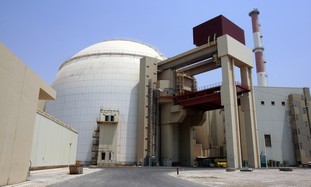
Iran's Bushehr nuclear reactor

  VIENNA – Expanding uranium enrichment, a new atomic energy chief said to have military expertise, missile tests — Western analysts see fresh signs that Iran may be seeking to develop the means to build nuclear warheads.

Iran’s determination to press ahead with a nuclear program it says is for purely peaceful purposes suggests that tougher Western sanctions are so far failing to force the Islamic state to back down in the long-running dispute over its atomic aims.

“Although developments elsewhere in the Middle East have dominated media attention, Iran has been working hard in several ways to advance a nuclear weapons capability,” London-based proliferation expert Mark Fitzpatrick said.

“It needs fissile material, weaponization expertise and a delivery vehicle. On each of these, it has been making progress,” Fitzpatrick, a director at the International Institute for Strategic Studies think-tank, said.

But even if Tehran decided to make such weapons it could still be years away from having nuclear-armed missiles, possibly giving diplomacy more opportunities to resolve a row which has the potential to spark a Middle East conflict.

World powers failed to make any progress in two rounds of talks with Iran half a year ago and no new meetings have been announced, leaving the diplomatic track apparently deadlocked.

“While difficult, Western capitals need to redouble their diplomatic effort to dissuade Iran from taking the nuclear weapons path,” Daryl Kimball, director of the Washington-based research and advocacy group Arms Control Association, said.

Kimball said Iran was closer to a capability to make atomic weapons but it “apparently has not yet made a strategic decision to do so and is still years, not months, away from building a deliverable nuclear arsenal”.

Britain last week said Iran had carried out covert tests of a missile that could carry a nuclear warhead, an allegation which Tehran swiftly denied.

During a military exercise last week, Iran test-fired 14 missiles on one day alone, including some it says are capable of hitting its arch foe Israel and US bases in the Middle East.

‘Iran years, not months from nuclear weapon’

Defense analyst Paul Beaver said he thought Iran aimed to have a “nuclear-capable weapons delivery system and then to be able to use that in its diplomatic and political posturing.”

He added: “How close are they? They are within years, rather than within months, I believe.”

Tehran says its missiles cannot carry nuclear payloads and insists it is enriching uranium for electricity production and medical purposes. Making atomic bombs would be a “strategic mistake” and would also not be allowed under Islam, it adds.

But in a defiant move that further fueled Western unease about its intentions, Iran announced last month it would shift its production of higher-grade uranium to an underground bunker and triple output capacity.

It says it needs 20 percent refined uranium to make fuel for a medical research reactor after talks on a swap — under which other countries would have supplied the material — broke down.

Nuclear experts argue the step would bring it significantly closer to the 90 percent purity needed for nuclear weapons, compared with a level of around 3-5 percent usually required to power atomic energy plants.

Olli Heinonen, a former chief UN nuclear inspector, said he saw Iran “moving in the direction” of becoming a state that has the ability to make atomic weapons.

“In spite of economical, technological and political difficulties faced, it appears that Iran is determined to, at the very least, achieve a ‘virtual nuclear weapon state’ capability,” he told a US Congress foreign affairs committee.

But former UN nuclear watchdog head Mohamed ElBaradei, Heinonen’s old boss who stepped down in 2009, criticized what he called the “hype” about the threat posed by Iran.

“During my time at the agency we haven’t seen a shred of evidence that Iran has been weaponizing, in terms of building nuclear-weapons facilities and using enriched materials,” he was quoted as saying in The New Yorker magazine last month.

Iran’s new atomic energy chief suspected of involvement in weapons research

The decision to boost 20 percent uranium output was announced by Iran’s new atomic energy chief, who has been subjected to UN sanctions because of what Western officials said was his involvement in suspected atomic weapons research.

A nuclear scientist, Fereydoun Abbasi-Davani was named head of Iran’s Atomic Energy Organization in February, after he was wounded in a 2010 bomb attack which Tehran blamed on Israel.

The Institute for Science and International Security (ISIS), a US-based think tank, said Abbasi-Davani’s extensive scientific background was “more suited to researching nuclear weapons” than building nuclear power reactors.

“Abbasi-Davani has regularly been linked to Iran’s efforts to make the nuclear weapon itself,” ISIS said.

Iran’s mission to the UN International Atomic Energy Agency (IAEA) was not available for comment, but Abbasi-Davani pledged last month to work with the agency and invited its head to tour Iran’s nuclear facilities.

The IAEA, the Vienna-based UN nuclear watchdog, is also voicing growing concern about possible military links to Iran’s nuclear activities and Western diplomats expect it to firm up its suspicions in reports due later this year.

For several years, the IAEA has been investigating Western intelligence reports indicating Iran has coordinated efforts to process uranium, test explosives at high altitude and revamp a ballistic missile cone so it could take a nuclear warhead.

Iran says the allegations are forged and baseless.

But its refusal to halt enrichment has led to four rounds of UN sanctions on the major oil producer, as well as tighter US and European Union restrictions.

“Iran has developed an ambitious nuclear program that is diffused in the nature of its distribution of sites and coordinated in its approach to achieve the capacity to field a nuclear arsenal,” Heinonen said.

“Its actions bear witness to a regime that intends to stay on this path,” said Heinonen, who is now a senior fellow at Harvard’s Belfer Center for Science and International Affairs.

Syrian security forces round up dozens in Hama

July 6, 2011

Syrian security forces round up dozens in … JPost – Middle East.

Anti-Assad protesters in Deir al-Zour, June 17.

  BEIRUT – Syrian forces rounded up dozens of people in Hama on Wednesday after shooting dead up to 22 people, activists said, and Amnesty International said Syria may have committed crimes against humanity in an earlier crackdown.

Tanks were still stationed outside Hama, which has seen some of the biggest protests against President Bashar Assad and was the site of a bloody crackdown against Islamist insurgents nearly 30 years ago.

But some of the tanks had been redeployed away from the city and a resident said security forces were now concentrated mainly around the headquarters of the ruling Baath Party, the police headquarters and a state security compound.

Ammar Qurabi, Cairo-based head of the Syrian National Human Rights Organization, said the death toll from Tuesday, when gunmen loyal to Assad swept through the city, had risen to 22.

He said hundreds of people had been arrested.

State news agency SANA said one policeman was killed in a clash with armed groups who opened fire on security forces and threw petrol and nail bombs at them. It made no mention of civilian deaths but said some “armed men” were injured.

Syria has prevented most independent media from operating inside the country, making it difficult to verify accounts from activists and authorities.

Hama was emptied of security forces for nearly a month after at least 60 protesters were shot dead on June 3, but the security vacuum emboldened demonstrators and on Friday activists said at least 150,000 people rallied to demand Assad’s downfall.

The next day Assad sacked the provincial governor and sent tanks and troops to surround the city, signaling a military assault similar to those carried out in other protest centers.

In a report released on Wednesday, Amnesty International said the crackdown two months ago against one of those protest centers — the town of Tel Kelakh near the border with Lebanon — may have constituted a crime against humanity.

Urging the United Nations to refer Syria to the International Criminal Court, it said nine people died in custody after being captured during the operation in the town, close to the Lebanese border.

Syrian forces shoot dead 10 protesters in Hama

July 5, 2011

Syrian forces shoot dead 10 protesters in Hama.

AMMAN – Forces loyal to President Bashar Assad shot dead 10 people on Tuesday in the Syrian city of Hama, activists said, and France called on the United Nations to adopt a firm stance in the face of “ferocious armed repression.”

Tanks were still surrounding Hama, days after it witnessed some of the biggest protests against Assad’s rule since a 14-week uprising erupted in March.

The attacks focused on two districts north of the Orontes River, which splits the city of 650,000 people in half. Residents said the dead included two brothers, Baha and Khaled al-Nahar, who were killed at a roundabout.

Troops raided towns to the northwest of Hama near the border with Turkey in Idlib province, and authorities intensified a campaign of arrests that has resulted in the detention of at least 500 people across Syria in the last few days, rights campaigners said.

In the eastern provincial capital of Deir al-Zor, security forces arrested Ahmad Tuma, a former political prisoner and secretary general of the Damascus Declaration, a grouping of opposition figures founded in 2005 to unify efforts to transform the country into a democracy.

“Heavily armed ‘amn’ (security police) came to Dr Tuma’s clinic and dragged him away in front of his patients,” one of Tuma’s friends told Reuters by phone.

Some residents of Hama, scene of a crackdown by Assad’s father nearly 30 years ago, had sought to halt any military advance by blocking roads between neighborhoods with garbage containers, burning tires, wood and metal.

Tuesday’s raid by security forces and gunmen loyal to Assad followed the killings of at least three people when troops and security police entered Hama at dawn on Monday.

French Foreign Ministry spokesman Romain Nadal said the world could not stand by “inactive and powerless” in the face of the violence.

“We are hoping that the Security Council adopt a clear and firm position and we call on all the members of the Security Council to take responsibility in light of this dramatic situation with a Syrian population subjected day after day to an unacceptable, ferocious and implacable armed repression.”

French MP Gerard Bapt, head of the French-Syrian Friendship Committee, told Reuters: “With the Arab League not moving and with a nation like Saudi Arabia saying nothing publicly to condemn the killings by the Syrian regime it is difficult to see international pressure rising beyond the economic.”

France, unlike its European partners and the United States, says Assad has lost legitimacy to rule. But a French campaign for UN condemnation of the crackdown has met stiff Russian and Chinese resistance.

Asked why there has been no international intervention in Syria like there was in Libya, British Foreign Secretary William Hague said a request from the Arab League to impose a no-fly zone on Libya was a major factor behind action there.

“Assad may wait to see whether large-scale protests in Hama continue. He knows that using military aggression against peaceful demonstrations in a symbolic place like Hama would lose him support even from Russia and China,” Syrian activist Mohammad Abdallah told Reuters from exile in Washington.

Abdallah said using tanks to attack Hama would “totally discredit” a promise made by Assad to seek dialogue with his opponents. Troops and armor were attacking villages and towns in the Jabal-al-Zawya region, north of Hama, which had been the scene of large protests against Assad’s 11-year rule, he said.

Assad’s father, Hafez al-Assad, who ruled Syria for 30 years until his death in 2000, sent troops into Hama in 1982 to crush an Islamist-led uprising in the city where the Fighting Vanguard, the armed wing of the Muslim Brotherhood, made its last stand.

That attack killed many thousands, possibly up to 30,000, and one slogan shouted by Hama protesters in recent weeks was “Damn your soul, Hafez”.

Authorities have prevented most independent media from operating in Syria, making it difficult to verify accounts from activists and authorities.

Rights groups say Syrian security forces have shot and killed at least 1,300 civilians across the country since the protests started and arrested over 12,000.

Several troops and police officers have been killed for refusing to fire at civilians.

Authorities say 500 police and soldiers have been killed by gunmen, who they blame for most civilian deaths.

Assad has promised a national dialogue with the opposition to discuss political reform in Syria, which has been under the iron rule of the Baath Party for nearly 50 years. Many opposition figures reject dialogue while the killings and arrests continue.

IDF intel chief: Iran intervening in Egyptian elections

July 5, 2011

IDF intel chief: Iran intervening in Egyptian … JPost – Defense.

Head of IDF Intelligence Maj.-Gen. Aviv Kochavi

  Head of IDF Intelligence Maj.-Gen. Aviv Kochavi warned of Iranian intervention in Egyptian elections, speaking about the regime in a Knesset Foreign Affairs and Defense Committee meeting on Tuesday.

“Iran is attempting to influence the political process in Egypt through efforts to connect with the Muslim Brotherhood,” Kochavi said.

Kochavi also said that the Muslim Brotherhood is pressing for elections in Egypt to take place as soon as possible, because it is “the only group that’s ready for elections.”

“The international community is trying to delay the vote so more moderate groups can be better organized,” he explained.

In the meantime, the Egyptian army is losing control of the Sinai, according to Kochavi.

The IDF intelligence chief also reported that Iran will be able to produce a nuclear weapon within two years.

“Iran recovered from the last wave of sanctions, even though the international consensus surprised them,” Kochavi said.

He also emphasized Iranian influence throughout the region, including Turkey.

“We see closer relations between Iran and Turkey, which are focused mostly on trade, but also include military matters,” he said.

“Iran is taking advantage of the upheaval in the Middle East to deepen their infiltration into states and organizations in the region,” he added, saying that the Islamic Republic is working in Syria, Lebanon, Egypt, Bahrain, Sudan, Yemen, Iraq and Gaza.

“As Iran continues to work on its nuclear project, it works to transfer weapons and instill radical Islamic ideologies throughout the Middle East,” Kochavi explained.

In addition “the potential for a cyber-attack is growing, and will eventually be a greater threat than Iran’s other weapons.”

Kochavi also said that Iran was active in planning the “Nakba” and “Naksa” day demonstrations and border crossings from Lebanon.

“Iran is making efforts to ensure that such events will continue,” he explained, “but they were disappointed that [the border crossings] were not more successful.”

“Iran and Hezbollah are actively helping the Syrian regime in oppressing protesters,” Kochavi said. “They are transferring means for dispersing demonstrations, knowledge and technical aid.”

“They are motivated to help due to their deep fear of the demonstrations’ implications, especially losing their partnership with the Syrians and a trickling of protests into their territory,” he explained.

Kochavi estimated that Syrian President Bashar Assad’s regime is stable, and will remain so as long as demonstrations do not reach Damascus and Aleppo.

“Assad understands that the way to end this situation is not only military, so he has turned to reform,” he explained, adding that the reforms include subsidies and job creation.

“Most of the Syrian army remains loyal to Assad, especially high-ranking Alawite officers, who believe that quelling the demonstrations is a legitimate mission, which will prevent the Alawites from losing control of Syria,” Kochavi said. “There is no major phenomenon of defection – only 20-30 officers and a few hundred soldiers have left the Syrian army.”

However, Kochavi also said that “if Assad remains in power after the riots, his position will be much weaker.”

The IDF intelligence chief stated that Syria continues to send weapons to Hezbollah in Lebanon, despite the demonstrations.

Kochavi also commented on the agreement between Fatah and Hamas, calling it “unstable.”

“The agreement is only for show, it doesn’t have any practical content,” he explained. “Fatah continues to arrest Hamas men in the West Bank, albeit in smaller amounts.”

“[Palestinian Authority President Mahmoud] Abbas wants to bolster [PA President Salam] Fayyad, because he is an asset internationally, but Hamas sees him as a red flag,” Kochavi added.

“Abbas prefers that we restart negotiations, so he doesn’t have to take Palestinian statehood to a vote in the UN,” Kochavi said. “He’ll negotiate if we accept his terms – ’67 borders and a settlement construction freeze.”

Syrian forces hit Hama as protestors erect barriers and set tires ablaze

July 5, 2011

Syrian forces hit Hama as protestors erect barriers and set tires ablaze.

Al Arabiya

Syrian refugees shout slogans as they protest against Syrian President Bashar Al Assad at a refugee camp in the Turkish border town of Yayladagi in Hatay province. (File Photo)

Syrian refugees shout slogans as they protest against Syrian President Bashar Al Assad at a refugee camp in the Turkish border town of Yayladagi in Hatay province. (File Photo)

Hundreds of residents of Hama burned tires, erected sand barriers and set up other makeshift roadblocks on Tuesday to prevent the advance of Syrian tanks and soldiers ringing the city, which has become a flashpoint of the uprising against President Bashar Al Assad’s authoritarian regime.

On Monday, Syrian forces sealed off Hama and blocked the roads leading to it, an apparent attempt to retake the city one month after security forces withdrew from it. About 300,000 people protested against the regime in Hama last week, a sign the city was edging away from government control.

Rami Abdul-Rahman, the London-based director of the Syrian Observatory for Human Rights, said security forces killed three people Monday night in Hama. At least 20 were wounded, including Nasser al-Shami, who won a bronze medal in the 2004 Olympics in Athens.

Hundreds of young men were burning tires and erecting barriers to prevent a military siege, he said, citing witnesses on the ground.

Hama, which has a history of militancy against the Assad regime, was targeted by Mr. Assad’s father, his predecessor, in a major government crackdown nearly three decades ago.

In 1982, the late President Hafez Al Assad ordered his troops to crush a rebellion by Sunni fundamentalists, killing between 10,000 and 25,000 people, rights groups say.

The 14-week uprising against Basher Assad has proved remarkably resilient despite a deadly government crackdown that has brought international condemnation and sanctions. Mr. Assad is facing the most serious challenge to his family’s four decades of rule in Syria.

Activists say security forces have killed more than 1,400 people −most of them unarmed protesters − since mid-March. The regime disputes the toll, blaming “armed thugs” and foreign conspirators for the unrest.

Mr. Assad has promised a series of reforms that would have been unthinkable before the uprising, which was inspired by the revolutions sweeping the Arab world. He lifted the country’s reviled emergency law, which gave the state a free hand to arrest people without charge, and said a national dialogue would start soon.

But the protesters, enraged by a growing death toll, are increasingly calling for nothing less than the downfall of the regime.

Syria has banned nearly all foreign media and restricted media coverage, making it nearly impossible to independently verify events on the ground. But witness accounts, including interviews with refugees who have fled to neighboring countries, indicate a brutal crackdown on the protest movement.

Also on Tuesday, a Syrian activist said buses carrying security forces had been spotted heading to restive mountainous areas near the Turkish border. Omar Idilbi, a spokesman for the Local Coordination Committees, which track the protests in Syria, said witnesses told him the vehicles were rushing to the area where the military has been trying to prevent the opposition from establishing a base.

About 10,000 Syrians have fled to Turkey amid the crackdown.

The exodus has been a source of embarrassment to Syria, which has tried to tightly control coverage of the revolt. It also has strained ties with Turkey.


