Archive for May 2011

Report: Syrian soldiers shot by fellow comrades

May 29, 2011

Report: Syrian soldiers shot by fellow comrades – Israel News, Ynetnews.


Al-Jazeera TV airs video showing Syrian soldiers bleeding after reportedly refusing to fire at protestors

Roee Nahmias

Published: 05.29.11, 19:39 / Israel News
Al-Jazeera TV aired video footage on Sunday which shows Syrian soldiers bleeding. According to the report, which could not be confirmed, the soldiers were shot by their comrades after refusing to open fire at protestors in the city of Daraa.


Al-Jazeera reported that soldiers from Syria’s 4th Division under Maher Assad’s command shot their friends.

Video footage showing wounded soldiers (Photo: Al-Jazeera)


It was also claimed that the injured soldiers were taken to a house in the city, where locals tried to treat them. There have been numerous reports about the Syrian army executing soldiers who refuse orders in the last few weeks.


Meanwhile, human rights activists and eye witnesses reported Sunday that Syrian forces backed by tanks and helicopters entered the city of Rastan and killed two people. An activist said at least three people were killed in Tabliseh.


It was also reported that soldiers broke into houses in the two towns and began performing mass arrests. Gunfire was heard across the towns and helicopters were seen circling the skies.


AP contributed to this report


Iran reportedly aiding Syrian crackdown

May 28, 2011

Iran reportedly aiding Syrian crackdown – The Washington Post.

U.S. officials say Iran is dispatching increasing numbers of trainers and advisers — including members of its elite Quds Force — into Syria to help crush anti-government demonstrations that are threatening to topple Iran’s most important ally in the region.

The influx of Iranian manpower is adding to a steady stream of aid from Tehran that includes not only weapons and riot gear but also sophisticated surveillance equipment that is helping Syrian authorities track down opponents through their Facebook and Twitter accounts, the sources said. Iranian-assisted computer surveillance is believed to have led to the arrests of hundreds of Syrians seized from their homes in recent weeks.

The United States and its allies long have accused Iran of supporting repressive or violent regimes in the region, including Syria’s government, the Hezbollah movement in Lebanon and Hamas in the Gaza Strip. Many previous reports, mostly provided by Western officials, have described Iranian technical help in providing Syria with riot helmets, batons and other implements of crowd control during 10 weeks of demonstrations against President Bashar al-Assad.

The new assertions — provided by two U.S. officials and a diplomat from an allied nation, all of whom spoke on the condition of anonymity to describe sensitive intelligence — are clearly aimed at suggesting deepening involvement of Iranian military personnel in Syria’s brutal crackdown against anti-Assad demonstrators.There was no response on Friday to requests for comment left with the Syrian Embassy and Iranian interests section in Washington.

In the account provided by the diplomat and the U.S. officials, the Iranian military trainers were being brought to Damascus to instruct Syrians in techniques Iran used against the nation’s “Green Movement’’ in 2009, the diplomat said. The Iranians were brutally effective in crushing those protests.

Officers from Iran’s notorious Quds Force have played a key role in Syria’s crackdown since at least mid-April, said the U.S. and allied officials. They said U.S. sanctions imposed against the Quds Force in April were implicitly intended as a warning to Iran to halt the practice.

The Quds Force is a unit of Iran’s Islamic Revolutionary Guard Corps responsible for operations outside the country. It has helped fund and train Hezbollah and Hamas militants and supported anti-U.S. insurgents inside Iraq.

While the size of the Iranian contingent in Syria is not known, the numbers of advisers has grown steadily in recent weeks despite U.S. warnings, according to the U.S. and allied officials.

The Obama administration mentioned the role of the Quds Forces in announcing two sets of sanctions imposed against Syrian government officials in the past month. A White House executive order last week that targeted Assad and six other top government officials also included a little-noticed reference to Mohsen Chizari, an Iranian military officer who is the No. 3 leader in the Quds Force in charge of training.

The naming of Chizari — who in 2006 was arrested but later released by U.S. forces in Iraq for allegedly supplying arms to insurgents there — suggests that officials possess evidence of his role in assisting Syria’s crackdown on protesters, said Michael Singh, a former senior director for Middle East affairs for the National Security Council during George W. Bush’s administration.

“There’s a deeply integrated relationship here that involves not only support for terrorism but a whole gamut of activities to ensure Assad’s survival,” Singh said.

It is not unusual for governments to draw on foreign assistance during times of unrest, as Western-allied governments in Bahrain and Egypt did when protests were building in those countries.

Iran’s increasing engagement in the Syrian crackdown reflects anxiety in Tehran about the prospects for Assad, who has failed to end the protests despite rising brutality that human rights groups say has left more than 800 people dead and perhaps 10,000 in prison. While managing to hold on to power, Assad has been severely weakened after months of Syrian unrest, according to current and former U.S. officials and Middle East experts.

“Iran is focused intently on how things are evolving in Syria,” said Mona Yacoubian, a former Middle East expert with the State Department’s intelligence division and who is a special adviser to the U.S. Institute of Peace. “The two countries have a long-standing alliance of 30 years-plus. Syria is Iran’s most important inroad into the Arab world, and its perch on the front line with Israel.”

Assad, whose army is stretched across dozens of cities in an unprecedented domestic deployment, increasingly needs help to survive, Yacoubian said. And Iran desperately needs Assad. “If they lose the Syrian regime, it would constitute a huge setback,” Yacoubian said.

Iran, a longtime supplier of military aid to Syria, has been helping Dasmascus battle the current wave of civil unrest since at least mid-March, said the U.S. and allied officials. The emergence of Syria’s first true mass protests — with tens of thousands of demonstrators pouring into the streets demanding Assad’s ouster — initially flummoxed the country’s security leaders, who had little experience with such phenomena.

On March 23, Turkish officials seized light weapons — including assault rifles and grenade launchers — on an Iranian cargo plane bound for Syria. Whether the shipment was intended to help suppress the uprising is unclear, but around the same time, Syria received other Iranian shipments that included riot control gear and computer equipment for Internet surveillance, the U.S. and allied sources said.

Just before the shipments, Assad announced with great fanfare that he was lifting the country’s ban on the use of social media such as Facebook and YouTube. While widely hailed at the time, the move gave Assad’s security police an Iranian-inspired tool for tracking down leaders of the protest movement, said Andrew Tabler, a former Syria-based journalist who is a Syria expert at the Washington Institute for Near East Policy.

“Lifting the ban on Facebook helped the regime pinpoint where the [activists] were coming from,” Tabler said in an phone interview from Lebanon, where he remains in contact with opposition figures. “It was not about being magnanimous; it was a way to allow more surveillance, leading to thousands of arrests.”


Researcher Julie Tate contributed to this report.

Lawrence Solomon: Time is on Israel’s side

May 28, 2011

Lawrence Solomon: Time is on Israel’s side | FP Comment | Financial Post.

The world’s dependence on Israel’s enemies is dwindling

By Lawrence Solomon

‘We cannot afford to wait another decade, or another two decades, or another three decades, to achieve peace,” President Barack Obama said Sunday, referring to the Arab-Israeli conflict. “The extraordinary challenges facing Israel would only grow. Delay will undermine Israel’s security and the peace that the Israeli people deserve.”

President Obama has it backwards. Time is very much on Israel’s side. In 10 years, the free world’s dependence on Israel’s enemies will likely have lessened immensely and the extraordinary challenges facing Israel will likely have diminished immensely. Peace will then have a chance.

Much of the world now sides with the Palestinians and not Israel. Some do so because they believe the United Nations was wrong to establish a Jewish state on what they viewed as Arab lands after the Second World War. Some do so out of sympathy for the millions of Palestinian refugees who remain homeless decades after Israel was established. Some believe Israel has treated Palestinians badly. Some sympathize with the underdog. Some simply are anti-Semitic.

And most, I submit, hold their views in good part because they are afraid. They believe the West must reach an accommodation with an often violent Islamic world. And they know that Islamic countries have an outsized influence over world energy markets and directly affect them whenever they fill their car up at the gas station.

In the decades after the United Nations established the state of Israel, Israel was popular in the Western world, seen as a plucky little country that, against all odds, had defeated the combined armies of eight invading Arab nations. The Academy Award winning 1960 movie, Exodus, starring Paul Newman, portrayed Israel heroically, as generally did the Western press. The U.K.’s Guardian, now anti-­Israel, was early on a fierce supporter. So, too, were most other European and North American media outlets. Among the most influential of writers was one Robert Kennedy, Middle East correspondent for The Boston Post and a passionate defender of Israel’s cause. His ongoing support for Israel, and his influence in liberal circles, would make him the first U.S. casualty of Arab terrorism — he was assassinated in 1968 by Palestinian Sirhan Sirhan while campaigning to be president. Kennedy had promised that, if elected, he would supply Israel with 50 fighter jets to ensure its continued survival.

The West in those first decades following Israel’s creation did not blame Israel for the many Palestinian Arabs kept in refugee camps — it blamed Israel’s Arab neighbours for refusing to take them in, unlike Israel which had welcomed the almost one million Jewish refugees who had been expelled from Muslim lands.

The West then also did not blame Israel for the Arabs’ continued belligerence against Israel, whose UN-established borders Arab nations refused to recognize. The West saw Israel as a democracy and as an idealistic member of the Socialist International; it saw the major Arab countries as backward military dictatorships, allied with the communist Soviet Union and overtly hostile to Western interests.

Israel lost its reputation as an underdog on June 5, 1967, when in six days it defeated the combined armies of Egypt, Syria and Jordan. It did not lose its popularity with the public and the press, however. In 1969, when president Charles De Gaulle tried to regain France’s former influence in the Arab world by reversing France’s long-standing military support for Israel, “De Gaulle came under stinging attack for his anti-Israel policies from the once subservient French press,” Time magazine reported. “In an unprecedented demonstration of unanimous scorn, French newspaper reporters boycotted the Information Ministry’s regular Wednesday briefing in what amounted to a direct snub of the general himself.”

Israel’s loss of popularity would come four years later, after a surprise attack by Egypt and Syria known as the 1973 Yom Kippur War. Israel survived that war, the fourth Arab-Israeli War in 25 years, but its popularity didn’t. The Egyptian-Syrian strategy included an agreement with Saudi Arabia to use the “oil weapon” — an embargo of oil shipments to the West. This embargo, begun during the war and now known as the 1973 OPEC oil crisis, led to skyrocketing oil prices that hit Western consumers at the pump and at home — oil was then commonly used in home heating.

Popular opinion in Europe soon swung decisively against Israel. The 1979 OPEC oil crisis, which saw further dramatic price increases, deepened the West’s sense that it was dependant on Middle East oil and furthered the swing. By then, the West had other reasons, too, to feel burdened by its relationship with Israel. The Arabs of the region had a charismatic new leader — Egyptian-born Yasser Arafat — and a new identity as a people — the newly coined “Palestinians” — and a new organization to represent them — the Palestinian Liberation Organization. (Before then, the Arabs in Palestine, overwhelmingly immigrants from neighbouring Arab lands or their children, hadn’t seen themselves as a nation. As the Arab Higher Committee to the United Nations told the UN General Assembly in 1947, in arguing against the creation of either a Jewish or an Arab state in Palestine, “Palestine was part of the Province of Syria… the Arabs of Palestine were not independent in the sense of forming a separate political entity.”)

Under Arafat, a motivated PLO became the world’s pre-eminent terrorist organization, hijacking planes, taking hostages and killing Westerners when its demands weren’t met (among its demands was the release of Sirhan Sirhan, whom some believe killed Kennedy on Arafat’s’s direct orders). Adding to the burden, numerous other terrorist agencies soon followed its path, among them al Qaeda, Hamas, Hezbollah, the Muslim Brotherhood and various Muslim states such as Iran, Iraq, Libya and Syria. In Europe, especially, the desire to appease the Muslim world became strong. There in the past decade, and now in the United States under the Obama administration, the belief has grown that an end to turmoil throughout the Middle East, and thus the secure energy supply that Western economies need, depend on a settlement of the Israeli-Palestinian conflict.

That belief will likely soon wane for a number of reasons. Chief among them, as I will argue next week, will be an emerging new world energy order, Israel’s pre-eminent role in that new order, and the effect on global security of that new order.

Financial Post
LawrenceSolomon@nextcity.com
Lawrence Solomon is executive ­director of Energy Probe.

In Censorship Move, Iran Plans Its Own, Private Internet – WSJ.com

May 28, 2011

In Censorship Move, Iran Plans Its Own, Private Internet – WSJ.com.

Iran is taking steps toward an aggressive new form of censorship: a so-called national Internet that could, in effect, disconnect Iranian cyberspace from the rest of the world.

The leadership in Iran sees the project as a way to end the fight for control of the Internet, according to observers of Iranian policy inside and outside the country. Iran, already among the most sophisticated nations in online censoring, also promotes its national Internet as a cost-saving measure for consumers and as a way to uphold Islamic moral codes.

In February, as pro-democracy protests spread rapidly across the Middle East and North Africa, Reza Bagheri Asl, director of the telecommunication ministry’s research institute, told an Iranian news agency that soon 60% of the nation’s homes and businesses would be on the new, internal network. Within two years it would extend to the entire country, he said.

The unusual initiative appears part of a broader effort to confront what the regime now considers a major threat: an online invasion of Western ideas, culture and influence, primarily originating from the U.S. In recent speeches, Iran’s Supreme Leader Ayatollah Ali Khamenei and other top officials have called this emerging conflict the “soft war.”

On Friday, new reports emerged in the local press that Iran also intends to roll out its own computer operating system in coming months to replace Microsoft Corp.’s Windows. The development, which couldn’t be independently confirmed, was attributed to Reza Taghipour, Iran’s communication minister.

Iran’s national Internet will be “a genuinely halal network, aimed at Muslims on an ethical and moral level,” Ali Aghamohammadi, Iran’s head of economic affairs, said recently according to a state-run news service. Halal means compliant with Islamic law.

Mr. Aghamohammadi said the new network would at first operate in parallel to the normal Internet—banks, government ministries and large companies would continue to have access to the regular Internet. Eventually, he said, the national network could replace the global Internet in Iran, as well as in other Muslim countries.

A spokesman for Iran’s mission to the United Nations declined to comment further, saying the matter is a “technical question about the scientific progress of the country.”

There are many obstacles. Even for a country isolated economically from the West by sanctions, the Internet is an important business tool. Limiting access could hinder investment from Russia, China and other trading partners. There’s also the matter of having the expertise and resources for creating Iranian equivalents of popular search engines and websites, like Google.

Few think that Iran could completely cut its links to the wider Internet. But it could move toward a dual-Internet structure used in a few other countries with repressive regimes.

Myanmar said last October that public Internet connections would run through a separate system controlled and monitored by a new government company, accessing theoretically just Myanmar content. It’s introducing alternatives to popular websites including an email service, called Ymail, as a replacement for Google Inc.’s Gmail.

Cuba, too, has what amounts to two Internets—one that connects to the outside world for tourists and government officials, and the other a closed and monitored network, with limited access, for public use. North Korea is taking its first tentative steps into cyberspace with a similar dual network, though with far fewer people on a much more rudimentary system.

Iran has a developed Internet culture, and blogs play a prominent role—even President Mahmoud Ahmadinejad has one.

Though estimates vary, about 11 of every 100 Iranians are online, according to the International Telecommunication Union, among the highest percentages among comparable countries in the region. Because of this, during the protests following 2009’s controversial presidential election, the world was able to follow events on the ground nearly live, through video and images circulated on Twitter, Facebook and elsewhere.

“It might not be possible to cut off Iran and put it in a box,” said Fred Petrossian, who fled Iran in the 1990s and is now online editor of Radio Farda, which is Free Europe/Radio Liberty’s Iranian news service. “But it’s what they’re working on.”

The discovery last year of the sophisticated “Stuxnet” computer worm that apparently disrupted Iran’s nuclear program has added urgency to the Internet initiative, Iran watchers say. Iran believes the Stuxnet attack was orchestrated by Israel and the U.S.

“The regime no longer fears a physical attack from the West,” said Mahmood Enayat, director of the Iran media program at the University of Pennsylvania’s Annenberg School of Communications. “It still thinks the West wants to take over Iran, but through the Internet.”

The U.S. State Department’s funding of tools to circumvent Internet censorship, and Secretary of State Hillary Clinton’s recent speeches advocating Internet freedom, have reinforced Iran’s perceptions, these people said.

Iran got connected to the Internet in the early 1990s, making it the first Muslim nation in the Middle East online, and the second in the region behind Israel. Young, educated and largely centered in cities, Iranians embraced the new technology.

Authorities first encouraged Internet use, seeing it as a way to spread Islamic and revolutionary ideology and to support science and technology research. Hundreds of private Internet service providers emerged. Nearly all of them connected through Data Communications Iran, or DCI, the Internet arm of the state telecommunications monopoly.

The mood changed in the late 1990s, when Islamic hardliners pushed back against the more open policies of then-president Mohammad Khatami. The subsequent shuttering of dozens of so-called reformist newspapers had the unintended effect of triggering the explosion of the Iranian blogosphere. Journalists who had lost their jobs went online. Readers followed.

Authorities struck back. In 2003, officials announced plans to block more than 15,000 websites, according to a report by the OpenNet Initiative, a collaboration of several Western universities. The regime began arresting bloggers.

Iran tried to shore up its cyber defenses in other ways, including upgrading its filtering system, for the first time using only Iranian technology. Until around 2007, the country had relied on filtering gear from U.S. companies, obtained through third countries and sometimes involving pirated versions, including Secure Computing Corp.’s SmartFilter, as well as products from Juniper Networks Inc. and Fortinet Inc., according to Iranian engineers familiar with with the filtering.

Such products are designed primarily to combat malware and viruses, but can be used to block other things, such as websites. Iranian officials several years ago designed their own filtering system—based on what they learned from the illegally obtained U.S. products—so they could service and upgrade it on their own, according to the Iranian engineers.

A Fortinet spokesman said he was unaware of any company products in Iran, adding that the company doesn’t sell to embargoed countries, nor do its resellers. McAfee Inc., which owns Secure Computing, said no contract or support was provided to Iran. Intel Corp. recently bought McAfee, which added that it can now disable its technology obtained by embargoed countries. A Juniper spokesman said the company has a “strict policy of compliance with U.S. export law,” and hasn’t sold products to Iran.

The notion of an Iran-only Internet emerged in 2005 when Mr. Ahmadinejad became president. Officials experimented with pilot programs using a closed network serving more than 3,000 Iranian public schools as well as 400 local offices of the education ministry.

The government in 2008 allocated $1 billion to continue building the needed infrastructure. “The national Internet will not limit access for users,” Abdolmajid Riazi, then-deputy director of communication technology in the ministry of telecommunications, said of the project that year. “It will instead empower Iran and protect its society from cultural invasion and threats.”

Iran’s government has also argued that an Iranian Internet would be cheaper for users. Replacing international data traffic with domestic traffic could cut down on hefty international telecom costs.

The widespread violence following Iran’s deeply divisive presidential election in June 2009 exposed the limits of Iran’s Internet control—strengthening the case for replacing the normal Internet with a closed, domestic version. In one of the most dramatic moments of the crisis, video showing the apparent shooting death of a female student, Neda Agha-Soltan, circulated globally and nearly in real time.

Some of the holes in Iran’s Internet security blanket were punched by sympathetic people working within it. According to one former engineer at DCI, the government Internet company, during the 2009 protests he would block some prohibited websites only partially—letting traffic through to the outside world.

Since the 2009 protests, the government has ratcheted up its online repression. “Countering the soft war is the main priority for us today,” Mr. Khamenei, the Supreme Leader, said November 2009 in a speech to members of the Basij, a pro-government paramilitary volunteer group. “In a soft war the enemy tries to make use of advanced and cultural and communication tools to spread lies and rumors.”

The Revolutionary Guard, a powerful branch of the Iranian security forces, has taken the lead in the virtual fight. In late 2009, the Guard acquired a majority stake of the state telecom monopoly that owns DCI. That put all of Iran’s communications networks under Revolutionary Guard control.

The Guard has created a “Cyber Army” as part of an effort to train more than 250,000 computer hackers. It recently took credit for attacks on Western sites including Voice of America, the U.S. government-funded international broadcasting service. And at the telecom ministry, work has begun on a national search engine called “Ya Hagh,” or “Oh, Justice,” as a possible alternative to popular search engines like Google and Yahoo.

Stuxnet virus: US refuses to deny involvement – Telegraph

May 27, 2011

Stuxnet virus: US refuses to deny involvement – Telegraph.

A senior Pentagon official has refused to answer questions about American involvement in the Stuxnet computer virus attack on Iran’s nuclear programme, fuelling claims it was a joint operation by Israel and the US.

In an interview for a TV documentary about cyber security, Deputy Defense Secretary William Lynn twice failed to address reports that the US was a partner in the internet-borne attack.

The presenter of CodeWars: America’s Cyber Threat, asked him “was the US involved in any way in the development of Stuxnet?”

His initial response was to discuss the general problem of tracing cyber attacks.

“The challenges of Stuxnet, as I said, what it shows you is the difficulty of any, any attribution and it’s something that we’re still looking at, it’s hard to get into any kind of comment on that until we’ve finished our examination,” he said.

“But sir, I’m not asking you if you think another country was involved,” the presenter replied, “I’m asking you if the US was involved: if the Department of Defense was involved.”

Mr Lynn then flatly refused to answer.

“This is not something that we’re going to be able to answer at this point,” he said.

His silence will be taken as the latest clue that clandestine elements of the American military or intelligence services were partners in Stuxnet.

Analysis of the virus, which was first detected in June last year, has found it was designed to infect industrial control systems and make subtle but damaging changes to equipment – specifically the centrifuges at Iran’s Natanz uranium enrichment plant.

Speculation as to its source immediately implicated Israeli, the most outspoken opponent of Tehran’s nuclear ambitions. But a New York Times report then said that the US government had been involved and had been allowed by Siemens, the German manufacturer of industrial control systems, to carry out test to identify security vulnerabilities in its software.

Further testimony of a collaborative effort was provided by computer forensics experts, who found evidence of two separate teams of developers having worked on Stuxnet’s code.

“It was most likely developed by a Western power, and they most likely provided it to a secondary power which completed the effort,” Tom Parker, a security researcher, told the Telegraph, naming the US and Israeli as the most likely pairing.

One part of the code was well organised and highly expert, requiring the detailed knowledge of Siemens software that the Americans reportedly obtained. The other part was more crude but would have required human agents to deliver virus to the Natanz systems, pointing to Israeli intelligence, which is known to be very active inside Iran.

Graham Cluley, of the British computer security firm Sophos, said Mr Lynn’s stonewall response would add to suspicions.

“Of course, a refusal to confirm or deny the US’s involvement in the Stuxnet worm isn’t an admission,” he said.

“After all, it’s possible that Lynn simply doesn’t know if the USA was involved – and doesn’t want to be caught on film denying something which later turns out to be true.”

“Or it’s possible that he’s not authorised to deny the US’s involvement for reasons best known to the higher echelons of US politics.

“Whatever the truth, it’s always fun to see a politician squirm when put on the spot regarding their own country’s murky activities on the internet.”

Britain’s military and intelligence agencies are currently bolstering their own online capabilities via the new £650m cyber security budget.

Canada takes pro-Israel line at G8 summit

May 27, 2011

Canada takes pro-Israel line at G8 summit – Israel News, Ynetnews.

Canadian delegation blocks mention of 1967 lines in Group of Eight leaders’ joint statement calling Israel, Palestinians to return to peace talks

Reuters

Group of Eight leaders had to soften a statement urging Israel and the Palestinians to return to negotiations because Canada objected to a specific mention of 1967 borders, diplomats said on Friday.

Canada’s right-leaning Conservative government has adopted a staunchly pro-Israel position in international negotiations since coming to power in 2006, with Prime Minister Stephen Harper saying Canada will back Israel whatever the cost.

Diplomats involved in Middle East discussions at the G8 summit said Ottawa had insisted that no mention of Israel’s pre-1967 borders be made in the leaders’ final communiqué, even though most of the other leaders wanted a mention.

“The Canadians were really very adamant, even though Obama expressly referred to 1967 borders in his speech last week,” one European diplomat said.

A spokesman for Harper would not comment on the line Canada had taken, saying only that the final communiqué would make positions clear.

No mention of 1967

In the final communiqué, a copy of which was obtained by Reuters, the leaders call for the immediate resumption of peace talks but do not mention 1967, the year Israel seized the West Bank and Gaza from Jordan and Egypt during the Six-Day War.

“Negotiations are the only way toward a comprehensive and lasting resolution to the conflict,” the communiqué said.

“The framework for these negotiations is well known. We urge both parties to return to substantive talks with a view to concluding a framework agreement on all final status issues.

“To that effect, we express our strong support for the vision of Israeli-Palestinian peace outlined by President Obama on May 19, 2011.”

In his speech last week, Obama said pre-1967 borders should be a basis of talks to achieve a negotiated settlement, although he also acknowledged any agreement would ultimately involve land swaps on either side of the border.

That position was rejected by Prime Minister Benjamin Netanyahu, who said Israel would be indefensible if it returned entirely to the borders that existed before 1967.

Canada’s strong backing for Israel was cited by diplomats last year as one reason why Ottawa failed to win a rotating two-year seat on the United Nations Security Council.

Harper has made is position on Israel very clear, saying last year: “When Israel, the only country in the world whose very existence is under attack, is consistently and conspicuously singled out for condemnation, I believe we are morally obligated to take a stand.”

Lessons of Netanyahu’s triumph

May 27, 2011

Column One: Lessons of Netanyahu’… JPost – Opinion – Columnists.


In the coming weeks and months, the threats to Israel will surely only increase. And with these escalating threats will come also the escalating need for strong and certain leadership.

Worlds apart – JPost – Opinion – Columnists

May 27, 2011

Editor’s Notes: Worlds apart – JPost – Opinion – Columnists.
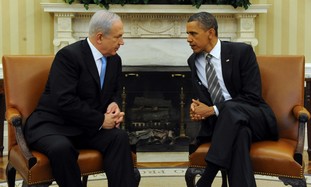
 

With Netanyahu bitterly rejecting the president’s flawed talk of ’67 lines, and the Palestinians not being asked by Obama to abandon the ‘right of return,’ it is the Jewish state that is seen to be defying its ally again, to the benefit of the disingenuous PA.

  WASHINGTON – It was never about his middle name or the color of his skin or even the views of his former spiritual leader. Israeli concerns about Barack Obama’s presidency have always revolved around the question of whether he “gets” the Middle East – whether he fully internalizes the ruthlessness of those in this region who are trying to wipe us out, and the relentlessness with which they have been battling for decades to do so.

And as his presidency has continued, the series of disputes he has had with our prime minister have only exacerbated Israeli worries.

Binyamin Netanyahu is neither a beloved prime minister nor one whose policies and leadership style enjoy anything approaching automatic consensual support. But to take, as prime examples, the two fundamental areas where we have witnessed the president and the prime minister profoundly and publicly at odds – first, over how best to make progress on the twin aims of thwarting Iran and advancing Israeli- Palestinian reconciliation, and now over the imperatives born of the dizzying Middle East turmoil – it seems safe to say that most Israelis believe Netanyahu has been reading the region more accurately than Obama.

At the root of their first public spat two years ago was Obama’s argument that blocking Iran’s nuclear drive would be easier if only there were progress on the Israeli-Palestinian front. Taking substantive steps toward healing our conflict, the president reasoned, could remove a key recruiting tool for the Islamists and their state champion, unleash a surge of moderation in the region, and bolster Arab states’ confidence in joining with the West in facing down Tehran.

Netanyahu held to the opposite view, insisting that if Iran’s nuclear program were halted, and its soaring self-confidence punctured, this would liberate more moderate forces across the region, notably among the Palestinians. But so long as Iran was moving steadily toward the bomb amid perceived Western impotence and weakness, the prime minister argued, then, in the Palestinian context, the Iranian-armed, – trained, -financed and -inspired Hamas would feel itself in the ascendant, and the prospects of a Palestinian leadership offering and winning internal support for the necessary compromises with Israel would remain slim.

That very basic divergence was a recipe for friction between these leaders – two charismatic, ferociously self-confident, articulate men, who nonetheless do not quite speak the same language. And that friction indeed erupted into very open argument, notwithstanding the mutual rhetoric about an unshakable Israeli- American partnership and the practical evidence that this partnership indeed endures.

The US administration, convinced that the best thing it could do for Israel was press hard for urgent progress on the Israeli-Palestinian diplomatic front, made the issue of its opposition to settlement expansion a central factor as it tried to convince the Palestinians of its fair-minded approach. During the dispute over building in Jerusalem’s Ramat Shlomo neighborhood at the time of Vice President Joe Biden’s visit last year, it even went so far as to question Israel’s commitment to the bilateral relationship.

For the Netanyahu government, Obama’s focus on the settlements seemed spectacularly wrong-headed. In any territorial accommodation, it was clear, most settlements would in any case be dismantled. In the interim, construction had already been much reduced.

US preoccupation with the issue actually kept Mahmoud Abbas away from the negotiating table – how could he be less angry with Israel than the Americans were? – while gravely weakening Israel in the eyes of our ruthless neighbors, headed by Iran. If our superpower ally was publicly furious with us, they must have been thinking, then we were potentially more vulnerable. And if we were becoming more vulnerable, then why would a Palestinian leadership be inclined to moderate its maximalist diplomatic demands?

NOW, FOR the second time, the president and the prime minister are fundamentally at odds in reading the region.

Obama, again doubtless well-intentioned, looks at a Middle East in chaos and argues that Israel will be in greater danger if it cannot find a way forward with the Palestinians now. “A new generation of Arabs is reshaping the region,” he told the AIPAC conference on Sunday. “A just and lasting peace can no longer be forged with one or two Arab leaders. Going forward, millions of Arab citizens have to see that peace is possible for that peace to be sustained.”

Or as he put it in his landmark Middle East policy speech the previous Thursday, “At a time when the people of the Middle East and North Africa are casting off the burdens of the past, the drive for a lasting peace that ends the conflict and resolves all claims is more urgent than ever. That’s certainly true for the two parties involved.”

Apparently thinking of Netanyahu, he observed in that same speech that “there are those who argue that with all the change and uncertainty in the region, it is simply not possible to move forward now. I disagree.”

Most Israelis, it seems fair to suggest, would side with their prime minister on this one too – not because we object to moving forward, ending the conflict and resolving all claims. Quite the contrary. It is rather because we sadly regard that essential goal as less attainable in this new climate of uncertainty.

In addition to our familiar concerns about the viability of leaders like Abbas and Syrian President Bashar Assad as partners for a high-risk land-for-peace diplomatic gambit, we must now ask whether these leaders will still be around a week, or a month, or a year from now. And if they are not, how committed their unknown successors might be to any accommodation we have achieved through our territorial withdrawal.

If even the seemingly stable Egypt of Hosni Mubarak can be ripped open overnight, bringing into question the sustainability of the most enduring of our peace accords, Israelis widely wonder, how confident could we possibly be of the preservation of any agreement with the now desperate, mass-murdering Assad that would give the Syrians the Golan high ground? How much trust could we afford to place in any accord with the now Hamas-partnered Abbas that would bring the Palestinians into terrifying proximity to the densely populated center of our country?

THE PRESIDENT took great offense at the “misrepresentation” (by the unnamed Netanyahu) of his partial blueprint for Israeli-Palestinian talks, and especially at the inaccurate notion that he was urging an Israeli return to the pre-1967 lines. Such territorial compromise would have to feature “mutually agreed swaps,” he repeated over and over in his AIPAC address, to warm applause.

But Obama’s indulgence of such border adjustments is not the issue here; the question of the minor land adjustments is not the heart of the disconnect.

The prime ministerial fury stems from the fact that our key ally has now publicly endorsed the main Palestinian territorial demand as the basis for negotiation, that he did so despite Netanyahu’s pleas not to, at a time when Israel is being physically threatened to some degree or other on all of its borders, and when our ostensible negotiating partner has just entered a reconciliation pact with Hamas. And, worst of all, Obama did not simultaneously require that the Palestinians give up their demand for a “right of return.”

As I wrote in Sunday’s Jerusalem Post, “It is immensely troubling for many Israelis to recognize that our most important strategic partner is now publicly advocating, before any significant sign of Palestinian compromise on final-status issues has been detected, that we withdraw, more or less, to the pre-1967 lines – the so-called ‘Auschwitz borders’ – from which we were relentlessly attacked in our first two fragile decades of statehood. But only a president who ignores or underestimates Palestinian hostility to Israel could propose a formula for reviving negotiations in which he set out those parameters for high-risk territorial compromise without simultaneously making crystal clear that there will be no ‘right of return’ for Palestinian refugees.

“Obama is urging Israel – several of whose leaders have offered dramatic territorial concessions in the cause of peace, and proven their honest intentions by leaving southern Lebanon, Gaza and major West Bank cities, only to be rewarded with new bouts of violence – to give up its key disputed asset, the biblically resonant territory of Judea and Samaria, as stage one of a ‘peace’ process.

“But he is not [explicitly] demanding that the Palestinians – whose leaders have consistently failed to embrace far-reaching peace offers, most notably Ehud Olmert’s 2008 offer of a withdrawal to adjusted ’67 lines and the dividing of Jerusalem – give up their key disputed asset, the unconscionable demand for a Jewish-state-destroying ‘right of return’ for millions, until some vague subsequent stage…”

IN THE Knesset last week, Netanyahu hinted at a greater readiness than in the past for dramatic West Bank withdrawal, intimating that his commitment to settlements in the Jordan Valley and outside the major settlement blocs might be wavering. He signaled similar positions in his rapturously received address to the joint meeting of Congress on Tuesday.

But these were hints and signals, not commitments. In Congress, for instance, he employed the deliberately unclear line that “some settlements will end up beyond Israel’s borders.” Did that mean that he would dismantle such settlements, or expect a new Palestinian sovereign power to protect them? The prime minister, who had polished every word of that speech, plainly did not want to say.

The Netanyahu two-state outline remains precisely that – an ambiguous overview. And while there are many Israelis who feel the prime minister is going unconscionably soft, there are also many who feel Netanyahu should long ago have set out a more generous and detailed position.

He had promised AIPAC on Monday that his speech to Congress the next day would “outline a vision for a secure Israeli-Palestinian peace.” But there was no series of dramatic new policies, even though Obama’s Sunday address to the pro-Israel lobby had provided a more reassuring context, with its clarifications on land swaps and its tougher language on Hamas, than the State Department speech.

Netanyahu’s two years of careful vagueness, born of his ideological commitment to the settlement enterprise, narrow coalition concerns and his characteristic desire to avoid alienating supporters, has harmed Israel’s international credibility, ultimately ill-serves those settlers whose lives would be most directly affected by the withdrawals he hints he is ready to order, and created the vacuum that Obama, unsurprisingly, has now begun to fill.

The prime minister’s speech to Congress was a rhetorical masterpiece. The passage in which he declared that “In Judea and Samaria, the Jewish people are not foreign occupiers. We are not the British in India. We are not the Belgians in the Congo. This is the land of our forefathers…” eloquently asserted Israel’s historic claim to the lands the president is asking that we relinquish.

But Netanyahu has now evidently internalized the demographic challenge Israel faces, and says he is ready to cut a “generous” deal with the Palestinians, giving up “parts of the ancestral Jewish homeland.” If so, think how much more international empathy and support he would have obtained – support in the diplomatic struggle against Palestinian unilateralism – had he gone on to detail the parameters of potential compromise, and offered, for a start, a timetable for the demolition of illegal outposts and a pledge that all further settlement budgetary allocations would be limited to West Bank areas that Israel insists on retaining.

In the absence of precise prime ministerial commitments, and with Netanyahu understandably resisting Obama’s flawed new diplomatic blueprint, few international players are going to be dissuaded from endorsing Palestinian statehood at the UN in September. Unfair and short-sighted though Israel may feel this to be, the consequence could be greater Israeli isolation, boycott pressures and a perceived legitimization for Palestinian protest. The prime minister could have done more in Congress to try to avert this, and done so without diverging from his broad vision.

YET NETANYAHU has not come under heavy domestic pressure for greater compromise – the kind of pressure he felt as prime minister in the late 1990s – because the regional climate is so different. And mainstream Israeli readiness for wrenching concessions is in large part a function of our sense of the mood in the region around us.

As demonstrated by the results of the 1992 and the 1999 elections, which respectively brought Yitzhak Rabin and Ehud Barak to power, when the public believes there are genuine opportunities for peace, it will oust leaders perceived as counter-productively obdurate (Yitzhak Shamir and first-term Netanyahu). Debunking the Arab extremists’ narrative that Israel only offers realistic peace terms when its people are being murdered, it is in periods of relative calm that the public gives its support to political doves, knowing full well that the compromises they favor will require the traumatic dismantling of much of the settlement enterprise. When it feels rising hostility, it goes into defensive mode.

Rarely in recent years has Israel had reason to feel as defensive and tangibly threatened as it feels now.

Several overseas commentators have this week scoffed at Israel’s security concerns and its fears of territorial withdrawal, noting accurately that we have an immensely strong army. They miss the point; it is not Israel’s conventional military strength that is being challenged.

The fate of Israel’s peace treaty with Egypt is uncertain. All Israel’s borders were targeted on “Nakba Day,” with varying degrees of success, by the kinds of unarmed masses the IDF has found no effective means of dispersing without resort to force. Hezbollah and Hamas have vast missile arsenals aimed at targets throughout the country. Iran is still on track to the bomb.

And thus, when Netanyahu was reduced to lecturing the president in that excruciating White House session last Friday, an ally telling a superpower, “Sorry, but no we can’t,” he spoke not only for his natural constituency but for many more dovish Israelis too.

In a climate of regional tranquility, with a Palestinian leadership credibly asserting its peacemaking credentials, and no imminent specter of a vicious regional bully achieving a nuclear capability, the prime minister’s blunt declaration to the president that the 1967 lines “are indefensible” might not have enjoyed consensual Israeli resonance. The fact that Obama had indeed stressed the necessity for mutual land swaps might have been regarded as significant and sensible.

But in today’s utterly unpredictable Middle East, you could imagine heads nodding nationwide, and not only in Likud households, on hearing Netanyahu tell Obama, “Before 1967, Israel was all of nine miles wide… And these were not the boundaries of peace; they were the boundaries of repeated wars, because the attack on Israel was so attractive… The only peace that will endure is one that is based on reality, on unshakable facts… a peace that will ensure Israel’s security and will not jeopardize its survival… We don’t have a lot of margin for error.”

OBAMA’S EMOTIVE phrase in his AIPAC speech regarding the Jewish link to our sliver of territory – his reference to “all the centuries that the children of Israel had longed to return to their ancient homeland” – was extremely welcome. So unfortunately absent from his Cairo address two years ago, and left unsaid again in last Thursday’s State Department speech, this presidential endorsement of our historical connection to the land constituted a vital rejection of the abiding Palestinian narrative that absurdly denies our past presence here and thus denies the legitimacy of our modern sovereignty. And his characterization of Israel as “a Jewish state and the homeland of the Jewish people” indicates that his administration rules out the notion of a mass influx of Palestinian refugee descendants.

But in the three days between his State Department address and his AIPAC speech, as he was successfully pressed by various pro- Israel advocates to formulate harsher wording on Hamas and introduce comments recalling the George W. Bush correspondence with Ariel Sharon about the “new demographic realities on the ground,” Obama was also urged to include for the AIPAC audience a specific negation of the “right of return.” And he chose not to do so.

I do not doubt that Obama opposes the “right of return.” He opted not to say this, however, not to provide Israel with that public reassurance, I am given to understand, because his current Israeli-Palestinian focus is aimed at preventing a diplomatic train wreck at the United Nations in September, when the Palestinians will seek international support for a state without the necessity of reconciliation with Israel. He is trying to build credible parameters for resumed negotiations, it is said, and in so doing to persuade other key international players, including the Quartet and the Europeans, not to lend their support to the unilateral drive for “Palestine.”

The president’s concern, apparently, is that to make explicit the inadmissibility of the “right of return” would run counter to the goal of enabling an environment among the Palestinians in which relatively moderate leaders can thrive. The Palestinians are preparing for elections next year under their new Fatah- Hamas reconciliation accord, and the White House did not want to spell out its position on the “right of return” because it feared this might force the likes of Abbas, whom it believes are prepared to give up that “right,” to publicly declare, for short-term electoral reasons, that they insist upon it.

In other words, Obama reasoned that it would actually be unhelpful to Israel for him to state explicitly that the Palestinians will indeed have to make this central concession, since it would weaken or box-in the very Palestinian leaders who might just agree to it. This is a dubious and complex argument, which I doubt would be widely endorsed in Israel.

It also exemplifies a striking double standard, and says a lot about who the administration wants around to advance Israeli-Palestinian diplomacy: Apparently it’s okay to go easy on Abbas over the “right of return” for fear that he might otherwise lose power, but just fine to turn the screws on Netanyahu, whose government would certainly fall were he to endorse the Obama formula of amended ’67 lines first, refugees and Jerusalem later.

The Israeli, and the American, imperative is to encourage the Palestinians toward reconciliation, both by demonstrating our willingness for viable compromise and by making explicit what it is that they are required to concede. The president chose not to follow that latter course; unsurprisingly, the prime minister felt obligated to fill the breach.

As he said on Friday, with Obama at his side, “The Palestinian refugee problem will have to be resolved in the context of a Palestinian state, but certainly not in the borders of Israel… It’s not going to happen. Everybody knows it’s not going to happen. And I think it’s time to tell the Palestinians forthrightly it’s not going to happen.” And again, this time to loud applause, before Congress on Tuesday: The Palestinians “continue to perpetuate the fantasy that Israel will one day be flooded by the descendants of Palestinian refugees. My friends, this must come to an end.”

If Netanyahu and Obama had managed to actually speak to each other before the president delivered his Thursday speech, as real friends should, there can be no doubt that the prime minister would have implored him to include a phrase ruling out the “right of return.” And if the president had suggested that this might cause more trouble than it would avert, I imagine Netanyahu would have assured him that the risk was worth taking. And he would have been speaking for most Israelis.

AS THINGS stand, with Netanyahu instinctively and bitterly rejecting the talk of ’67 lines, and the Palestinians not being asked by the president to make any commitment at this juncture on the refugee issue, it is the Jewish state that is seen to be defying its ally again, and the Palestinians who are the perceived victims of that intransigence.

If the cerebral, analytical Obama resisted Netanyahu’s panicked pleas, via Secretary of State Hillary Clinton, to reconsider some of his wording last Thursday because he believes he understands Israel’s interests better than the prime minister does, that would indicate a relationship dangerously soured both by those fundamentally divergent readings of the region and the personal antipathy between the two men. These are leaders pursuing the same ostensible goals; they should have quietly conceived the shared parameters for doing so.

And if the president’s motivation for the Israeli-Palestinian section of his speech was preventing that diplomatic train wreck at the United Nations in September, one can only sadly conclude that his approach may well backfire. The unsavory sniping and very public disagreements of the past few days, combined with Netanyahu’s preference for generalities over specifics in his address to Congress, seem far more likely to bolster than to reduce international sympathy for the disingenuous Palestinians, accelerating the dangerous unilateral momentum rather than slowing it.

Barack Obama regards himself as a friend of Israel – albeit one who has spent far too little time here and, consequently or otherwise, one with no particular empathy for the notion of an Israel expanded beyond its pre-1967 lines. (In his unscripted remarks at a press conference with British Prime Minister David Cameron on Wednesday, Obama characterized his suggested Israeli pullback to adjusted ’67 lines as one of the “perhaps less emotional issues” on the Israeli-Palestinian negotiating agenda, in contrast to the “extraordinarily emotional” issues of Jerusalem and the refugees. Only a president obtuse or dispassionate about Israeli claims and attachments beyond the ’67 lines could have extemporized that particular formulation.)

But he plainly does understand the moral imperative, the heartfelt desire for normalization and the demographic considerations that motivate our relentless obsession with trying to reach an accommodation with the Palestinians and the wider Arab world.

Where we and he have consistently fallen out is over the paths to try to achieve it – with the differences, time and again, seeming to stem from his reluctance to internalize the extent of regional hostility to us, the centrality of an Arab narrative that argues that our country has no place here, wherever we draw our final borders.

“Why has peace not been achieved?” Netanyahu asked Congress rhetorically on Tuesday. “Because, so far, the Palestinians have been unwilling to accept a Palestinian state, if it meant accepting a Jewish state alongside it. You see, our conflict has never been about the establishment of a Palestinian state. It has always been about the existence of a Jewish state.”

Opting not to insist – explicitly and relentlessly – that the Palestinians come to terms with Israel as a Jewish state, specifically by abandoning their demand to overrun it via an influx of refugee descendants, simply gives the Palestinians room to perpetuate their fundamental hostility and their dream of destroying us by weight of numbers. Many, many Israelis wonder why Obama doesn’t “get” that.

Are you saying it would have been better for the president to have taken a public position on all the final-status issues, someone asked me in Washington this week? If he had coordinated with Israel, I answered, then, of course.


Diplomacy: Netanyahu and ‘The Book of Why’

May 27, 2011

Diplomacy: Netanyahu and ‘Th… JPost – Features – Week in review.

PM Netanyahu addresses Congress

  WASHINGTON – When Prime Minister Binyamin Netanyahu fired off an unprecedentedly sharp response to US President Barack Obama’s Middle East speech last Thursday night just two hours before boarding a plane to meet the president, it was clear this prime minister’s five-day trip to the American capital was going to be unlike any other.

And, indeed, it was. From the pre-boarding surprises that included Obama’s reference to a return to the 1967 borders and Netanyahu’s angry reaction, to the astonishing media session after their meeting in which Netanyahu essentially told Obama he was wrong; to Obama’s clarifications at AIPAC and his dig that Netanyahu was misrepresenting what he said; to the overwhelmingly warm reception Netanyahu received in Congress – this trip was exceptional.

And yet it remains full of questions. In the world of diplomacy, things don’t generally just happen. They are thought out, considered, weighed. And they have reasons. As such – when reviewing the major events of Netanyahu’s 2011 Washington trip – it’s instructive to ask one simple question: Why?

Why did Obama surprise Netanyahu with a speech that clearly stated the 1967 lines as the negotiation baseline?

Of all the “why” questions, this is perhaps the most difficult to answer, especially since sources close to the prime minister had been saying for days prior to the trip that there was close coordination between the White House and the Prime Minister’s Office regarding the substance of both Obama’s speech and Netanyahu’s address to Congress.

In the final analysis, there wasn’t. Close coordination would have prevented the unpleasant surprises.

Yet Obama’s speech was full of them: In addition to the 1967 reference, there was also a failure to rule out talks with a PA government that includes Hamas, and an unwillingness to lay down a clear marker on the refugee issue and say – as George W. Bush once did – that the descendants of 1948 Palestinian refugees would return to a Palestinian state, not to Israel.

One reason proffered for the surprise was a White House fear that if the information were shared with the Prime Minister’s Office a number of days, not hours, before the speech’s delivery, then it would have been leaked, triggering a chain of events that would have altered the content of the speech – content that Obama believes in.

According to one senior diplomatic source, the White House views the Israeli-Palestinian conflict through the following prism: Palestinian Authority President Mahmoud Abbas has the will to make peace, but not the power; Netanyahu has the power, but not the will.

The presidential tactics, therefore, are informed by that overall assumption. How to give Abbas the power, and Netanyahu the will.

Well, one way to give Abbas the power is not to undercut him in the eyes of his public – which an unequivocal “no” to the refugee issue would have done. Another way is not to completely rule out Hamas, especially when the Hamas-Fatah reconciliation is so popular on the Palestinian street.

A third way to give Abbas power is to raise his stature among his people – something that is done by adopting a position he has put forward for months: a return to the 1967 lines, with mutually agreed swaps, as the basis for negotiations.

And how, if you are Obama, do you give Netanyahu the will to make peace? Show him where the US stands; box him into a corner, force his hand.

Which is what Obama did. The time to procrastinate is over, Obama seemingly said Thursday night; “I want to see action now” – and then he laid out in what direction he wanted to see the action. This, he thought, would inject some will into a Netanyahu he viewed as recalcitrant.

Since taking office in January 2009, Obama’s policies on Israel seem infused by the assumption – long popular among some Israeli pundits and opposition leaders – that the Israeli public would never tolerate a direct confrontation with a US president, and if it came to that, the public would rally around the president, rather than their prime minister, so as not to risk the vital US-Israel relationship.

With that as an assumption, the president had no problem surprising Netanyahu – almost daring the prime minister to take him on. Obama apparently thought, mistakenly, that if Netanyahu did pick a fight, he would lose politically in Israel.

Why did Netanyahu choose to pick a fight with Obama, issuing an extremely tough response to the president’s Mideast speech?

The speech Obama delivered Thursday night was complex.

It is probably fair to state that for most people watching on television or listening on the radio, it did not seem that egregious.

The casual listener heard Obama come out against the delegitimization of Israel and the planned PA end-around run to the UN in September seeking recognition; restate his commitment to the country’s security; and acknowledge that the Fatah-Hamas agreement raised “profound and legitimate” questions for Israel.

Sure, the casual listeners also heard the reference to the 1967 lines, with mutual agreed swaps, and that Jerusalem and the refugee issue must be deferred down the line.

But, many probably thought, that has all been said many times before.

Indeed, one could – after hearing and reading that speech – choose to emphasize either the good or the bad, to find the cup half full or half empty. Netanyahu took a calculated decision to focus on the half-empty part of the cup.

Why? First of all, because he was genuinely angered, as was apparent in a furious phone call he had with US Secretary of State Hillary Clinton after he was informed of what would be placed in the speech. Netanyahu felt ambushed, as he felt during his first visit to the White House in May 2009 when the president sprung on him – unannounced – a demand for a complete settlement freeze.

Second, Netanyahu saw an opportunity to rally political support. As one of his aides put it on the plane to Washington early Friday morning, soon after Netanyahu’s sharp retort, “If I had to give the response a headline, I’d say the prime minister restored national pride.”

Netanyahu went to the US wanting to stand up to the president – feeling that following the pictures last Sunday of hundreds of Palestinians rushing the country’s northern borders, there would be huge public backing for saying clearly to the president that Israel could not return to the 1967 lines or tolerate any wishy-washy language on Hamas or the refugee issue.

Obama, the aide said, simply does not understand the Israeli psyche, and his failure to address the refugees – saying this would be dealt with later – just a few days after refugees rushed the Israeli borders, showed the degree to which he is tone deaf to the Israeli public.

Netanyahu, on the other hand, understands the public very well, and crafted his comments to align with the vulnerability much of the country feels. Indeed, a Haaretz poll Thursday showed that Netanyahu’s popularity skyrocketed as a result of the Washington trip.

Why, after issuing this response, did Netanyahu feel the need to cross swords with Obama when they issued joint statements after their Friday meeting?

According to Israeli sources, the Friday meeting was divided into two parts. The first part was a one-on-one meeting of about 90 minutes, followed by the public statements. The second part was an additional 30- minute talk, followed by a walk on the White House lawn.

According to one version of events, when Obama failed to clarify to the degree Netanyahu thought necessary what he meant about the 1967 lines, Hamas and the refugees, Netanyahu decided to challenge him publicly – saying that his call the night before about a return the 1967 lines would not happen, and reiterating that a return of refugee descendants or talks with Hamas was also nowhere in the cards.

Yet even before that meeting, Netanyahu had made clear during private conversations that his statement following his meeting with the president would be very important – an indication even before the meeting that he was going to publicly challenge Obama over his speech. And indeed, it was extraordinary watching him do so even as Obama was hosting and sitting next to him.

The statement, together with the meeting, had an obvious impact, as Obama then felt compelled to clarify what he meant during his AIPAC speech – clarifications that brought his positions more in line with those of Israel.

Why did Obama decide to speak before AIPAC, and why did he say what he said?

Obama’s decision to speak at AIPAC three days after delivering a major Middle East address echoed his decision in 2009 to go to Buchenwald after delivering his landmark address to the Arab world in Cairo.

A pattern is emerging: Deliver a speech to the world that is difficult to Israeli ears in one forum, and follow up with a speech geared toward American Jews in another, seemingly designed to reduce the fallout.

While Obama’s visit to Buchenwald in 2009 resonated with American Jews who were touched by the symbolism of an American president visiting the concentration camp, it did not strike any chord with Israelis.

Likewise, in his AIPAC speech, Obama seemed to be trying to pave over, for American Jews, the pot-holes he had created in his Mideast speech.

And of course, a speech to AIPAC makes good political sense. Obama can tell his critics on the Left that he had the “courage” to stand before 10,000 passionate Israel supporters and speak forthrightly about what was needed to forge Middle East peace.

But at the same time, he can tell Jewish critics of his Israel policies that he went to AIPAC and explained fully what he meant. To the world, he didn’t call Hamas a terrorist organization; to the Jews, he did. To the world, he didn’t say that settlement blocs would remain inside Israel; to the Jews, he hinted that they would. To the world, he didn’t rule out once and for all any Palestinian refugee return; to the Jews, he stepped closer in that direction.

Obama, for all his bluster during the speech about not taking the easy path and avoiding controversy, knows that he is going to need Jewish support in the next elections: both financial support and the votes. He also knows that with his Israel policy, he risks losing a few percentage points of the 78% of the Jewish vote he garnered in 2008, and that those percentage points, in key battleground states like Florida and Ohio, could be critical in a close presidential race.

Or, as Ari Fleischer, former spokesman to president George Bush, said at a panel at the AIPAC conference, if Obama wins over the Jews 4:1, as he did last time, he wins the next election; if he only takes the Jews 3:1, he’s in trouble.

Obama went to AIPAC and made his policy clarifications with those considerations obviously in mind.

Why was Netanyahu’s speech to Congress important, especially since he did not chart any radically new course?

While Netanyahu’s speech Tuesday did not detail a new Israeli program, it did set down basic markers that are not irrelevant. Or, as Netanyahu himself said in private conversations, what he was trying to do was pound some policy stakes into the ground that would not be moved by the swirling winds in the region.

And those stakes are: No return to 1967, no refugees, no Hamas, and the absolute necessity of the Palestinians recognizing Israel as the nation-state of the Jewish people.

Yet there were some other elements of the speech that deserve notice.

The first is that Netanyahu signaled flexibility – that he said he was willing to be “generous” if the Palestinians uttered six key words: “We will accept a Jewish state.”

Second, it is important to notice that Netanyahu never speaks of dismantling, destroying or uprooting settlements.

Instead, as he said to Congress, “in any real peace agreement, in any peace agreement that ends the conflict, some settlements will end up beyond Israel’s borders.”

Close aides to Netanyahu have said in the past that if a million Arabs live in Israel, there is no reason in the world why a Palestinian state must be cleansed of all Jews.

Third, when talking about a future Palestinian state – saying that Israel will be generous about the size but firm on where the border is put so the lines are defensible – Netanyahu never used the word “contiguity.” This was not an oversight, and it is not clear how exactly he envisions a link between the West Bank and Gaza.

And fourth, he indicated – for the first time publicly – some wiggle room on Jerusalem, saying that while it “must remain the united capital of Israel,” he also believed that “with creativity and with goodwill a solution can be found.”

Although these points are significant, they don’t give the speech its importance. That comes from the reception the address received. That Israel’s prime minister received a rock-star ovation from both sides of the aisle of both houses of Congress sends an important message of support to both friend and foe alike.

Netanyahu knows this, and he knew it before walking into the House chamber. He knew the symbolic value of a speech by a foreign leader to a joint meeting of Congress, something that only happens about four times a year. He knew that he had the rhetorical abilities to get the congressmen on their feet repeatedly.

He knew that the speech, and its reception, would fill many of his countrymen – and Jews around the world – with pride, and would boost his popularity at home.

And even if he knew Obama was probably not applauding either the content of the speech, or the fact that he went to Congress to deliver it, he gambled that in the long run, both he and the country would gain more by – in his mind – “speaking truth to power.”

‘At least 8 killed as anti-gov’t protests sweep Syria’

May 27, 2011

‘At least 8 killed as anti-gov’t protests … JPost – Middle East.

Thousands of Syrians protest in Banias

  A total of eight protesters were killed Friday as anti-government demonstrations spread throughout the country. Three protesters were shot dead as live fire was used to disperse hundreds of protesters in the Qatana suburb east of the capital Damascus, the Syrian Observatory for Human Rights said.

Earlier on Friday, Syrian security forces killed four protesters in the southern town of Daal as demonstrations demanding the removal of President Bashar Assad swept the area, residents and activists said.

An additional protester was killed in an incident near the Lebanon border. In the city of Albu Kamal on the Iraqi border, protesters burned pictures of Hezbollah leader Hassan Nasrallah, whose speech in Beirut this week in support of Assad infuriated demonstrators, activists and a tribal leader in the province told Reuters by phone, adding security forces had withdrawn from the streets of Albu Kamal.

Foreign correspondents are barred from Syria and witness reports are hard to verify independently.

Nasrallah said on Wednesday most Syrians still backed President Bashar Assad and the removal of his regime on the back of mass unrest would serve US and Israeli interests.

The Syrian and Iranian-backed ally said he believed Assad was serious about making reforms, in response to pro-democracy protests that have gripped the country for nine weeks and which have presented the gravest challenge to Assad’s 11-year rule.

“All indications and information until now still affirm that the majority of the Syrian people support this regime and have faith in President Bashar Assad and are betting on his steps towards reforms,” Nasrallah said in his first comments on Syria since protests broke out in March.

“I personally believe … based on discussions and directly listening to President Bashar Assad that he believes in reforms and is serious and committed … and is ready to take very big steps towards reforms,” he told a crowd in the southern Lebanese town of Nabi Sheet by video link, on the 11th anniversary of Israel’s withdrawal from south Lebanon.

Syrian protesters, inspired by popular uprisings in other parts of the Arab world, initially took to the streets to call for greater freedoms and an end to corruption.

Assad made some gestures towards reforms, including lifting a hated decades-old emergency law, while also sending in tanks to crush revolts in flashpoints across the country.

Met with a violent crackdown by Syrian security forces — human rights group Sawasiah said at least 1,100 civilians have been killed — demonstrators have demanded Assad’s overthrow.

Nasrallah, who had praised popular uprisings that overthrew the leaders of Tunisia and Egypt earlier this year, said the fall of the Syrian government would serve American and Israeli interests since it would be replaced by a regime “ready to sign any peace, meaning surrender, with Israel”.

Human rights activists and witnesses say Syrian security forces, the army and irregular Assad loyalists, have opened fire on peaceful protesters. Syrian authorities blame the violence on armed groups backed by Islamists and outside powers.

