Archive for December 2010

Pakistan makes two nuclear weapons available to Saudi Arabia

December 30, 2010

DEBKAfile, Political Analysis, Espionage, Terrorism, Security.

DEBKAfile Exclusive Report December 30, 2010, 9:41 AM (GMT+02:00)

Pakistan’s GhauriII guided missile

With an eye on the nuclear arms race led by its neighbor Iran, Saudi Arabia has arranged to have available for its use two Pakistani nuclear bombs or guided missile warheads, debkafile‘s military and intelligence sources reveal. They are most probably held in Pakistan’s nuclear air base at Kamra in the northern district of Attock. Pakistan has already sent the desert kingdom its latest version of the Ghauri-II missile after extending its range to 2,300 kilometers. Those missiles are tucked away in silos built in the underground city of Al-Sulaiyil, south of the capital Riyadh.

At least two giant Saudi transport planes sporting civilian colors and no insignia are parked permanently at Pakistan’s Kamra base with air crews on standby. They will fly the nuclear weapons home upon receipt of a double coded signal from King Abdullah and the Director of General Intelligence Prince Muqrin bin Abdel Aziz. A single signal would not be enough.
Our military sources have found only sketchy information about the procedures for transferring the weapons from Pakistani storage to the air transports. It is not clear whether Riyadh must inform Pakistan’s army chiefs that it is ready to take possession of its nuclear property, or whether a series of preset codes will provide access to the air base’s nuclear stores. The only detail known to our Gulf sources is that the Saudi bombs are lodged in separate heavily-guarded stores apart from the rest of Pakistan’s nuclear arsenal.
This secret was partially blown by Riyadh itself. In recent weeks, Saudi officials close to their intelligence establishment have been going around security forums in the West and dropping word that the kingdom no longer needs to build its own nuclear arsenal because it has acquired a source of readymade arms to be available on demand. This broad hint was clearly put about under guidelines from the highest levels of the monarchy.

Partial nuclear transparency was approved by Riyadh as part of a campaign to impress on the outside world that Saudi Arabia was in control of its affairs:  The succession struggle had been brought under control; the Saudi regime had set its feet on a clearly defined political and military path; and the hawks of the royal house had gained the hand and were now setting the pace.

Deputy PM: West has three years to stop Iran nuclear program

December 29, 2010

Deputy PM: West has three years to stop Iran nuclear program – Haaretz Daily Newspaper | Israel News.

Moshe Ya’alon says Iran remains the government’s biggest worry, hopes for success of U.S.-led actions against Teheran.

By Reuters

The United States and its allies have up to three years to curb Iran’s nuclear program, which has been set back by technical difficulties and sanctions, Deputy Prime Minister Moshe Ya’alon said on Wednesday.

Saying Iran remained the government’s biggest worry, Yaalon did not mention possible unilateral military strikes by Israel, saying he hoped U.S.-led action against Tehran would be successful.

“I believe that this effort will grow, and will include areas beyond sanctions, to convince the Iranian regime that, effectively, it must choose between continuing to seek nuclear capability and surviving,” Ya’alon told Israel Radio. “I don’t know if it will happen in 2011 or in 2012, but we are talking in terms of the next three years.”

Ya’alon, a former armed forces chief, noted Iran’s uranium enrichment plan had suffered setbacks. Some analysts have seen signs of foreign sabotage in incidents such as the corruption of Iranian computer networks by a virus.

“These difficulties postpone the timeline, of course. Thus we cannot talk about a ‘point of no return’. Iran does not currently have the ability to make a nuclear bomb on its own,” Ya’alon said. “I hope it won’t succeed at all and that the Western world’s effort will ultimately deny Iran a nuclear capability.”

Ya’alon had previously been hawkish on Iran, saying Israel, believed to have region’s only nuclear arsenal, should attack Iran rather than see it get the bomb.

Other officials, including Prime Minister Benjamin Netanyahu, have been tight-lipped about the military option, which would face big tactical and diplomatic hurdles.

Iranian President Mahmoud Ahmadinejad said on Tuesday Iran will retain its right to pursue nuclear technology.

Speaking about next month’s planned nuclear talks with world powers in Istanbul, Ahmadinejad said “We are willing to cooperate with [them] in Istanbul, but all of them should acknowledge Iran’s right to pursue nuclear technology and know that we will not retreat on inch from these rights.”

The six world powers – Britain, China, France, Germany, Russia and the United States – demand that Iran suspend its controversial uranium enrichment, in line with five United Nations Security Council resolutions, four of them with sanctions, designed to make sure the Islamic state is not pursuing a secret military program.

While denying the existence of military nuclear programs, Tehran has referenced its right as a Nuclear Non-Proliferation Treaty signatory and International Atomic Energy Agency member, saying, like any other country, it has the right to have civil nuclear projects, including uranium enrichment.

Vice Premier Moshe Ya'alon Vice Premier Moshe Ya’alon.
Photo by: Archive

Yaalon: Iran’s nuclear arms drive delayed. Iran: Mossad killed Iranian official

December 29, 2010

DEBKAfile, Political Analysis, Espionage, Terrorism, Security.

DEBKAfile Special Report December 29, 2010, 1:28 PM (GMT+02:00)

Iran’s ex-Deputy Defense Minister Alireza Asgari, missing 4 years

The Iranian-Israeli clandestine war is heating up. Just a day after Iran publicly hanged alleged Israeli spy Ali Akbar Siadat, hinting that at least one more Iranian national was due to be executed for working for the Mossad, Iranian Deputy Foreign Minister for Middle East and Russia Affairs Mohammad Rauf Sheibani announced Wednesday, Dec. 29 that Tehran would ask international organizations to investigate “the murder by the Israeli Mossad'” of the former Iranian deputy defense minister Alireza Asgari in Israel’s Ayalon Prison.

Asgari went missing form his Istanbul hotel shortly after arriving there from Damascus on Dec. 9, 2006 and has not been seen since.. Until now, Iranian sources claimed he was in American hands. Western intelligence had reported in fact that he was the source of the information about secret Iranian nuclear installations, including the underground enrichment plant near Qom. Now, for the first time, Tehran has come up with the tale not only that he was taken to an Israeli prison after his disappearance in Istanbul, but that he died there.

Commenting on this new claim, Asgari’s wife, Ziba Ahamdi, said Wednesday that she had no idea if the report of her husband’s murder was true. If it were, she said, it would mean he had achieved his greatest ambition, which was to serve the Islamic Revolution.

On the morning of that same Wednesday, Israel’s Deputy Prime Minister in charge of Strategic Affairs, Gen (ret.) Moshe Yaalon, told a radio interviewer that Iran was not currently able to manufacture a nuclear bomb because of technical difficulties but he estimated it would attain this capability within three years.
debkafile‘s intelligence sources note that the current Israeli intelligence timeline for a nuclear-armed Iran was previously 2011. Yaalon did not go into the reasons for the delay, but our sources mention two:

1. His estimate represented the first official Israel evaluation of the scale of the destruction and havoc the Stuxnet malworm has wrought to Iran’s most secret nuclear weaponization facilities. Up until now, only the nuclear reactor at Bushehr and the uranium enrichment plant at Natanz had been admitted to have been affected by the invasive virus.
2.  The second factor seriously slowing progress is the tightening ring of sanctions which are keeping Iran from receiving the materials, replacement parts and new electronic and technical systems needed to bring its clandestine military nuclear program to fruition.

These revelations came to a head in the last 24 hours for good reason, say debkafile‘s intelligence and Iranian sources.

The regime in Tehran is under pressure to account to its own public and friendly Muslims for the shambling pace of its nuclear effort. Loth to admit the devastation caused by Stuxnet, the Iranians have seized on a distraction in the form of a “revelation” on the Eurasia Review web site that Alireza Asgari while held in Israel’s Ayalon jail under the name of Prisoner X had committed suicide. The Review cites inner circles of Israeli Defense Minister Ehud Barak and goes on to speculate that he did not die by his own hand but was murdered by Mossad agents – although there was no suggestion about motive.
Tehran has made big play of this report and is calling for an international investigation into the fate of the missing deputy defense minister – partly also to demonstrate that leaders of the Islamic Regime are willing to lay down their lives for the sacred mission of arming Iran with a nuclear bomb.
Tehran is moreover girding up for the resumed nuclear talks in Istanbul on Jan. 5 with the Five UN Security Council Permanent Members and Germany. The first round in Geneva on Dec. 6-7 was taken up with a long-winded tirade by senior negotiator Saad Jalili which held US and Israeli intelligence guilty of murdering Iranian nuclear scientists in broad daylight in downtown Tehran.

For the next session, Iran has prepared a fresh indictment against the Israeli Mossad, now accused of murdering Asqari

Ahmadinejad: Iran won’t make nuclear concessions in Istanbul talks

December 29, 2010

Ahmadinejad: Iran won’t make nuclear concessions in Istanbul talks – Haaretz Daily Newspaper | Israel News.

Iranian leader says sanctions will only speed up the progress of his country’s nuclear program.

By DPA


Iranian President Mahmoud Ahmadinejad said Tuesday that, just like in Geneva, his country will provide no concessions in next month’s nuclear negotiations in Istanbul, the ISNA news agency reported.

“We are willing to cooperate with the world powers in Istanbul, but all of them should acknowledge Iran’s right to pursue nuclear technology and know that we will not retreat on inch from these rights,” Ahmadinejad said in a speech in the city Karaj, west of the capital Tehran.

Mahmoud Ahmadinejad Dec. 23, 2010 (Reuters) Iranian President Mahmoud Ahmadinejad
Photo by: Reuters / Umit Bektas

After the talks between the six world powers and Iran in Geneva earlier this month, the two sides agreed to continue the talks in Istanbul at the end of January.

“And if (the powers) come again with sanction threats, they should know that all the sanctions already issued and all the hundreds more to be issued will not in the least affect Iran’s will, and just speed up our progress,” Ahmadinejad said.

Foreign Ministry spokesman Ramin Mehmanparast said Tuesday that Iran would discuss “ways to explore more cooperation” with the six world powers on global and economic issues, but not discuss the nuclear dispute.

The six world powers – Britain, China, France, Germany, Russia and the United States – primarily demand that Iran suspend its controversial uranium enrichment, in line with five United Nations Security Council resolutions, four of them with sanctions, designed to make sure the Islamic state is not pursuing a secret military program.

While denying the existence of military nuclear programs, Tehran has referenced its right as a Nuclear Non-Proliferation Treaty signatory and International Atomic Energy Agency member, saying, like any other country, it has the right to have civil nuclear projects, including uranium enrichment.

IAF commander: We are prepared to counter all threats

December 28, 2010

IAF commander: We are prepared to counter all threats.

iaf nevatim base 248.88 IDF

The Israeli Air Force is prepared to counter all of the threats and challenges that Israel currently faces including those from Iran, Israeli Air Force commander Maj.-Gen. Ido Nehushtan said on Tuesday amid predictions that 2011 is a “critical year” for stopping the Islamic Republic’s race to develop a nuclear weapon.

“The IAF has an important job to be prepared for anything it might be required to do,” Nehushtan told reporters during a briefing at the Ramon Air Force Base in the South. “We are always tracking what is happening around us so we can be ready.”

Nehushtan was at Ramon for his weekly training flight like all IAF pilots in active service and the reserves who are required to fly at least once a week. His flight on Tuesday was in a F-16I – called “Sufa” (Storm) in the IAF – which he flew in a dogfight training scenario against another aircraft.

The IAF’s greatest challenge, he said, was the military buildup on all of Israel’s different fronts – by Hamas in the Gaza Strip, Hizbullah in Lebanon and in Syria and Iran.

“We prepare for the different scenarios on a daily basis by analyzing the different fronts and thinking what the IAF can do to counter each one,” he said.

Asked about the recent announcement that the United States was selling $60 billion worth of military systems including over 80 F-15 fighter jets to Saudi Arabia and its effect on Israel, Nehushtan said that the IDF’s job was to ensure that it retained a qualitative military edge in the region. In October, Israel signed a $2.75 billion deal to purchase 20 F-35 Joint Strike Fighters, a fifth-generation stealth fighter jet.

“A guiding principle for the IAF has been to ensure that we have a qualitative edge,” he said. “To do this, we rely on our people who provide us with that edge as well as ensuring that we receive the most advanced planes and systems that exist.”

Nehushtan referred to Hamas and Hizbullah’s military buildup and the possibility that in a future, war missiles will land in IAF bases throughout the country.

“There have been developments in the amount of missiles and rockets that are in our enemies’ hands,” he said. “We assume that in the future, IAF bases will be a target. We are aware of this and are preparing accordingly.”

At the Hatzor IAF base, for example, airmen have carried out 25 drills since the beginning of the year, compared to just 12 last year. The drills vary and include scenarios that involve missile attacks on the base’s runway, living quarters and plane storage facilities.

During Operation Cast Lead last year, a number of rockets were fired in the direction of Hatzor, which is located near Gedera, as well as at Hatzerim, near Beersheba. During the Second Lebanon War in 2006, Hizbullah also tried to target the Ramat David base in the north.


Iran hangs man convicted of spying for Israel

December 28, 2010

Iran hangs man convicted of spying for Israel.


Teheran prosecutor: Man arrested many times for spying; got $60,000 for information on military, Revolutionary Guard navigation systems

The Teheran Prosecutor’s Office said that a man accused of spying for Israel was executed in Teheran’s Evin Prison early Tuesday morning, official Iranian news agency IRNA reported.

In and out of prison for decades, Ali Akbar Siadati was arrested in 2008 while trying to escape Iran with his wife, according to IRNA.

He was accused of conducting espionage “under the umbrella of business services initially, after which he got in direct contact with one of the Israeli embassies in the region, after which he gradually began dispatching secret military information” to Israel, IRNA reported.

According to the official Iranian news agency, Siadati was arrested again in 2009, when “29 pages of top secret information” were discovered in his briefcase.

He was suspected of meeting Israeli agents in Turkey, Thailand and Holland.

Siadati reportedly confessed to receiving between three and seven thousand dollars for each set of information he delivered, totaling 60,000 dollars.

He was said to have passed on numbers of Iranian military aircraft, training and operational flight information, causes of air disasters, and vital information on Revolutionary Guard air navigation systems.


Focus on Iran: Who’s next on Ahmadinejad’s list?

December 27, 2010

Focus on Iran: Who’s next on Ahmadinejad’s list?.

Manouchehr Mottaki with Ahmadinejad

First it was Ali Larijani, who resigned as top nuclear negotiator in October 2007. Now it’s Manouchehr Mottaki, who was dismissed as foreign minister this month in humiliating fashion, fired while out of the country on a diplomatic mission.

Both had something in common: They were Ahmadinejad antagonists.

Ahmadinejad never wanted either of them in their positions in the first place, but had to put up with it because they were Supreme Leader Ayatollah Ali Khamenei’s picks. So he worked to undermine them using a two-pronged strategy.

First, there appears to have been some straightforward lobbying with the supreme leader over their appointments. But Ahmadinejad also looks to have gone further, creating as many obstacles and problems for the two as possible in the hope they’d either tire of working with him or else be made to look so incompetent that Khamenei would seek their removal.

It seems to have worked. In Larijani’s case – it took six resignation letters before his resignation was finally accepted, the first five having been submitted after he was reported to have found it impossible to work with Ahmadinejad.

In Mottaki’s case, it seems Khamenei simply tired of the constant conflict between the president and his foreign minister. On the surface, it may have looked like the dismissal was down to Mottaki being unable to resolve the mounting list of foreign policy challenges Iran faces. But although Khamenei likely realizes that many of these problems have been created by Ahmadinejad, the president is still a more important ally than the former foreign minister.

These two are only the most high profile victims of Ahmadinejad, whose appetite for firing subordinates is reminiscent of US businessman Donald Trump in his reality TV show The Apprentice. He has previously fired numerous officials, ministers and the head of the country’s central bank.

So who’s next in Ahmadinejad’s crosshairs? There’s one politician who must be starting to worry.

ACCORDING TO a December 6 article in the Teheran-based Farda News, the number of hostile articles written by Ahmadinejad’s supporters against one particular politician has almost doubled compared with this time last year.

His opponents have described him as “antireligion,” accused him of disregarding Islamic and revolutionary values and stated bluntly that he has “no place among the religious and revolutionary people of Iran.” The target of these attacks? Mohammad Bagher Ghalibaf, the mayor of Teheran.

If it were up to Ahmadinejad, there’s little doubt Ghalibaf would have been removed long ago.

But even though it’s not up to the president to remove the mayor of Teheran, this doesn’t mean he hasn’t tried. In what was seen as a highly controversial move last June, 50 members of the Majlis (parliament) tried to introduce a bill whose goal was to transfer responsibility for the election of mayors to the Interior Ministry. It’s rumored that Ahmadinejad’s government was behind this move, but with its failure he is left trying to do to Ghalibaf what he did to Larijani and Mottaki, create as many problems for him as possible.

His best tool for undermining the mayor is the Interior Ministry, which is responsible for distributing funds to the municipality. One way Ahmadinejad can make Ghalibaf look incompetent is to withhold funds from the Teheran Municipality for important projects in the hope that the people will hold Ghalibaf responsible for any discontent they feel.

Indeed, this already seems to have been happening.

So far this year, the central government is supposed to have provided $120 million in subsidies for bus and metro tickets to be allocated to the city of Teheran. However, to date, only $3 million of that has reportedly been provided. (This is only the clearest example of the Interior Ministry’s withholding of funds for the expansion of the Metro and Bus Rapid Transit system, which Ghalibaf has backed.) The people of Teheran already seem to be feeling the pinch of a lack of investment in public transportation.

Just this month, much of Teheran was shut down because of heavy air pollution, with schools and government offices closed for three days and universities for almost a week.

The disillusionment is becoming evident in dayto- day jokes shared between Teheranis. “What’s a bus stop? It’s the place you go to curse at the mother, father, aunt and the entire family of the bus driver for failing to stop,” is one running joke. Of course, the reality is that the bus driver doesn’t stop because of overcrowding on his bus. But that’s little consolation for an increasingly frustrated populace. It’s hard not to see Ghalibaf being held at least partly responsible as frustration grows.

For now, Ghalibaf seems to be holding back and has avoided locking horns with Ahmadinejad despite the clear provocations, a restraint that has already earned him praise among politicians such as Mohammad Taghi Rahbar, head of the clerics’ faction in the Majlis.

But the support of a parliament that’s growing weaker by the day is likely to offer scant comfort to Ghalibaf, especially with Ahmadinejad apparently becoming stronger, not just at the top, but also at the grassroots level.

The fact is that Ahmadinejad is heading in Ghalibaf’s direction. And, much like a Teheran bus, he’s unlikely to stop.

The writer is an Iranian-Israeli Middle East analyst and the coauthor of The Nuclear Sphinx of Teheran: Mahmoud Ahmadinejad and the State of Iran. He runs the Middle East Economic and Political Analysis Company from its offices in Tel Aviv.


Report: Iran passes death sentence on ‘Israeli spy’

December 26, 2010

Report: Iran passes death sentence on ‘Israeli spy’ – Haaretz Daily Newspaper | Israel News.

Tehran’s chief prosecutor says the suspect’s identity is to be announced after approval of the verdict by Iran’s Supreme Court.

By The Associated Press


Iran has imposed a death sentence on a man suspected of spying for Israel, local media reported on Sunday.

Mahmoud Ahmadinejad AP Sept. 24 2010 Mahmoud Ahmedinejad at a press conference in New York on Sept. 24, 2010.
Photo by: AP

The semiofficial Mehr news agency quoted Abbas Jafari Dowlatabadi, Tehran’s chief prosecutor, as saying, The spy has been sentenced to death … (His) identity will be announced after approval of the verdict by Iran’s Supreme Court. He did not say when that would be.

Dowlatabadi said three more cases of espionage were under review by the Iranian judiciary. He did not elaborate.

Israel had no immediate comment.

Iran and Israel have been enemies since the 1979 Islamic revolution in Iran, and Tehran periodically announces arrest of people suspected of spying for Israel.

In 2008, Iran executed Ali Ashtari, an electronics salesman convicted of relaying information on the country’s nuclear program and other sensitive data to Israel’s Mossad intelligence agency.

A court in 2000 convicted 10 Iranian Jews of spying for Israel in a closed-door trial and sentenced them to prison terms ranging from four to 13 years. All were released before serving out their full sentences after international pressure.

The report on the latest death sentence came as Israel continued to press for curtailment of Iran’s nuclear program.

Israel, the United States and many Western countries contend that Iran’s nuclear program is intended to produce nuclear weapons. Iran denies that, saying its program is for peaceful purposes, such as generating power.

Israel considers Iran a strategic threat because of its nuclear program and missiles. Israel has said it prefers to resolve the issue through diplomatic means but has not taken a military operation off the table.

Security and Defense: Avoiding Cast Lead II

December 26, 2010

Security and Defense: Avoiding Cast Lead II.
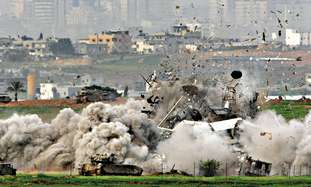
operation cast lead

The latest round of clashes along the Gaza border reminded a number of veterans from the IDF’s Southern Command of the period preceding the abduction of Gilad Schalit in the summer of 2006.

Then too, shortly after the completion of the historic withdrawal from the Gaza Strip in 2005, a period of fighting began mostly along the border: small clashes, involving sporadic gunfire, mortar shelling and Kassam rockets into Sderot. Attacks deeper into the country were rare, mostly since Hamas did not yet have the capability.

All this changed with the abduction of Schalit on June 25, which led Israel back into the Gaza Strip in the first large-scale military operation since the evacuation.

The current round of clashes and escalating violence is also being fought primarily along the border. This time, though, it is not because Hamas or Islamic Jihad are lacking missiles that can hit deep into Israel – on the contrary, they have the Iranianmade Fajr-5, which can strike Tel Aviv – but because, at the moment, they prefer not to use them.

Instead, attacks launched by Hamas and its proxies are aimed at IDF soldiers and positions lining the border, and while neither side is believed to be interested in a large-scale conflict, a devastating attack by either could lead right to it.

One possibility is another kidnapping. In the past few months, the IDF says it has bombed about 15 “terror tunnels,” underground passageways Hamas digs from Gaza to Israel and which it plans to use to either kidnap a soldier or infiltrate a nearby community. The tunnel used by Schalit’s abductors, for example, was just less than a kilometer long.

Some of the Israeli strikes have been against the very same tunnel, which the Palestinians tried to rebuild after it was bombed. But Southern Command sources admitted this week that the number of terror tunnels has grown since before Operation Cast Lead two years ago.

Another possibility was provided on Tuesday when a rocket landed just feet away from an Ashkelon-area kindergarten as parents were dropping off their children. A few feet in the other direction and the IDF would might already be laying siege to Gaza City.

In the absence of such a catalyst, the more likely possibility is that the current escalation will eventually simmer down, but not completely extinguish. The assessment within Southern Command is that Hamas will continue targeting soldiers along the border, but will refrain from attack cities like Ashkelon, Ashdod and Beersheba, favorite targets in the days before Operation Cast Lead.

From an Israeli perspective, the best scenario would be that the relative quiet which has prevailed in Gaza for the past two years will endure. But even Chief of General Staff Lt.-Gen. Gabi Ashkenazi recently admitted that it is possible deterrence has slightly eroded and could require some maintenance.

Hamas, however, prefers to enjoy two different worlds at the same time.

ON THE one hand, this Sunday, Israel will begin implementing its new policy of allowing exports out of Gaza. This move, like the easing of restrictions implemented following the Turkish flotilla fiasco, helps Hamas strengthen its rule and solidify its regime. A large-scale incursion would curtail that process. That is why it does not want to overly provoke Israel.

Another restraint is the continued rehabilitation of its military infrastructure, severely damaged by Cast Lead. While Hamas has obtained long-range rockets and Kornet antitank missiles, it is still working hard on rebuilding and bolstering the defensive measures which were destroyed.

These include the tunnel and bunker systems on the outskirts of Gaza City, which ran for dozens of kilometers, and rocket launcher silos, many of which were destroyed by the air force two years ago.

On the other hand, the Hamas leadership in Gaza is under growing internal pressure, mainly from its military wing, to allow operatives to resume attacks against Israel. This is due to two primary reasons: Hamas fighters are frustrated at not being allowed to fight for two years, and after working hard to smuggle advanced weaponry into Gaza, they want to use it.

There is also Hamas’s feeling that it has been sidelined by the international community and particularly Palestinian Authority President Mahmoud Abbas, who traverses the world as the leader of the Palestinian people gathering signatures for his declaration of independence without even mentioning Hamas or the Gaza Strip. Resuming attacks is a way of getting back on the world’s agenda.

It is also possible that Hamas planned the recent escalation to coincide with personnel changes within the IDF. In October, Maj.-Gen. Tal Russo took the reins of Southern Command and there is also a new Gaza Division commander. In two months, Ashkenazi will be replaced by former OC Southern Command Maj.- Gen. Yoav Galant. Hamas might be thinking that during this transitional period, the IDF will not want to embark on large-scale military operations.

HAMAS HAS come a long way since Cast Lead. Immediately after the operation, military experts from Iran and Lebanon began flocking to the Gaza Strip to assist it in studying its own mistakes and formulating a future battle plan.

Most predictions are that in a future conflict, the IDF will encounter the same difficulties, but in higher numbers.

There will be more underground mines, more booby-trapped homes, more antitank missiles and likely a surface-to-air capability. Hamas has also significantly increased the range of its missiles and will be capable of hitting Tel Aviv.

Some of these capabilities it had during Cast Lead. “They are still in the process of rebuilding and improving their capabilities,” a senior officer in the Gaza Division explained this week.

Judging by the last operation, the challenge in a future large-scale conflict will be in trying to suppress the rocket and missile fire as quickly as possible with more boots on the ground and more firepower. This will be all the more important if Hamas succeeds in hitting Tel Aviv, which will have a major impact on Israeli morale.

At the same time, the IDF has not neglected the public diplomacy effect of a future operation. Just this week, it completed the first course to train civilian liaison officers. Their job will be to assist battalion and brigade commanders in planning operations in Gaza, while taking into consideration the impact they will have on the civilian population.

If Israel can’t avoid Cast Lead II, at least it will try to spare itself a Goldstone II.

U.S. may delay aid for Israel’s anti-rocket system due to budget woes

December 26, 2010

U.S. may delay aid for Israel’s anti-rocket system due to budget woes – Haaretz Daily Newspaper | Israel News.

Delay comes as a result of Obama’s difficulties in pushing next year’s budget through Congress due to Republican opposition.

By Amos Harel

American aid to Israel for developing and buying additional Iron Dome anti-rocket batteries might be delayed for at least a few months due to President Barack Obama’s difficulties in pushing next year’s budget through Congress.

The delay will mean a long wait before the weapons can be bought from Rafael Advanced Defense Systems.

Iron Dome rocket-defense system - Defense Ministry Test of the Iron Dome rocket-defense system on Monday July 19, 2010. The military said the test was highly successful.
Photo by: Defense Ministry

In May, the House of Representatives approved Obama’s decision to grant $205 million in special aid to Israel to buy the additional batteries and intercept missiles. Israel has so far funded the development of only two batteries by Rafael.

Obama has had problems getting the budget passed due to disagreements with the Republicans over health care reform and other issues. So he signed a presidential order outlining the administration’s activities until March 2011.

The order extends the current budget, allowing the administration to spend one-twelfth of the 2010 budget every month until March. But under these circumstances, funding for Iron Dome will have to wait until the annual U.S. budget is approved in March.

Another benefit delayed by the administration’s budget woes is the increase of general defense aid. In June 2008, the Bush administration approved an increase in defense aid to Israel of $3 billion a year for 10 years, up from $2.4 billion. Israel was to have received $3 billion in 2011, but in the meantime it will remain at this year’s level of $2.775 billion.

The problems are expected to be solved within a few months, but they will affect defense officials’ annual planning.

The delay in Washington is not Iron Dome’s only problem. The cabinet has yet to decide on additional funding to buy more Iron Dome batteries. Lacking either Israeli or American funding, no plan or estimated timetable is in place for producing and purchasing the system.

The Israel Air Force has already received the two systems Rafael has made, but they have not yet been declared operational. The IAF reportedly prefers to conduct more tests.

Moreover, all signs indicate that the Israel Defense Forces does not intend to deploy the systems in the western and northern Negev, as politicians had initially indicated. Instead, it is likely to place them on alert at an IAF base in the south.


