Security and Defense: Avoiding Cast Lead II.
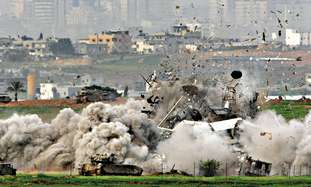
Photo by: kobi gideon
By YAAKOV KATZ
12/24/2010 15:57
Hamas has long-range rockets, and Israel’s deterrence may have eroded, but neither side is interested in another large-scale conflict.
The latest round of clashes along the Gaza border reminded a number of veterans from the IDF’s Southern Command of the period preceding the abduction of Gilad Schalit in the summer of 2006.
Then too, shortly after the completion of the historic withdrawal from the Gaza Strip in 2005, a period of fighting began mostly along the border: small clashes, involving sporadic gunfire, mortar shelling and Kassam rockets into Sderot. Attacks deeper into the country were rare, mostly since Hamas did not yet have the capability.
All this changed with the abduction of Schalit on June 25, which led Israel back into the Gaza Strip in the first large-scale military operation since the evacuation.
The current round of clashes and escalating violence is also being fought primarily along the border. This time, though, it is not because Hamas or Islamic Jihad are lacking missiles that can hit deep into Israel – on the contrary, they have the Iranianmade Fajr-5, which can strike Tel Aviv – but because, at the moment, they prefer not to use them.
Instead, attacks launched by Hamas and its proxies are aimed at IDF soldiers and positions lining the border, and while neither side is believed to be interested in a large-scale conflict, a devastating attack by either could lead right to it.
One possibility is another kidnapping. In the past few months, the IDF says it has bombed about 15 “terror tunnels,” underground passageways Hamas digs from Gaza to Israel and which it plans to use to either kidnap a soldier or infiltrate a nearby community. The tunnel used by Schalit’s abductors, for example, was just less than a kilometer long.
Some of the Israeli strikes have been against the very same tunnel, which the Palestinians tried to rebuild after it was bombed. But Southern Command sources admitted this week that the number of terror tunnels has grown since before Operation Cast Lead two years ago.
Another possibility was provided on Tuesday when a rocket landed just feet away from an Ashkelon-area kindergarten as parents were dropping off their children. A few feet in the other direction and the IDF would might already be laying siege to Gaza City.
In the absence of such a catalyst, the more likely possibility is that the current escalation will eventually simmer down, but not completely extinguish. The assessment within Southern Command is that Hamas will continue targeting soldiers along the border, but will refrain from attack cities like Ashkelon, Ashdod and Beersheba, favorite targets in the days before Operation Cast Lead.
From an Israeli perspective, the best scenario would be that the relative quiet which has prevailed in Gaza for the past two years will endure. But even Chief of General Staff Lt.-Gen. Gabi Ashkenazi recently admitted that it is possible deterrence has slightly eroded and could require some maintenance.
Hamas, however, prefers to enjoy two different worlds at the same time.
ON THE one hand, this Sunday, Israel will begin implementing its new policy of allowing exports out of Gaza. This move, like the easing of restrictions implemented following the Turkish flotilla fiasco, helps Hamas strengthen its rule and solidify its regime. A large-scale incursion would curtail that process. That is why it does not want to overly provoke Israel.
Another restraint is the continued rehabilitation of its military infrastructure, severely damaged by Cast Lead. While Hamas has obtained long-range rockets and Kornet antitank missiles, it is still working hard on rebuilding and bolstering the defensive measures which were destroyed.
These include the tunnel and bunker systems on the outskirts of Gaza City, which ran for dozens of kilometers, and rocket launcher silos, many of which were destroyed by the air force two years ago.
On the other hand, the Hamas leadership in Gaza is under growing internal pressure, mainly from its military wing, to allow operatives to resume attacks against Israel. This is due to two primary reasons: Hamas fighters are frustrated at not being allowed to fight for two years, and after working hard to smuggle advanced weaponry into Gaza, they want to use it.
There is also Hamas’s feeling that it has been sidelined by the international community and particularly Palestinian Authority President Mahmoud Abbas, who traverses the world as the leader of the Palestinian people gathering signatures for his declaration of independence without even mentioning Hamas or the Gaza Strip. Resuming attacks is a way of getting back on the world’s agenda.
It is also possible that Hamas planned the recent escalation to coincide with personnel changes within the IDF. In October, Maj.-Gen. Tal Russo took the reins of Southern Command and there is also a new Gaza Division commander. In two months, Ashkenazi will be replaced by former OC Southern Command Maj.- Gen. Yoav Galant. Hamas might be thinking that during this transitional period, the IDF will not want to embark on large-scale military operations.
HAMAS HAS come a long way since Cast Lead. Immediately after the operation, military experts from Iran and Lebanon began flocking to the Gaza Strip to assist it in studying its own mistakes and formulating a future battle plan.
Most predictions are that in a future conflict, the IDF will encounter the same difficulties, but in higher numbers.
There will be more underground mines, more booby-trapped homes, more antitank missiles and likely a surface-to-air capability. Hamas has also significantly increased the range of its missiles and will be capable of hitting Tel Aviv.
Some of these capabilities it had during Cast Lead. “They are still in the process of rebuilding and improving their capabilities,” a senior officer in the Gaza Division explained this week.
Judging by the last operation, the challenge in a future large-scale conflict will be in trying to suppress the rocket and missile fire as quickly as possible with more boots on the ground and more firepower. This will be all the more important if Hamas succeeds in hitting Tel Aviv, which will have a major impact on Israeli morale.
At the same time, the IDF has not neglected the public diplomacy effect of a future operation. Just this week, it completed the first course to train civilian liaison officers. Their job will be to assist battalion and brigade commanders in planning operations in Gaza, while taking into consideration the impact they will have on the civilian population.
If Israel can’t avoid Cast Lead II, at least it will try to spare itself a Goldstone II.






 anneinpt
 artaxes
 danmillerinpanama
 davidking1530
 Peter Hofman
 Joseph Wouk
 Peter
Peter Louisiana Steve
 WarSclerotic
Recent Comments