Archive for November 2010

Iran blames Israel after nuclear scientist killed

November 30, 2010

Iran blames Israel after nuclear scientist killed.

By ALI AKBAR DAREINI

The Associated Press
Monday, November 29, 2010; 5:01 PM


TEHRAN, Iran — Iran’s president accused Israel and the West of being behind a pair of daring bomb attacks that killed one nuclear scientist and wounded another in their cars on the streets of Tehran on Monday. He also admitted for the first time that a computer worm had affected centrifuges in Iran’s uranium enrichment program.

Mahmoud Ahmadinejad and other Iranian officials vowed that the nuclear program would not be hampered by what they described as a campaign to sabotage it – whether by assassination or by the computer virus. The United States and its allies say Iran is seeking to build a nuclear bomb, a claim Tehran denies.

The two bomb attacks occurred when assailants on motorcycles attached magnetized bombs to the cars of two nuclear scientists as they drove to work in separate parts of the capital Monday morning. They detonated seconds later, killing one scientist, wounding another and wounding each of their wives, who were in the cars, Tehran’s police chief said.

At least two other Iranian nuclear scientists have been killed in recent years, one of them in an attack similar to Monday’s.

The wounded scientist, Fereidoun Abbasi, is on a list of figures suspected of links to secret nuclear activities in a 2007 U.N. sanctions resolution, which puts a travel ban and asset freeze on those listed. The resolution describes him as a Defense Ministry scientist who works closely with Mohsen Fakhrizadeh, believed to head secret nuclear projects. Iranian media said he was a member of the Revolutionary Guard, Iran’s strongest military force.

Majid Shahriar, the scientist killed in the bombing, was involved in a major project with Iran’s nuclear agency, said the agency’s chief, Vice President Ali Akbar Salehi, though he did not give specifics.

“Undoubtedly, the hand of the Zionist regime and Western governments is involved in the assassination,” Ahmadinejad told a press conference. He said the attack would not hamper the nuclear program.

ad_icon

Salehi, who was a former teacher of the slain scientist, wept as he went on state TV later to talk of the killing. “They (Iran’s enemies) are mistaken if think they can shake us,” he said.

Asked about the Iranian accusations, Israeli government spokesman Mark Regev said Israel did not comment on such matters. In Washington, U.S. State Department spokesman P.J. Crowley said, “We decry acts of terrorism, wherever they occur. And beyond that, we do not have any information on what happened.”

Meanwhile, Ahmadinejad also acknowledged for the first time that a computer worm affected centrifuges in Iran’s uranium enrichment program, which the United Nations has demanded Tehran halt.

Iran has previously acknowledged discovering the Stuxnet worm, which experts say is calibrated to destroy centrifuges by causing them to spin out of control, at its nuclear facilities. But Iranian officials – including Salehi – said it was discovered and neutralized before it could cause any damage, and they accused the West of trying to sabotage Iran’s program.

But Ahmadinejad told reporters, “They managed to create problems for a limited number of our centrifuges through the software … installed on electronic parts. But this (virus) was discovered and the problem was resolved.”

He said Iranian experts had learned from the attempt and “this became an experience that stops the path for (sabotage) forever.”

Earlier in November, U.N. inspectors found Iran’s enrichment program temporarily shut down, according to a recent report by the U.N. nuclear watchdog. The length and cause of the shutdown were not known, but speculation fell on Stuxnet.

Iran’s enrichment program is of international concern because the process can create both fuel for an electricity-generating reactor and nuclear warhead material. Iran insists it wants to enrich only to run a nuclear reactor network.

The latest attacks come a day after the release of internal U.S. State Department memos by the whistle-blower website WikiLeaks, including several that vividly detail Arab fears over Iran’s nuclear program. In some memos, U.S. diplomats say Arab leaders advocated a U.S.-led attack on Iranian nuclear facilities.

Ahmadinejad dismissed the leaks as “mischief” aimed at damaging Tehran’s ties with the Arab world.

Monday’s bombings bore close similarities to another in January that killed Tehran University professor Masoud Ali Mohammadi, a senior physics professor. He was killed when a bomb-rigged motorcycle exploded near his car as he was about to leave for work.

In 2007, state TV reported that nuclear scientist, Ardeshir Hosseinpour, died from gas poisoning. A one-week delay in the reporting of his death prompted speculation about the cause, including that Israel’s Mossad spy agency was to blame.

There are several active armed groups that oppose Iran’s ruling clerics, but it’s unclear whether they could have carried out the apparently coordinated bombings in the capital. Most anti-government violence in recent years has been isolated to Iran’s provinces such the border with Pakistan where Sunni rebels are active and the western mountains near Iraq where Kurdish separatists operate.

ad_icon

Tehran police chief Hossein Sajednia said no one has been arrested in connection with Monday’s attack and no one has so far claimed responsibility.

The bombings both took place in the morning, in locations in north and northeast Tehran that lie about a 15-minute drive apart, without traffic. There were conflicting reports on what time each attack took place.

The slain scientist, Shahriari, was a member of the nuclear engineering faculty at Shahid Beheshti University in Tehran and cooperated with the Atomic Energy Organization of Iran, said Salehi, who heads the organization.

“He was involved in one of the big AEOI projects, which is a source of pride for the Iranian nation,” Salehi said, according to IRNA, without giving any details on the project. The AEOI is in charge of Iran’s nuclear activities, including its uranium enrichment program.

A pro-government website, mashreghnews.ir, said the wounded scientist, Abbasi, is a Revolutionary Guard member who is a laser expert at Iran’s Defense Ministry and one of few top Iranian specialists in nuclear isotope separation – a process needed for a range of purposes, from producing enriched uranium fuel for a reactor, to manufacturing medical isotopes to producing a bomb.

Alan Dershowitz: There Will Never Be Peace if Iran Gets the Bomb

November 29, 2010

Alan Dershowitz: There Will Never Be Peace if Iran Gets the Bomb.

Now that the WikiLeaks reveal widespread Arab support for the military option against Iran’s nuclear facilities to be put on the table, the time has come to reassess United States policy toward the Ahmadinejad regime.

Even if Israel freezes settlement building, the Palestinians come to the negotiating table and an agreement is reached about borders, refugees and Jerusalem, there will still be no real peace in the Middle East — if Iran continues on its determined path toward developing deliverable nuclear weapons. And despite noble efforts by the United States to bring Israel and the Palestinians to the peace process, the inability to achieve a real peace will be largely the fault of the deeply flawed American policy toward Iran.

The policy of the United States seems to be that a nuclear Iran is inevitable, that sanctions may delay but not prevent the Iranians from developing the bomb, and that a policy of containment is the best we can hope for. But containment is not a policy; it is an admission of failure. A nuclear Iran cannot be contained, because it operates largely through surrogates such as Hezbollah, Hamas and other terrorist groups. It can direct these surrogates to take actions that do not leave Iranian fingerprints. Currently these actions are limited to Hezbollah aiming rockets at Israel’s heartland and Hamas firing improvised rockets at Israeli civilians. If these groups — which oppose any peace with Israel — could operate under the protection of an Iranian nuclear umbrella, they would constantly provoke retaliatory and preventive military actions. These actions might well force the Palestinian Authority to violate agreements they made with Israel. Moreover, an Israeli population constantly under the threat of a nuclear Holocaust from a nation whose leader has called for Israel to be wiped off the map may demand that preventive military action be taken. Any such action by Israel would provoke an immediate response from Hezbollah and Hamas, if not from the Palestinian Authority.

Nor would a nuclear Iran limits its mischief to Israel. Now that it has obtained medium range ballistic missiles from North Korea, it might feel adventurous enough to export nuclear terrorism to other parts of the Middle East, North Africa and Europe. President Barack Obama understated the threat when he said that a nuclear Iran would be “a game changer.” It would be unmitigated disaster, threatening world peace, putting an end to any hope of nuclear non-proliferation, and engendering the greatest arms race in modern history.

The fault for this disaster would be equally shared by the Bush and the Obama administrations. Under George Bush’s watch, the United States issued its notorious National Security Estimate of November 2007, which essentially denied that Iran was seeking to develop nuclear weapons. This report was known to be false at the time it was issued since American intelligence became aware of the nuclear weapons facility at Qum before the report was issued. The publication of this report sent a powerful message to Iran: The Americans have fallen for your bait and switch game in which you hide your capacity to develop nuclear weapons under the cover of purported civilian use. This has encouraged the Iranians to move full-throttle ahead on their program. At the same time the Bush Administration changed Israel’s green light to yellow and then to red, as it related to United States approval of an Israeli strike against Iran’s nuclear facilities. The end result was that Iran felt no real constraints on continuing to develop its nuclear weapons capacity in a pretextual civilian context.

The Obama administration appears to have taken any military option off the table, relying instead on its enhanced package of sanctions. Secretary of Defense Gates has been explicit about this and the Iranians have been listening. It makes absolutely no sense to take the military option off the table, even — perhaps especially — if one is reluctant to deploy it. As George Washington taught us in his first address to Congress: “To be prepared for war is one of the most effectual means of preserving peace.” Israel’s Prime Minister echoed President Washington when he recently said, “The simple paradox is this: If the international community, led by the United States, hopes to stop Iran’s nuclear program without resorting to military action, it will have to convince Iran that it is prepared to take such action.” What is it that American policymakers don’t seem to understand about this self-evident proposition?

The man most responsible for both the Bush and Obama administration’s failure with regard to Iran is Secretary of Defense Robert Gates, whose tenure has straddled both the issuance of the false National Security Estimate and the decision to take the military option off the table. He is Iran’s favorite American facilitator. Although he soon plans to leave office, there are no signs — certainly none visible to Iran — that his failed policies with regard to Iran’s nuclear program will end with his too long tenure.

The Biblical prophet cautioned “peace, peace and there is no peace.” This tragic prophecy will become a sad reality if Israel and the Palestinian Authority make great sacrifices in an effort to bring peace to their people, only to see that peace shattered by a short-sighted American policy that allows Iran to hold a nuclear sword of Damocles over the entire region.

Professor Alan Dershowitz’s latest book is a novel, The Trials of Zion.

US Embassy Cables from Tel Aviv, “Israeli Intentions regarding the Iranian Nuclear Program”

November 29, 2010

US Embassy Cables from Tel Aviv, “Israeli Intentions regarding the Iranian Nuclear Program”.

Reference ID Date Classification Origin
05TELAVIV1593 2005-03-17 14:02 SECRET Embassy Tel Aviv
This record is a partial extract of the original cable.  The full text of the original cable is not available.
S E C R E T SECTION 01 OF 03 TEL AVIV 001593SIPDIS 

E.O. 12958: DECL: 03/14/2015
TAGS: PARM PREL MNUC KNNP EU IR IS GOI EXTERNAL
SUBJECT: C-NE4-01083: ISRAELI INTENTIONS REGARDING THE
IRANIAN NUCLEAR PROGRAM

REF: STATE 26053

Classified By: Ambassador Daniel C. Kurtzer; Reasons: 1.4 (B) and (D).

¶1. (S) SUMMARY:  Israel sees Iran as the primary threat to its security and sees the enrichment cycle as the “point of no return” for Tehran’s nuclear weapons program.  The GOI believes that diplomatic pressure with teeth, such as sanctions, can affect Iranian behavior, and is lobbying the EU-3 and IAEA on details of a permanent suspension agreement.  The Israelis support a unified international front but are concerned that the USG may move toward the EU position.  Despite the GOI’s focus on the diplomatic track, public and private speculation about possible Israeli air strikes continues.  In weighing the military options, the GOI is aware of significant differences from its successful strike against Iraq’s nuclear program in 1981, including an uncertain and dispersed target set, the presence of coalition forces in Iraq and the Gulf, Iranian capabilities to retaliate through Hizballah and terrorism, and the changed strategic environment.  END SUMMARY.

————————————————————————-
The Iranian Threat, “Point of No Return,” and Timelines
————————————————————————-

¶2. (S) PM Sharon calls Iran “the main threat to Israel” and has recently expressed concern that some states are “getting used to” the idea of Iran obtaining nuclear weapons.  Other senior Israeli officials echo this, cautioning that Tehran’s nuclear weapons program poses what Mossad Chief Meir Dagan calls an “existential threat” that alters the strategic balance in the region.

¶3. (C) In a meeting with congressional visitors in December, Defense Minister Shaul Mofaz described operation of the enrichment cycle as the “point of no return” for the Iranian program, a view shared by many senior GOI officials.  Mossad Chief Dagan went a step further, saying that the Iranian program will be unstoppable once it no longer requires outside assistance to complete the enrichment process.  At the technical level, the director for external affairs at the Israel Atomic Energy Commission (IAEC) told poloff that the critical step would be Iran’s operation of a centrifuge enrichment cascade.

¶4. (S) GOI officials have given different timelines for when they believe Iran will have full enrichment capability.  In February, PM Sharon told the Secretary that he believes there is still time remaining to pressure Iran, but that the window of opportunity is closing quickly.  DefMin Mofaz cautioned that Iran is “less than one year away,” while the head of research in military intelligence estimated that Iran would reach this point by early 2007.  Technical experts at the IAEC predicted that Iran would have enrichment capability within six months of the end of the suspension agreement.  A few GOI officials admitted informally that these estimates need to be taken with caution.  The head of the MFA’s strategic affairs division recalled that GOI assessments from 1993 predicted that Iran would possess an atomic bomb by 1998 at the latest.

—————————————————————–
Focus on Diplomacy and Concern with the EU-3
—————————————————————–

¶5. (S) In the near term, Israel is focused on maintaining diplomatic pressure on Iran to cooperate with the IAEA and EU-3.  Sharon defines diplomatic pressure to include UNSC sanctions, e.g. on Iran’s airlines and trade, as noted below.  President Katsav has said that Tehran is “very conscious of international opinion.”  Other MFA and NSC officials point to the current suspension and to Iranian reaction to the Mykonos case as proof that diplomatic pressure can affect decision-making in Tehran.

¶6. (S) The Israelis often express disappointment with EU-3 efforts, but see no real alternative at this time.  PM Sharon told reporters on March 10 that Iran uses the negotiations to “play for time.”  In private, Sharon, his Cabinet, and military leaders have all complained that the Europeans are “too soft.”  Similarly, President Katsav has cautioned that Iran will “cheat” on any commitments it makes.  MFA staff told poloff that they do not believe that the EU-3 effort will be successful in obtaining a permanent suspension or that the Europeans will support effective sanctions against Iran.

¶7. (C) GOI technical experts said they have been lobbying the Europeans and IAEA on several issues.  First, the GOI would like a clearer and more detailed listing of all activities covered by the suspension, along with timelines for each step.  Second, they want more robust verification measures and greater focus on Iran’s denial of access to IAEA inspectors.  Third, the Israelis insist that any final agreement must be endorsed by the UNSC to ensure that noncompliance will be dealt with at an appropriate level.  Fourth, Israel is pushing the EU-3 to define benchmarks that would signal a failure of the process, and to identify the concrete consequences of such failure.

¶8. (C) According to the IAEC, the GOI has urged the Europeans to examine bilateral or EU sanctions with small, but noticeable, economic impacts.  After telling the press on March 10 that “it would probably not be advisable to impose an oil embargo on Iran,” PM Sharon advocated trade and flight restrictions.  Lower-level GOI officials said these steps could include restrictions on Iranians studying in Europe, limitations on travel by Iranian scientific personnel, and suspension of landing privileges for Iranian airlines within the EU.  The goal, according to the deputy NSA for foreign affairs, is unified pressure from the EU, Russia, and U.S. for a “complete, full, verifiable cessation of the fuel cycle program.”  In the short term, this means a full suspension of all enrichment, reprocessing, heavy-water-reactor construction, and related R&D activities.

——————————————————————–
Israeli Preference for USG and UNSC Involvement
——————————————————————–

¶9. (C) In light of their uneasiness with EU-3 efforts, the Israelis are hoping for robust U.S. involvement and action by the UNSC.  PM Sharon has urged the EU-3 to continue its efforts, but also stressed the importance of preparing to take Iran to the UNSC.  In a meeting with a CoDel on December 12, DefMin Mofaz pushed for the U.S. to take the lead with the Europeans and pursue all diplomatic solutions, including sanctions.  President Katsav asked the Secretary not to “wait for the Europeans.”

¶10. (C) This desire for U.S. activity is amplified by the extremely limited options open to Israel on the diplomatic front.  The IAEC’s director for non-proliferation admitted that the GOI sees “little we can do” to increase pressure on Iran as long as Tehran abides by the suspension agreement.  The MFA’s office director for the Gulf states said that Israel would maintain its low-profile diplomatic activities, such as supplying IAEA members with intelligence material related to the Iranian program.  She said the MFA believes that any overt Israeli pressure would backfire, leading to a surge of Arab support for Iran and focusing attention on Israel’s own nuclear activities.

¶11. (C) Following the recent announcements on Iran by the President and the Secretary, several Israeli officials asked if the USG is shifting its policy on Iran.  The deputy NSA for foreign affairs acknowledged that the U.S. move is probably necessary to build international consensus for taking Iran to the UNSC.  At the same time, he expressed concern that the USG would be influenced by what he called the EU’s habit of granting concessions to Iran prior to full compliance.  Mid-level staffers at the NSC and IAEC were also disquieted by U.S. press reports claiming that the USG is re-examining its position on Hizballah.

——————————————————–
The Military Option: Bushehr is not Osirak
——————————————————–

¶12. (S) Despite frustrations with diplomatic efforts, Israeli officials are understandably reluctant to discuss possible military options.  In public, PM Sharon has stressed the importance of the “political and economic” track.  During a recent discussion with a visiting USG official, IDF Deputy Chief of Staff (and CoS-designate) Major General Dani Haloutz similarly said “we don’t want to go there.”  In February, President Katsav told the Secretary that “the military option is not necessary — bring the issue to the Security Council.”

¶13. (S) Public speculation about possible military strikes usually focuses on the differences from the Israeli Air Force’s attack on Iraq’s Osirak reactor in 1981.  In private, GOI officials have acknowledged that several factors would make any attack against Iran a much more difficult mission.  A senior military intelligence official told the Embassy that the GOI does not know where all of the targets are located and said that any attack would only delay, not end, the Iranian program.  The MFA’s office director for the Gulf states noted that potential target sites are well dispersed throughout the country, with several located in built-up civilian areas.  The IAEC stressed the importance of Russian assistance in restraining Iran’s nuclear ambitions and said that any attack on Bushehr would likely result in Russian casualties and endanger Moscow’s cooperation.

¶14. (C) MFA contacts said that the distance to the targets and the presence of U.S. forces in Iraq and the Gulf raise additional complications.  An Israeli assault would necessitate prior coordination with coalition forces in Iraq, they maintained, leaving the USG open to retaliation throughout the Islamic world, especially in Iraq.  MFA and NSC officials acknowledged that any attack would also elicit a strong response from Arab states and the Palestinians, effectively freezing the peace process.

¶15. (C) The Israelis realize that Iran would use any military strike as an excuse to cease cooperation with the EU-3 and the IAEA.  In addition, the GOI is acutely aware of Iran’s ability to retaliate, both militarily and through attacks by its regional surrogates.  PM Sharon has claimed that Hizballah has 11,000 rockets (and possibly UAVs) capable of reaching Israel from launching sites in Lebanon.  The MFA’s office director for the Gulf states said that she believed that Iran would retaliate by inciting terrorist groups in Israel and the Occupied Territories.

¶16. (C) Current USG, EU-3, and IAEA focus on Iran also creates a situation that differs from 1981, when the Israelis felt that the international community was ignoring the Iraqi threat.  Israelis hope that the others will solve the Iranian problem for them, or as Vice PM Shimon Peres has said, “I do not think that the matter of Iran needs to be turned into an Israeli problem — it is a matter of concern for the whole world.”

—————————————————————-
Comment: Diplomatic Solution Preferred, but …
—————————————————————-

¶17. (S) COMMENT: The Israelis are focusing on diplomatic channels in the IAEA and EU-3, and appear to have very real concerns about the feasibility of military strikes against the Iranian nuclear program.  Nevertheless, the GOI has shown time and again that it will act militarily if it believes that its security is threatened, and the IDF is most certainly keeping contingency plans up to date.  The Israeli press reported that in February PM Sharon’s Security Cabinet had given “initial authorization” for an attack on Iran.  The press reports cited an unnamed “Israeli security source,” who claimed that the USG would “authorize” an Israeli attack.  Post notes that it may not be possible to detect preparations for any military strike.  Air defense operations would pose nearly perfect cover for civil defense and Air Force activities preceding any attack.  Due to both the extreme sensitivity of the issue and the GOI’s near inability to prevent leaks, any attack order would be closely held, probably even from many members of PM Sharon’s Cabinet.

¶18. (C) COMMENT CONTINUED: The GOI knows that we share its interest in preventing Iran from obtaining nuclear weapons.  Nevertheless, we should expect continued Israeli lobbying at the highest levels urging the USG to ensure that the EU-3 effort is on track and backed by a solid international front.  We will also hear Israeli concerns that the U.S. position may move toward the EU stance.  At the same time, we should recognize that Israeli intelligence briefings will understandably focus on worst-case scenarios and may not match current USG assessments.

********************************************************************
Visit Embassy Tel Aviv’s Classified Website:
http://www.state.sgov.gov/p/nea/telaviv

You can also access this site through the State Department’s Classified SIPRNET website.
*********************************************************************
KURTZER

* * *

Excerpts from Other US Embassy Cables
about the Israeli Intentions

CODEL ACKERMAN’S MEETING WITH OPPOSITION LEADER BINYAMIN NETANYAHU: ECONOMIC SQUEEZE ON IRAN AND HAMAS; SCENARIOS FOR A NEW GOVERNMENT; RIGHT OF RETURN AS ACID TEST OF ARAB INTENTIONS

Reference ID Date Classification Origin
07TELAVIV1114 2007-04-18 06:06 CONFIDENTIAL Embassy Tel Aviv
Toppling Ahmadinejad
——————————
¶3.  (C) Representative Ackerman told Netanyahu that in his meeting the day before with Egyptian President Mubarak, he had asked Mubarak if military action were necessary to prevent Iran from obtaining a nuclear weapon, should the strike be carried out by the U.S. or Israel?  Mubarak had responded that if it came to that, the U.S. should do it and Israel should stay out.  Netanyahu said he took Mubarak’s point, but commented that he thought the Iranian regime, or at least President Ahmadinejad, could be toppled by economic pressure, including a divestment campaign.  Noting that economic sanctions lose their effect over time, but can be powerful in the short term.  The goal should be to encourage Ahmadinejad’s political rivals to remove him from power.  Afterward, if the pressure could be maintained it might be possible to bring down the entire Iranian regime, but that would also entail identifying alternative leaders.  The idea was to use economic pressure to create a public sense of regime failure.  Netanyahu said he had consulted with noted historian Bernard Lewis, who believed that Iran would be less dangerous once Ahmadinejad was removed. 

¶4.  (C) Netanyahu said there were three bills in Congress designed to divest U.S. pension funds from investing in about 300, mostly European, companies currently doing business in Iran.  Divestment would immediately bring down the credit ratings of these companies, thus forcing them to respond.  Netanyahu urged Congress to support the divestment legislation, adding that he also planned to use a visit to the U.S. to raise the issue with Wall Street fund managers.  His approach was to tie in Darfur to expand the scope of anti-genocide divestment and link it to U.S. policy goals.  Netanyahu said he was unsure that financial pressures would be enough to stop Iran’s nuclear program, but he was confident they would succeed in bringing down Ahmadinejad.  He commended Dore Gold’s efforts to put Ahmadinejad on a genocide watch list as part of a broader effort to delegitimize the Iranian President.  Asked about the quality of U.S. and Israeli intelligence on Iran, Netanyahu said his nightmare was that we had missed part of the Iranian program.  He added that if the current intelligence was correct, it would take Iran a few more years to develop a nuclear weapon.  He agreed with Ambassador Jones’ assessment that Ahmadinejad’s announcement of a breakthrough in Iran’s centrifuge program was probably exaggerated.  It would be critical, Netanyahu stressed, to target companies investing in Iran’s energy sector.

Ambassador Richard H. Jones

07TELAVIV2652, U/S BURNS’ AUGUST 17 MEETING WITH ISRAELI MOSSAD CHIEF MEIR DAGAN

Reference ID Date Classification Origin
07TELAVIV2652 2007-08-31 12:12 SECRET Embassy Tel Aviv
————————————————————————————-
IRAN: DAGAN REVIEWS ISRAEL’S FIVE PILLAR STRATEGY
————————————————————————————-¶10. (S) Dagan led discussion on Iran by pointing out that the U.S. and Israel have different timetables concerning when Iran is likely to acquire a nuclear capability.  He clarified that the Israel Atomic Energy Commission’s (IAEC) timetable is purely technical in nature, while the Mossad’s considers other factors, including the regime’s determination to succeed.  While Dagan acknowledged that there is still time to “resolve” the Iran nuclear crisis, he stressed that Iran is making a great effort to achieve a nuclear capability: “The threat is obvious, even if we have a different timetable.  If we want to postpone their acquisition of a nuclear capability, then we have to invest time and effort ourselves.” 

¶11. (S) Dagan described how the Israeli strategy consists of five pillars:

A) Political Approach: Dagan praised efforts to bring Iran before the UNSC, and signaled his agreement with the pursuit of a third sanctions resolution.  He acknowledged that pressure on Iran is building up, but said this approach alone will not resolve the crisis.  He stressed that the timetable for political action is different than the nuclear project’s timetable.

B) Covert Measures: Dagan and the Under Secretary agreed not to discuss this approach in the larger group setting.

C) Counterproliferation: Dagan underscored the need to prevent know-how and technology from making their way to Iran, and said that more can be done in this area.

D) Sanctions: Dagan said that the biggest successes had so far been in this area.  Three Iranian banks are on the verge of collapse.  The financial sanctions are having a nationwide impact.  Iran’s regime can no longer just deal with the bankers themselves.

E) Force Regime Change: Dagan said that more should be done to foment regime change in Iran, possibly with the support of student democracy movements, and ethnic groups (e.g., Azeris, Kurds, Baluchs) opposed to the ruling regime.

Ambassador Richard H. Jones


The US embassy cables above, first released by WikiLeaks, are available at <cablegate.wikileaks.org/cable/2005/03/05TELAVIV1593.html>; <cablegate.wikileaks.org/cable/2007/04/07TELAVIV1114.html>; <cablegate.wikileaks.org/cable/2007/08/07TELAVIV2652.html>.  Other cables about Iran may be viewed at <cablegate.wikileaks.org/tag/IR_1.html>

WikiLeaks builds case against Iran – CNN.com

November 29, 2010

WikiLeaks builds case against Iran – CNN.com.

By David Frum, CNN Contributor
November 29, 2010 12:38 p.m. EST

Washington (CNN) — Some say that the WikiLeaks document dump has embarrassed the United States government.

Agreed — it is probably no fun to be the U.S. official in charge of calling Italian Prime Minister Berlusconi to admit that our government noticed his Russian business dealings.

But here’s who really should be embarrassed:

• Those who pooh-poohed George W. Bush’s “axis of evil.” WikiLeaks confirms that Iran and North Korea have for years been sharing weapons technology.

• Those who suggest that it’s some “Israel lobby” or Jewish cabal that is driving the confrontation with Iran. WikiLeaks confirms that the region’s Arab governments express even more anxiety than Israel about the Iranian nuclear weapons program.

WikiLeaks: Public has ‘right to know’

Rubin: WikiLeaks an ‘attack’ on govt.

Dept. of Justice statement on WikiLeaks

Ahmadinejad: Leaked info not valuable

• Those who have condemned Israel for inspecting or impeding Red Crescent ambulances. WikiLeaks confirms that during the 2006 Lebanon war, Iran smuggled weapons to Hezbollah in Red Crescent vehicles, including ambulances.

• Those who have appeased Red Crescent demands that Israel’s Red Magen David be excluded from international Red Cross organizations. The Red Crescent has been thoroughly penetrated by the Iranian Revolutionary Guards and is regularly used as a tool of Iranian foreign policy.

• Those who lamented that Israel’s interception of the Turkish blockade-runner Mevi Marmara would alienate Turkey as a key U.S. ally: The U.S. government itself has for years regarded the Turkish government as trending on its own impetus toward anti-Western Islamist radicalism.

• Those who look blank-faced at the origin of cyber-attacks on Google and other crucial U.S. networks. WikiLeaks documents U.S. awareness that at least one cyber-attack on Google was ordered at the highest levels of the Chinese government.

This is not to deny that WikiLeaks has done enormous harm. The leakers or hackers or whoever it was who obtained and published this information have put individual lives at risk. Toby Harnden of the Telegraph notes that one of the released documents names a U.S. informant in the region. The document identifies him as a U.K.-educated engineer from a prominent pre-revolution Isfahan family who once owned a large factory in Iran and is a former national fencing champion of Iran, a former president of the Iran Fencing Association and a former vice president of an Azerbaijan sports association. Harnden aptly asks: How many such persons do you think are out there?

But here’s the ghastliest irony of the leak. If it was Julian Assange’s intention to use information hacked from U.S. computer systems to protect Iran from U.S. military action, he has very likely massively failed at his own purpose.

The leak makes military conflict between Iran and the United States more likely, not less. The leak has changed the political equation in ways that reduce the restraint on U.S. policy.

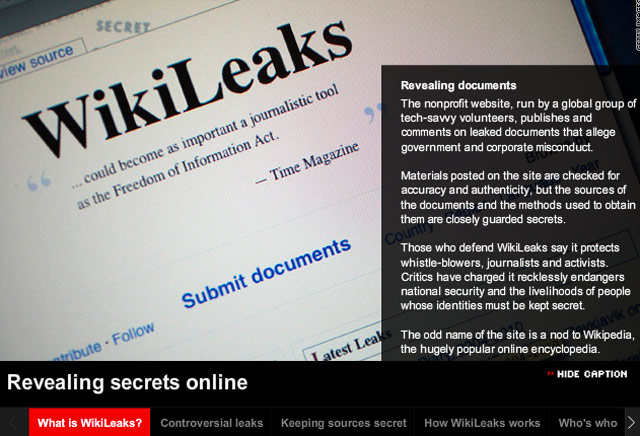
Revealing secrets online

Public opinion in all U.S.-allied countries can now see that the dread of the Iranian nuclear program is not some artificial emotion whipped up by Israel, but a widespread fear among Arab and European governments. It’s Iran’s Gulf neighbors who have begged most urgently that the United States hit Iran’s nuclear sites.

Iranian recklessness and duplicity has been widely publicized — as has Iran’s contemptuous rejection of all diplomatic approaches.

President Obama’s hand has been strengthened inside the United States. Members of Congress can see the intimate details of the administration’s determined effort to restrain Iran by peaceful means. And they can see in equally intimate detail that the effort has failed, and failed entirely because of Iran’s obduracy.

If any doubt remains that a nuclear Iran would massively destabilize the region, WikiLeaks alleviates it: It’s there in black and white, according to Israeli sources, that Saudi Arabia would seek a nuclear weapon. And it’s a good question whether an increasingly anti-Western Turkey would likely soon pursue a nuclear weapon too.

I am not saying that a U.S. attack on Iran has suddenly become likely. Just that it has become more politically feasible than it was 72 hours ago.

The opinions expressed in this commentary are solely those of David Frum.

‘By Whatever Means Necessary’: Arab Leaders Want Iran Stopped – Raymond Bonner – Politics – The Atlantic

November 29, 2010

‘By Whatever Means Necessary’: Arab Leaders Want Iran Stopped – Raymond Bonner – Politics – The Atlantic.

LONDON — Rather than prosecuting Julian Assange for what he calls his “outrageous, reckless, and despicable” action in leaking thousands of sensitive government cables, Joe Lieberman might want to consider praising the head of WikiLeaks. He might find a chorus of support from all the ardent Israel supporters, whether Republican, Democrat, or Tea Party, arch conservative or screaming leftist. For one thing that emerges from the latest WikiLeaks cache is that Israel is, as Jeffrey Goldberg notes, not alone in wanting decisive action to stop Iran’s nuclear program.
Sure, we knew that Middle East governments were concerned about Iran. But we didn’t know to what degree. The cumulative impact of these cables is profound.
King Abdullah of Saudi Arabia, the largest, wealthiest, and among the most conservative Middle East nations, made “frequent exhortations to the US to attack Iran and so put an end to its nuclear weapons program,” the American embassy in Riyadh reported in April 2008. “He told you to cut off the head of the snake,” one of the King’s aides reminded the American ambassador to Iraq Ryan Crocker and Gen. David Petraeus when they were in the kingdom for a two day visit.
From tiny Bahrain, King Hamid, in a meeting with Gen. Petraeus seven months later, said that Iran was the source for much of the trouble in Iraq and Afghanistan. “He argued forcefully for taking action to terminate their nuclear program, by whatever means necessary,” according to a leaked cable from the American embassy there. “That program must be stopped,” the King told Gen. Petraeus. “The danger of letting it go on is greater than the danger of stopping it.”
This the same chilling language, which the American public is accustomed to hearing from hardline Israeli officials. Hearing it expressed by Muslim leaders in the Middle East might now have a profound effect on American public opinion.
And it goes on.
Invaded by Iraq in 1990, Kuwait is not stranger to threat from its larger neighbors. Its Interior Minister sounded the alarm about Iran, telling the American ambassador that Iran is intent on exporting Islamic extremism, “and will only be deterred from achieving its objectives — including a nuclear weapons capability — by force,” the embassy reported. “The U.S. will not be able to avoid a military conflict with Iran, if it is serious in its intention to prevent Tehran from achieving a nuclear weapons capability.”
Back during the Bush Administration, Abu Dhabi Crown Prince Sheikh Mohammed bin Zayed, in a meeting with CENTCOM Commander General Abizaid, said he “was strongly in favor of taking action against Iran and its president sooner rather than later,” the embassy reported. “I believe this guy is going to take us to war …. It’s a matter of time,” the embassy reported bin Zayed said. He wanted action “this year or next year.” It didn’t happen, of course, at least not in a public way. (One assumes, and maybe even hopes, that the CIA is earning its pay these days, with covert programs designed to slow down, if not halt, Iran’s nuclear program).
In Iran on Monday, a nuclear physicist was killed and another badly injured in an attack by men on motorcycles. President Mahmoud Ahmadinejad promptly blamed “the hand of the Zionist regime and Western governments.”
The attack was predictable — and prior to today, we’d have easily accepted Ahmadinejad’s explanation. But what we know now, after the WikiLeaks drop, raises the real possibility that it could have been Saudi Arabia, or UAE, or Kuwait. In many ways, those governments are more likely suspects: easier for one of those countries to have infiltrated, or recruited, and less likely to be caught, because they could be confident Iran would blame Israel or the United States.

Iran admits cyber attack on nuclear plants | Reuters

November 29, 2010

Iran admits cyber attack on nuclear plants | Reuters.

TEHRAN | Mon Nov 29, 2010 1:36pm EST

TEHRAN (Reuters) – Iran admitted Monday that its controversial uranium enrichment centrifuges had been affected by a malicious computer virus, as reported by Western diplomats last week.

Hours earlier, car bombs killed a top Iranian nuclear scientist in Tehran and wounded another.

Both events may color a resumption of talks on nuclear issues next week with the five permanent members of the U.N. Security Council and Germany.

President Mahmoud Ahmadinejad told a news conference Iran would attend the talks on December 5, but restated its position that its uranium enrichment program, which it says is purely for power generation, was not negotiable.

Major Western powers as well as Israel and Russia have become increasingly concerned that Iran’s program may soon give it the capacity to build and launch a nuclear bomb, despite four rounds of U.N. sanctions.

Israel and the United States have not ruled out pre-emptive military strikes. But the emergence of Stuxnet, which some experts believe was aimed specifically at Iran’s nuclear installations, shows Tehran’s foes may no longer be restricted to conventional diplomatic and military options.

CENTRIFUGE PROBLEMS

Ahmadinejad did not specify whether he was referring to the Stuxnet virus identified by Western security experts, but said:

“They succeeded in creating problems for a limited number of our centrifuges with the software they had installed in electronic parts. But the problem has been resolved.”

International talks on Iran’s nuclear program have made little or no progress and been stalled for more than a year.

Russia’s RIA news agency quoted Iran’s ambassador to Moscow as saying the latest round would be held in Geneva.

Ahmadinejad said Iran was ready to discuss nuclear cooperation and international problems, but not enrichment.

“The complete enrichment cycle and the production of fuel are basic rights of (IAEA) member states and are non-negotiable,” Ahmadinejad said.

A senior Western diplomat in Tehran whose country is involved in the talks said no major breakthrough was expected.

“Iran has always tried to evade pressure by expressing its readiness for talks. But we want to discuss sensitive issues like enrichment,” the diplomat told Reuters on condition of anonymity.

Ahmadinejad: US planned Wikileaks release to pressure Iran

November 29, 2010

Ahmadinejad: US planned Wikileaks release to pressure Iran.

Ahmadinejad speaking to press

Iranian President Mahmoud Ahmadinejad said Monday that leaked American diplomatic cables recounting Arab calls for the US to launch a strike on Iran’s nuclear facilities were intended to stir “mischief.”

According to the cables released Sunday by online whistle-blower Wikileaks, King Abdullah of Saudi Arabia repeatedly urged the United States to attack Iran to destroy its nuclear program and to stop Teheran from developing a nuclear weapon.

“We don’t give any value to these documents,” Ahmadinejad told a news conference “It’s without legal value. Iran and regional states are friends. Such acts of mischief have no impact on relations between nations.”

Ahmadinejad alleged the leaks were an “organized” effort by the US to stir trouble between Iran and Arab neighbors. When asked to comment on the documents, he said “the material was not leaked, but rather released in an organized way,” according to a Press TV report.

“The US administration released them and based on them they pass judgment …. [The documents] have no legal value and will not have the political effect they seek,” Ahmadinejad was further quoted as saying. He went on to say that the Wikileaks “game” is “not worth commenting upon and that no one would waste their time reviewing them.”

The comments came after Lebanese Prime Minister Sa’ad Hariri told Ahmadinejad that his country would not be part of any international group that aims to pressure Iran over its controversial nuclear program, seemingly in reaction to the Wikileaks exposure.

Among the first-published documents on Sunday night were nicknames for a number of world leaders. Ahmadinejad was referred to as “Hitler,” French President Nicolas Sarkozy as a “naked emperor,” the German Chancellor was called Angela “Teflon” Merkel and Afghan President Hamid Karzai as “driven by paranoia.” Russian Prime Minister Vladimir Putin, an “Alpha Male,” while President Dmitry Medvedev is “afraid, hesitant.”

Israel says WikiLeaks vindicates its Iran focus | Reuters

November 29, 2010

Israel says WikiLeaks vindicates its Iran focus | Reuters.

4:25am EST

By Dan Williams

JERUSALEM (Reuters) – WikiLeaks disclosures about U.S.-led diplomatic efforts to curb Iran’s nuclear program are a surprise public relations windfall for Israel, a former Israeli national security adviser said Monday.

The secret cables leaked by the whistleblower website on Sunday showed Israel trying to prod a sometimes skeptical Washington into tougher action — such as sanctions, subversion, and even a military strike by 2011 — against Tehran.

But the documents also described Saudi Arabia urging the Americans to “cut off the head of the snake” by attacking Iran, a hawkishness echoed by other Arab leaders, and outline suspicions that North Korean missiles may have given the Iranians the range to reach western Europe and beyond. “These (disclosures) don’t hurt Israel at all — perhaps the opposite,” said Giora Eiland, a retired Israeli general who served as national security adviser to former prime ministers Ariel Sharon and Ehud Olmert.

“If there is something on the Iranian issue that, in my opinion, happens to help Israel, it is that these leaks show that Arab countries like Saudi Arabia are far more interested in Iran than they are in the Israeli-Palestinian conflict, for example,” Eiland told Israel Radio.

Commentator Sever Plotzker, writing in Israel’s biggest newspaper, Yedioth Ahronoth, said “a single picture, sharp and clear” had emerged: “the entire world, not just Israel, is panicked over the Iranian nuclear program.”

Speaking ahead of the Wikileaks release, Israeli Prime Minister Benjamin Netanyahu appeared to anticipate the potential embarrassment for Sunni Arabs who fear the rising Shiite power.

“In such matters (diplomacy) there is usually a gap between what is said in public and what is said in private. In Israel the gaps aren’t so large, but in some of the other countries in the region the gaps are very large,” Netanyahu told reporters.

MILITARY OPTION

Israel, which is reputed to have the region’s only atomic arsenal, sees itself as uniquely threatened by the prospect of an Iranian bomb, but has long lobbied for foreign intervention.

Some analysts believe Israel lacks the armed clout to pull off a preventive strike, and may be reluctant to trigger a new Middle East war with Iran, which denies seeking nuclear arms.

According to Wikileaks, U.S. Defense Secretary Robert Gates was asked in a closed meeting in February about a possible Israeli attack and responded “that he didn’t know if they would be successful, but that Israel could carry out the operation.”

Another cable from May 2009 recounts Israeli Defense Minister Ehud Barak telling U.S. Congress members there was a six to 18-month opportunity to hit Iran without incurring “unacceptable collateral damage.” Barak’s deadline now looms.

While Eiland acknowledged that Wikileaks had reflected a degree of Israeli “exaggeration” but no major indiscretion.

“For now, at least, no state secret has come out here about operational plans, on intelligence capabilities,” he said.

(Editing by Jon Hemming)

Wikileaks Confirm Our Analysis of U.S. Policy and Middle East Politics [Article]

November 29, 2010

Gloria Center: Wikileaks Confirm Our Analysis of U.S. Policy and Middle East Politics [Article].

November 29, 2010

Please forgive me for saying this, but what really amazed me in reading the Wikileaks was how thoroughly they proved points I’ve been making for years. I wouldn’t have had the nerve to say that except that readers have been telling me the same thing.

1. Iran steadily smuggled arms to Hizballah using various means including in ambulances and medical vehicles during the 2006 war. This violates the laws of war. At times, the media has condemned Israel for attacking ambulances though it showed Hamas was also using such vehicles for military and arms-smuggling operations. Moreover, the postwar UN force proved consistently ineffective in stopping smuggling while the U.S. government did not denounce Iran, Syria, and Hizballah for breaking the ceasefire arrangements.

2. Israeli leaders have repeatedly made clear in diplomatic discussions their acceptance of a two-state solution but warned that the Palestinian leadership sought Israel’s destruction.

3. Arab states have constantly been warning the United States about the threat from Iran as their highest priority, even urging the United States to attack Iran itself. Note that Arab leaders did not condition their oppositon to Iran or call for a U.S. attack on settling the Arab-Israeli or Israel-Palestinian conflicts. This is contrary to what Administration officials, academia, and parts of the mass media who argue these issues are basically linked and that is why the conflicts must be “solved”  before doing much else. As I’ve told you, the Arab regimes worry first and foremost about Iran and have greatly downgraded their interest in the conflict or antagonism toward Israel.

4. Iran and North Korea cooperated to provide Tehran with long-rang missiles that were shipped to Hizballah.

5. One week after President Bashar al-Asad promised a top State Department official that he would not send “new” arms to Hizballah, the United States complained that it had information that Syria was providing increasingly sophisticated weapons to the group. Yet the U.S. government did not take strong action.

(Reminds me of how Bashar promised the Bush Administration that he would stop buying oil from Iran in violation of UN sanctions but continued doing so; and how Yasir Arafat promised that he had nothing to do with terrorism and arms smuggling from Iran and then was shown to have lied. Is there a pattern here?)

6. Israel has been warning the United States about how Iran obtaining nuclear weapons would destabilize the region, not just create a danger of an Ian-initiated attack on Israel.

7. U.S. Officials in Turkey think that the current government is in fact an Islamist one, though the U.S. government (and media) keeps insisting it is some kind of democratic-reform-minded centrist regime.

8. The U.S. government ignored repeated pleas from Israel to press Egypt to block smuggling of military equipment into the Gaza Strip.

Here are some sources for the raw materials:

http://www.guardian.co.uk/world/us-embassy-cables-documents/240364

http://www.msnbc.msn.com/id/40405218/ns/world_news-the_new_york_times/

http://www.guardian.co.uk/world/us-embassy-cables-documents/209599

http://yidwithlid.blogspot.com/2010/11/wikileaks-bombshells-get-early-release.html

http://www.israellycool.com/2010/11/28/wikileaks-israel-related-cables/

http://cablegate.wikileaks.org/

Israel says Wikileaks vindicates its Iran focus

November 29, 2010

Israel says Wikileaks vindicates its Iran focus.

U.S. Secretary of State Hillary Rodham Clinton (L) and Israeli Prime Minister Benjamin Netanyahu in New York, November 11, 2010. Israeli Prime Minister Benjamin Netanyahu said on Monday leaked U.S. diplomatic cables had exposed widespread Arab fear of Iran's nuclear programme and vindicated his priorities in peacemaking.

TEL AVIV — Israeli Prime Minister Benjamin Netanyahu said on Monday leaked U.S. diplomatic cables had exposed widespread Arab fear of Iran’s nuclear programme and vindicated his priorities in peacemaking.

While viewing the Wikileaks publication on Sunday as a potential damper to secret coordination between Washington and its allies, Netanyahu said he hoped Middle East leaders would make public their concerns over Iran.

“For the first time in modern history, there is a not inconsequential agreement in Europe and in the region – in Israel and countries in the region – that the main threat stems from Iran, its expansion plans and its weaponisation steps,” Netanyahu said in a speech to newspaper editors.

Israel says an Iranian bomb would embolden those opposed to Middle East peace and endanger its existence.

The huge Wikileaks trove of U.S. diplomatic documents included accounts of the Saudi king urging the Americans to “cut off the head of the snake” by attacking Iran. One Arab dignitary likened Iranian President Mahmoud Ahmadinejad to Hitler.

Netanyahu said he hoped Arab leaders would be “courageous enough to say publicly what they think secretly”.

“It would be a real breakthrough … first and foremost for peace, because we must change the narrative – the bogus argument that it is Israel that is threatening peace and security in the region, while everyone knows where the real danger lies,” he said.

Netanyahu’s rightist government is formally committed to U.S.-sponsored peace talks with the Palestinians but progress has been slight. The Palestinians blame Israel’s continued settlement of the occupied West Bank.

The Israelis argue the problem is in Palestinian refusal to recognise the Jewish state – especially from the Gaza Strip, whose Islamist Hamas rulers enjoy Iranian support.

CLOUT IN DOUBT

The leaks further outline U.S. suspicions that North Korean technology may have boosted the range of Iranian missiles to western Europe and beyond.

Israel, which is reputed to have the region’s only atomic arsenal, sees itself as uniquely threatened by Iranian uranium enrichment and has long lobbied for foreign intervention.

Some analysts believe Israel lacks the armed clout to pull off a preventive strike, and may be reluctant to trigger a new Middle East war with Iran, which denies seeking nuclear arms.

According to Wikileaks, U.S. Defense Secretary Robert Gates was asked in a closed meeting in February about a possible Israeli attack and responded “that he didn’t know if they would be successful, but that Israel could carry out the operation”.

Another cable from May 2009 recounts Israeli Defence Minister Ehud Barak telling U.S. Congress members there was a six to 18-month opportunity to hit Iran without incurring “unacceptable collateral damage”. Barak’s deadline now looms.

Giora Eiland, a former Israeli national security adviser, said that while the leaks may have reflected a degree of “exaggeration” by Israel, they betrayed no major indiscretion.

“These don’t hurt Israel at all – perhaps the opposite,” he told Israel Radio. “For now, at least, no state secret has come out here about operational plans, on intelligence capabilities.”

Netanyahu, a two-time premier at times dogged by media exposes, said Wikileaks had compromised the discretion required for delicate policymaking.

“Secrecy is built into diplomacy, and exposure is built into the media, and the effect of what happened now with Wikileaks is that it will be harder for you to do your work and more difficult for us to do our work,” he told the editors.


Read more: http://www.canada.com/Israel+says+Wikileaks+vindicates+Iran+focus/3898947/story.html#ixzz16fiCiQs6