Archive for April 2010

Al Arabiya | Iran occupation of UAE islands like Israel’s: FM

April 21, 2010

Middle East News | Iran occupation of UAE islands like Israel’s: FM.

UAE likens Iran’s control of islands to Israeli occupation

UAE FM  Sheikh Abdullah bin Zayed al-Nahayan said that no Arab land is more  precious than another
UAE FM Sheikh Abdullah bin Zayed al-Nahayan said that no Arab land is more precious than another

ABU DHABI (Agencies)

The foreign minister of the United Arab Emirates on Tuesday likened Iran’s control of three disputed Gulf islands to Israel’s occupation of Arab territories.

“The occupation of any Arab land is an occupation,” Sheikh Abdullah bin Zayed al-Nahayan said in a question-and-answer session of the consultative Federal National Council, according to WAM state news agency.

“There is no difference between Israel’s occupation of the Golan Heights, southern Lebanon, the West Bank or Gaza, as occupation remains occupation… No Arab land is more precious than another,” he said, referring to the islands of Greater Tunb, Lesser Tunb and Abu Mousa.

“As an Emirati, it is normal that I should be… more sensitive about an occupied part of the UAE than other Arab territories. Otherwise, one would be fooling himself,” the minister said.

Iran, under the rule of the Western-backed shah, gained control of the islands in 1971, as Britain granted independence to its Gulf protectorates and withdrew its forces.

The Islamic republic took possession of the Tunbs, while Abu Mousa — the only inhabited island — was placed under joint administration in a deal with Sharjah, now part of the UAE.

But the UAE says the Iranians have since taken control of all access to the strategic island and installed an airport and military base there.

Al Arabiya | The Role before the bomb

April 21, 2010

Middle East Views | The Role before the bomb.

Ghassan Charbel

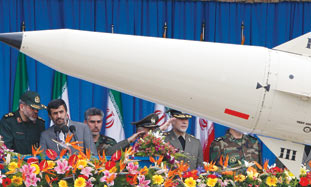
Iran is celebrating the manufacture of new generations of rockets. It is keen on showing that its rockets are able to reach Israel and the U.S. bases in the region. The message behind this is simple and crystal clear. Any attack against the Iranian nuclear facilities would imply igniting the region. Such a huge fire would have high costs vis-à-vis the region’s stability and the security of its states, as well as the global economy and the great countries that do not forget where oil is located and where it passes through.

Iranian officials reiterate to their visitors that there will be no war. They say that this war exceeds the capacity of Israel, which is bound to also think of the repercussions of launching its first missile. They mean to say that rockets will not pelt down on the Hebrew State from Iran only, but also from South Lebanon and Gaza. They believe that Israel will be burnt by the fire of war if it runs the risk of providing the first spark for its ignition. They exclude such an Israeli adventure unless it is part of a U.S. scenario or a trap to lure the United States into a war against Iran.

The Iranian officials also tell their visitors that what happened in Iraq has broken the fangs of the U.S. military machine and depleted the strongest economy in the world; that what has taken place today in Afghanistan continues this depletion; that Barack Obama’s administration is aware that striking the Iranian nuclear facilities implies risking the security of Israel and oil, and the safety of the U.S. soldiers deployed in Iraq, Afghanistan, and other countries. Tehran’s confidence in its military arsenal has reached a stage of exaggeration. It is enough to read the declarations of the Basij militia leader General Mohammad Rida Naji: “The U.S. threats are nothing but ramblings of a dead man… Their aircraft carriers are nothing but cooking pans… The United States used to be stronger before and was unable to do anything about its threats. Today, the Basij are stronger and the United States weaker.”

The Iranian officials stress that their country’s ambitions do not exceed the peaceful use of nuclear energy, and that what it demands is a basic right for a nation that wants to progress and refuses for scientific and technological progress to be a privilege for others and a card that influences its decisions and sovereignty. During the nuclear conference held a few days ago in Tehran, President Mahmoud Ahmadinejad talked about “double standards”. Also, Supreme Leader Ali Khamenei was keen on repeating that the use of nuclear, chemical, and microbial weapons is “prohibited by the Islamic Sharia”.

What the officials tell their visitors was repeated in a clear manner yesterday by Ahmadinejad. He said that the presence of the U.S. forces in the region is the reason for instability. He added: “They need to leave the region. This is not a request, but an order from the regional countries. It is the will of those countries… If they are interested in supporting stability in the region, they need to dismantle their military presence in it and stop supporting Israel.”

It is obvious from Ahmadinejad’s words that Iran considers the U.S. military presence in the region to be a threat or an obstacle before the role that it assumes it has the right to play. It is also obvious that Iran considers that its transformation into a great country in the region which has the primary role in formulating the affairs of security and stability in it is linked to the absence of U.S. reins. There are those who believe that Iran is more interested in grabbing the role than it is in manufacturing the bomb. They think that it is able to postpone the timing of the bomb, but that it considers it a good opportunity now for forcing the acknowledgment of its role as a great regional power in the Middle East.

Among the pundits of Iranian affairs, there are those who believe that Tehran has crossed a significant distance on the path of its role expansion. They give as an example of this the impossibility of forming an Iraqi government without its blessing. The same applies to Lebanon. They also believe that this is part of its desire to turn into a political and religious reference for Arab Shi’as. As for the second key, it is the maintaining of the tension level in the conflict with Israel. The third one is the security of oil and its passageways and the enshrinement of a presence in a country that has amazing oil resources: Iraq.

Hence, Iran appears to be waging a battle of roles more than one of the bomb, which can come at a later stage to move the Iranian role in the region away from any threat. It is hard to believe that the great countries are ready to give Iran such a great role, especially with the current regime. It is also hard to believe that its Arab neighbors would acknowledge its right to restructure the region according to its interests and aspirations.

*Published in the London-based AL-HAYAT on Apr. 19, 2010.

‘Hizbullah arms real danger to Israel’

April 21, 2010

‘Hizbullah arms real danger to Israel’.


Top US senator says there is a high likelihood terror group has Scuds.

Following last week’s uncertainty surrounding a reported Syrian Scud missile delivery to Hizbullah, a senior US senator said Tuesday that the guerrilla group probably possessed the weapons and that its missiles posed a real danger to Israel.

“I believe there is a likelihood that there are Scuds that Hizbullah has in Lebanon. A high likelihood,” Senate Intelligence Committee chair Dianne Feinstein, a Democrat from California, told AFP.”The rockets and missiles in Lebanon are substantially increased and better technologically than they were and this is a real point of danger for Israel.”

Feinstein stressed that the tensions in the North would only subside with a peace deal between Israel and the Palestinians.

“There’s only one thing that’s going to solve it, and that’s a two-state solution,” she said.

Hizbullah sources confirmed last week that the group had received a shipment of Scud missiles from Syria, but Damascus denied the reports, saying Israel was trying to stoke tensions in the region

Netnyahu on Iran’s nuclear program

April 21, 2010

New posts below this video.

“It’s a huge, huge danger. It’s the biggest issue facing our times.”

‘Revolutionary Guards – terrorists’

April 21, 2010

‘Revolutionary Guards – terrorists’.'Revolutionary Guards - terrorists'
BERLIN – A broad swath of prominent European intellectuals and politicians, crisscrossing Germany, France, the Netherlands, Sweden, Spain, Italy and the United Kingdom, are slated to announce on Wednesday that the Iranian Revolutionary Guards Corps (IRGC) should be put on the European Union terror list, The Jerusalem Post has learned.

The European “Stop the Bomb” coalition, which advocates aggressive European-based sanctions against the Iranian government, organized the petition.

The petition, signed by the likes of Elfriede Jelinek, the Austrian winner of the Nobel Prize for Literature in 2004, reads: “As Iran’s most important trading partner, the EU is in a unique position to effect change. Therefore, the EU has the responsibility to impose severe sanctions to thwart Teheran’s drive towards nuclear weapons, and to firmly act towards the protection of human rights in Iran.”

Those who support designating the IRGC a terrorist entity encompass a wide range of the left and conservative political spectrum. Gisela Stuart, Labor MP in the UK and Italy’s Gianni Vernetti, a MP from the liberal Alliance for Italy and former secretary of state for foreign affairs, were two of a number of parliamentarians who advocate isolating the IRGC.

Former Spanish minister of defense and Socialist party member Julian García Vargas also signed the anti-IRGC petition, as did Mats G. Nilsson, a Swedish MP from the Moderate Party, and Claude Goasguen, a French MP from the center-right Union for a Popular Movement.

“By targeting the Revolutionary Guards, Europe can lead the way with ‘smart’ sanctions that cripple the Iranian energy sector – the lifeblood of the men who rule Iran – and, in doing so, support the Iranian reformers against a brutal and illegitimate regime,” according to Mark Dubowitz, executive director the Foundation for Defense of Democracies and a leading expert on the Revolutionary Guards and energy sanctions, whospoke to the Post on Tuesday.

“Banning trade with the Guards’ leaders and front companies, which are such dominant players in Iran’s energy sector, would weaken the Guard and undermine its primary source of wealth and influence,” he added.

“It also would send a shot across the bow to Iran’s European energy partners, which are literally fueling the armored vehicles and motorcycles used to brutally repress those standing for freedom on the streets of Teheran.”

Sergei Ryabkov, Russia’s deputy foreign minister and point man on the nuclear crisis in Iran, resisted robust sanctions on the IRGC during the non-nuclear proliferation conference in Teheran.

He told the daily Süddeutsche Zeitung that “in view of the role that the IRGC plays in Iran’s society and economic sphere… we do not believe in comprehensive sanctions.”

Iran’s Commerce Minister Mehdi Ghazanfari confirmed that “problems will certainly surface” because of pending sanctions and alluded indirectly to difficulties in refining oil because Iran is dependent on foreign gas supplies.

The United States designated the IRGC as a global terrorist entity in 2007 because of its involvement in arms trade and sponsorship of Islamic-based terror groups such as Hizbullah.

According to economic and security experts, the IRGC controls as much as 75% of Iran’s economic activity, including military work on its nuclear program; a crackdown on the IRGC could cause a massive financial and economic meltdown in Iran.

Meanwhile, members of the Free Democrat Party (FDP) in Berlin drafted a groundbreaking resolution urging their party’s delegates to the party congress in Cologne this coming weekend to sponsor a bill to place the IRGC on the EU’s terror list.

Germany’s Foreign Minister Guido Westerwelle is the head of the FDP, but his party’s top-level leadership has remained averse to tough sanctions against Iran, largely because of the party’s pro-business base.

Yet Nils Augustin, a FDP member and attorney in Berlin, crafted the resolution along with Saba Farzan, a German-Iranian FDP member and Iran expert.

According to the resolution, it would “correspond to the liberal spirit” of the party’s tradition.

The resolution cites the role of the Guards in terrorizing the civilian population in Iran as well as Teheran’s jingoistic foreign policy.

The FDP paper cites the Dutch Parliament resolution as a precedent. The Netherlands is the only European country at this time pushing for the EU to designate the IRGC as a terror organization.

How will Netanyahu respond to Obama’s ultimatum?

April 21, 2010

How will Netanyahu respond to Obama’s ultimatum? – Haaretz – Israel News.

The holidays are over and Prime Minister Benjamin Netanyahu has a problem. He has to respond to U.S. President Barack Obama’s ultimatum, the gist of which is the demand to freeze construction in East Jerusalem and the numbers of Jews moving there. Netanyahu would have been glad to dismiss Obama’s demands, but he understands that he can’t, so he’s waging a PR campaign in the United States to soften the administration’s position.

Netanyahu has been saying for many years now that the president is not an autocrat and that American foreign policy is influenced by Congress, public opinion, the media and think tanks. Now his theory is being put to the test. Over the past three weeks the administration has been flooded with letters by U.S. representatives and senators, ads of support by Ron Lauder and Elie Wiesel, editorials and columns, television interviews with the prime minister and e-mails from Jewish supporters of Israel. They all warn, at various levels of bluntness and harshness, that Obama is abandoning Israel in the face of threats from Iran’s nuclear program and Palestinian terror.

Obama’s pressures have called Netanyahu’s bluff: It’s not Iran that is Netanyahu’s top priority, as he claimed before he was elected, but rather the East Jerusalem neighborhood of Sheikh Jarrah. The fact is, the prime minister did not call on Elie Wiesel and members of congress to warn against the “second Holocaust” that Mahmoud Ahmadinejad is plotting, but to prevent construction plans at the Shepherd Hotel, Silwan and Ramat Shlomo from shutting down, which would cost the prime minister his right-wing coalition.

From Netanyahu’s point of view, Obama misled him. The prime minister wanted only one thing: not to come out looking like a sucker. To him, statecraft consists of give and take, of “if they give they’ll get,” while Obama wants only to take – he opposes a surprise attack on Iran’s nuclear facilities and is hardening his demands on the Palestinian issue. It started with the acceptance of the two-state principle, continued with a construction freeze in the settlements, and has now arrived in East Jerusalem, in the shadow of a threat to force a solution that will take Israel out of the West Bank and to the 1967 lines.

Netanyahu is coming out a super-sucker: He gave and gave and got nothing. Netanyahu expected that in return for his gestures to the Palestinians, Obama would harden his position on Iran and come closer to the threshold of conflict (“paralyzing sanctions”). But the president is not playing along. His feeble moves signal that the Americans are coming to terms with the Iranian nuclear program. Instead of pressuring Ahmadinejad and Supreme Leader Ali Khamenei, he is pressuring Netanyahu to get out of the territories and hinting that Israel might embroil America in a very bloody and costly war.

Obama-haters are using Israel to goad the president for “hurting allies,” and this is driving the White House even crazier. Netanyahu is torn between his political supporters at home and in the United States who are pushing him toward a direct conflict with a hostile administration, and his understanding that the rainy day will come when Israel needs Obama’s help.

But Netanyahu’s problem is much deeper and more serious than the coalition’s makeup. Replacing Shas, Yisrael Beiteinu and Habayit Hayehudi with Tzipi Livni would soften Israel’s aggressive tone toward “the world” but not really change the situation. No Israeli government would risk rockets on Tel Aviv, a civil war with the settlers and a political rupture in the Israel Defense Forces just to satisfy Obama.

An Israel that is preparing for conflict with Iran and that does not trust American support will not move an inch in the territories. Netanyahu and Defense Minister Ehud Barak will try to wear Obama and his people out with empty discussions until a decision is made on whether to go to war. Netanyahu and Barak know that the extent of Israel’s concessions in the territories will determine the extent of American help in stopping the Iranian nuclear program. Itamar in exchange for Natanz.

Netanyahu managed to rouse public discourse in the United States about Israel, and Obama got the message. His statement on Independence Day was enthusiastic and warm, speaking about Israel as the historic homeland of the Jewish people and assuring continued efforts to work for a two-state solution and “to counter the forces that threaten Israel, the United States, and the world” (that is, Iran). Now that the fireworks are over, it will become clear whether the president’s message was mere lip service to quiet the criticism at home, or whether it signals intent to forge a deal with Netanyahu.

Report: Assad due in Egypt to discuss fear of Israel-Syria war

April 21, 2010

Report: Assad due in Egypt to discuss fear of Israel-Syria war – Haaretz – Israel News.

Syrian President Bashar Assad was due Tuesday night to land in Egypt “within hours,” his first visit in four years, several Arab media outlets reported. The urgency of the surprise trip stems from a fear of war between Israel and Syria.

A Syrian commentator noted that Assad, who last week denied that Syria had delivered Scud missiles to Hezbollah, would seek to make clear that this information was false. He believes that the accusations are “an Israeli excuse for warmongering,” according to the media reports.

In their meeting, Assad and Egyptian President Hosni Mubarak would also discuss the Palestinian reconciliation talks between Fatah and Hamas.

Assad’s visit to Egypt would be his first since the Second Lebanon War, when he called Arab leaders who did not back Hezbollah “half men.” Saudi Arabia and Egypt responded by refusing to meet with Assad and by launching a media attack on Hezbollah. This included Egyptian accusations that the Lebanese group was targeting sites in Egypt.

Saudi Arabia had already cooled relations with Syria before the war, following suspicions that it might have been involved in the assassination of former Lebanese prime minister Rafik Hariri.

But the Saudis thawed relations last year, largely due to Lebanon’s parliamentary elections and Syria’s desire to support Hariri’s son Saad, who became prime minister. In October, the Saudi king arrived for a historic visit to Damascus, but Syrian efforts to persuade Mubarak to do the same failed; the Egyptian president refused to talk to Assad.

Both Saudi Arabia and Egypt seek to minimize Iranian influence among Arab countries in the Middle East and see embracing Syria as a step that might make it easier for Assad to pick a side.

However, Egypt has been waiting for a gesture of apology and reconciliation from the Syrian president. Assad’s request to visit his Egyptian counterpart after Mubarak had undergone an operation could represent a good start for a better relationship between the two men.

In the meantime, Egypt is pushing for a special conference to discuss the Nuclear Non-Proliferation Treaty, with all Middle Eastern countries attending, including Israel. The conference would aim to persuade Israel to sign the treaty.

Egyptian sources say the permanent members of the Security Council support a Middle East nuclear conference, but it is still unclear whether the conference would be empowered to negotiate with Israel.

U.S. officials slam pro-Israel Jerusalem ad – Haaretz – Israel News

April 21, 2010

U.S. officials slam pro-Israel Jerusalem ad – Haaretz – Israel News.

United States administration officials have voiced harsh criticism over advertisements in favor of Israel’s position on Jerusalem that appeared in the U.S. press with Prime Minister Benjamin Netanyahu’s encouragement. The authors of the most recent such advertisements were president of the World Jewish Congress Ronald Lauder and Nobel Peace Prize laureate Elie Wiesel. “All these advertisements are not a wise move,” one senior American official told Haaretz.

In the advertisement, Wiesel said that for him as a Jew, “Jerusalem is above politics,” and that “it is mentioned more than 600 times in Scripture – and not a single time in the Koran.” Wiesel called to postpone discussion on Jerusalem until a later date, when there is an atmosphere of security allowing Israeli and Palestinian communities to find ways to live in peace.

The ongoing confrontation with the U.S. administration over construction in East Jerusalem was present in many of the comments made by senior Israeli officials during Independence Day.

Netanyahu himself said in an interview to ABC that freezing construction in the east of the city was an impossible demand, and refused to answer questions on the Israeli response to demands from Washington. Instead, he called on Palestinian Authority chairman Mahmoud Abbas to return to the negotiating table without preconditions.

Foreign Minister Lieberman, meanwhile, made Jerusalem the focal point of his speech in a festive reception for the diplomatic corps at the President’s Residence in Jerusalem. President Shimon Peres spoke first, calling for progress in the diplomatic process. Lieberman, who took the podium immediately after Peres, made diametrically opposed statements in his speech, stressing that the Palestinian Authority is no partner for peace.

“Jerusalem is our eternal capital and will not be divided,” Lieberman said. Many of the ambassadors in the audience left feeling stunned and confused, some of them told Haaretz. “The gap between Peres and Lieberman is inconceivable,” one of them said. “We couldn’t comprehend how Lieberman can say all that in front of all the international community delegates.”

Speaking at the torch-lighting ceremony on Mount Herzl on Monday, Knesset speaker Reuven Rivlin said that there was “an attack on Jerusalem” and that Israel “will not apologize for the building of Jerusalem, our capital.”

The diplomatic freeze and crisis with the Americans fueled a heated meeting of Labor Party ministers on Sunday. Minister Benjamin Ben-Eliezer, Isaac Herzog and Avishay Braverman told Defense Minister and party chairman Ehud Barak that unless there was some movement on the diplomatic front within weeks, the Labor Party should consider leaving the government or working to bring in Kadima.

Senior Labor officials, who declined to be named, said this was the first time the diplomatic freeze was being discussed between Labor ministers. “They main message coming from this discussion is that things can’t go on like this,” one senior Labor official told Haaretz. “The Labor ministers told Barak that we will be approaching a moment of political decision within weeks.”

Barak tried to calm the ministers, saying he was concerned by the state of Israeli-American relations and will travel to Washington next week for talks on the peace process. Barak appears to be set to meet with Secretary of State Hillary Clinton, special U.S. envoy George Mitchell and national security advisor General Jim Jones.

Editorial – Iran, Sanctions and Mr. Gates’s Memo – NYTimes.com

April 21, 2010

Editorial – Iran, Sanctions and Mr. Gates’s Memo – NYTimes.com.

Published: April 19, 2010

Sometime this spring, but still months later than President Obama predicted, Iran may finally face new United Nations sanctions for its illicit nuclear program.

Mr. Obama has done a lot to prepare the ground. He has bolstered American credibility with his — since rebuffed — offer to engage with Iran. He signed a new arms reduction treaty with Russia, improved relations with China and is personally lobbying other United Nations Security Council members to support stronger sanctions.

We are skeptical that even that will be enough to get Moscow and Beijing to sign on to anything with real bite. In the last four years, the Security Council has passed three far-too-modest sanctions resolutions. Tehran has shrugged them all off and kept churning out nuclear fuel.

The good news is that Mr. Obama is also hedging his bets, with an effort — first begun under President George W. Bush — to persuade an ever-widening circle of international corporate interests to eschew business in economically strapped Iran.

Total, the French energy company, and Eni of Italy claim they are planning to end new investments in Iran. Major international banks like Deutsche Bank and HSBC have said that they are withdrawing from Iran. Several oil companies have said they would no longer supply gasoline to Iran, including Royal Dutch Shell, Vitol, Russia’s Lukoil and India’s Reliance. Last week, Malaysia’s state oil firm, Petronas, said it was cutting off shipments. Its prime minister then denied it.

Promises are clearly cheap. The administration will have to keep pressing these companies to live up to their commitments. And it is time for Mr. Obama’s European partners to think about more formal ways to tighten their own sanctions on Iran.

None of this should let the Security Council off the hook. A new resolution would provide important cover for these parallel tracks. Iran is especially vulnerable now, both economically and politically. Its leaders will be watching carefully, especially to see what its longtime trading partners and enablers in Russia and China do.

There, the news is not good. While Russian and Chinese leaders told Mr. Obama that they will work seriously on new sanctions, diplomats say their representatives are already seeking ways to dilute any resolution. Brazil and Turkey, which currently sit on the Security Council and have a lot of international sway, also are resisting. Mr. Obama needs to keep pressing Moscow and Beijing hard. He and his European partners need to make clear that Brazil (which seeks permanent Security Council membership) and Turkey (a NATO member) must step up.

We don’t know if there is any mixture of pressure — or inducements — that will force Iran to abandon its nuclear ambitions. That’s what makes a memo written earlier this year by Defense Secretary Robert Gates and reported by The Times on Sunday so important.

Looking beyond the current maneuvering, he raises some very disturbing and difficult questions that need to be addressed. How will the world contain Iran if it actually produces a weapon? What will Washington and its allies do if Iran acquires all of the parts but decides to stop just short of that?

The United States and its allies need to quietly discuss and prepare for those possibilities — without giving Russia, China and others any more excuses not to act.

As for the military options under review, we are sure that an attack would be a disaster. We urge anyone who has doubts to listen closely to Adm. Mike Mullen, the chairman of the Joint Chiefs of Staff. He told reporters on Sunday that while military “options would cause delay” to Iran’s nuclear program, “that doesn’t mean the problem is going to go away.”

Editorial – Iran, Sanctions and Mr. Gates’s Memo – NYTimes.com.

Beware the coming war

April 21, 2010

Beware the coming war.

Matein Khalid

21 April 2010

The July 2006 war between Israel and Hezbollah transformed both Lebanese and Arab politics. Hezbollah emerged as the heroic champion of resistance to Israeli aggression across the Arab and Islamic world. While Hassan Nasrallah claimed “divine victory”, Hezbollah lost its autonomy to operate in south Lebanon to units of UNIFEL and the Lebanese Army.

Israel lost its psychological aura of invincibility in the Middle East when its troops were unable to defeat Hezbollah in the village battlefields and rock strewn hills of south Lebanon even though the northern Galilee border is calm for the first time since the late 1960’s. Unfortunately, the balance of power between Hezbollah and Israel is unstable and the calculus of deterrence cannot last.

Israel has myriad strategic reasons to launch a preemptive strike against a resurgent Hezbollah. Despite Ehud Olmert’s brutal Dahiya doctrine, Israeli warplanes were unable to terror-bomb the Shia militia into submission, unable to kill or capture its high command. In fact, Israel’s devastating aerial firepower only turned Nasrallah into the first truly popular Arab war hero since President Nasser during the Suez war in 1956. Hezbollah’s defiance of Israel narrowed the Sunni-Shia cleavage in the Arab world created by the overthrow of Saddam Hussein.

Israel has tried its best to wage psychological war against Hezbollah and its Iranian patrons. Mossad agents assassinated top Hezbollah commander Imad Mughniyeh, the mastermind of suicide bombings attacks against the US Marine barracks and the American embassy in Beirut. To add insult to injury, Mughniyeh was killed by a car bomb in the Damascus neighbourhood of Kfir Soussa, the citadel of the Syrian secret police. Israeli warplanes bombed an alleged North Korean built nuclear reactor in the western deserts of Syria in September 2007. Israeli F-16’s routinely create sonic booms over Shiite villages in south Lebanon and the southern suburbs of Beirut, the Dahiya stronghold of Hezbollah.

In fact, a Syrian-Saudi rapprochement and the procession of Lebanese leaders to Damascus five years after the Cedar Revolution only increases the probability of a preemptive Israeli attack against Hezbollah. Hezbollah is an integral component of the Sunni, Maronite and Druze coalition that now rules Lebanon, no longer a mere “state within a state” whose infrastructure could be safely bombed by the IDF. Hezbollah has rearmed since the July 2006 war. Its military arsenal includes 40,000 long rage rockets and surface to air/anti-tank missiles. Hezbollah’s M-600 rockets have the range to hit Tel Aviv and Jerusalem, not just Haifa, Tiberias and the north Galilee kibbutz networks. Nasrallah has also been defiant, vowing to destroy Israel in the next war and “change the face of the region”. To the Israeli zealots, Nasrallah and Iran’s President Ahmadinejad are the modern incarnations of Nazis.

The willingness to launch preemptive attacks and use overwhelming force against its enemies has defined the military doctrine of the Haganah and the IDF since the 1948 Palestine war. Israeli deterrence and terror bombing, however, failed against Hezbollah in July 2006. In fact, Hezbollah’s unending attacks in a protracted war of attrition had forced the IDF to humiliatingly withdrew from Lebanon in 2000, a bitter blow to a military machine whose blitzkriegs had once vanquished the Egyptian, Syrian and ordanian armies in the Six Day War. Miscalculation on either side could ignite a new war, as in 2006 when Nasrallah ordered the kidnapping of two IDF soldiers in a cross-border raid.

The Israelis violated the balance of terror when Mossad assassinated Mughniyeh and Netanyahu has publicly threatened to flatten the Dahiya. A war in Lebanon could be the inevitable consequence of an Israeli attack on Iran’s nuclear arsenal or an Iranian Revolutionary Guard attempt to midwife an anti-US Shia coalition in the Middle East. Mired in two wars, unable to broker the peace process, distrusted by its own Lebanese and Arab allies the US is impotent to prevent another war.

The next war will differ from July 2006. The IDF will launch large scale bombing attacks against Shia Beirut, the Bekaa valley and the Shia villages of South Lebanon. A ground offensive on the northern banks of the Litani River to occupy the Nabatiyeh heights, a Hezbollah stronghold. The Sunni, Christian and Druze villages of south Lebanon will not be immune to Israeli attacks nor will the infrastructure of the Lebanese state. Hezbollah’s mobile anti-tank missile batteries will be prime targets, since they can disable even the Merkeva M4, the best armoured battle tank in the Middle East. Israeli tank columns and commonado units could even infiltrate Baalbek and the Hezbollah command nerve centres in Bekaa valley even as UNIFIL units limit Hezbollah’s ability to launch retaliatory rocket attacks against northern Israeli cities. Suicide bombing cells in Tel Aviv, Haifa and Jerusalem could wreck havoc behind the front line. The next war in Lebanon will be sudden, bloody and protracted, just like the horror show of July 2006.


