Archive for September 2009

Over a Barrel: Why Iran Sanctions Won’t Work

September 30, 2009

This story was filed by CBS News foreign affairs analyst Pamela Falk, based at the United Nations, who was in Beijing last month speaking with economists about China’s energy security

.


(AP Photo/Guang Niu, Pool)

Going into Thursday’s high-stakes negotiations with Iran, President Obama will soon see for himself the corner into which the Islamic Republic has thrust his predecessors.

Iran has the world over a barrel, literally. The country’s vast oil reserves will undermine Obama administration efforts to increase U.N. sanctions, and Iran knows it.

U.N. sanctions only work when they are airtight. Despite the White House’s message that the veto-wielding permanent members of the Security Council (the P5 as they are called: the U.S., Russia, France, China, and the U.K.) and Germany are unified in their response and that the Iranian missile tests of last week were a game changer, they are dodging the harsh reality that China is not even close to being “on board” for tough sanctions.

The U.N. is, overall, trying to do something about Iran. This week, Secretary-General Ban Ki-moon supported the International Atomic Energy Agency’s efforts to force Iranian transparency over its nuclear facilities. But without the ability to convince Russia and China to send a unified message, there is little the Security Council can do short of another round of not-so-tough sanctions.

China’s booming population and insatiable thirst for oil to fuel development is driving Beijing directly into Tehran’s arms.

A net oil exporter until the early 1990s, China’s government estimates that crude oil imports will rise to meet 60 percent of its demand by 2020. That led Beijing, in the midst of nuclear brinksmanship with Iran, to seal a deal with the otherwise isolated nation worth about $2.5 billion.

Just this week, the China National Petroleum Corporation inked an agreement with the state-run National Iranian Oil Company to develop an oilfield, in southwestern Iran.

The South Azadegan oilfield is home to the largest reserves found since the 1970’s — slated to produce a quarter of a million barrels of oil a day — and the deal struck with Beijing gives China a 70 percent share of the proceeds.

Combine that with the fact that Iran already provides about 14 percent of China’s oil needs, and the White House can pretty much scratch off the list of possible U.N. sanctions it has been discussing:

1) A ban on international investment in Iran’s energy sector.

2) The new idea of banning insurance for Iran’s oil tankers.

3) A ban on Iranian oil imports.

Imposing sanctions is made all the more difficult by the need to target them in a way that won’t hurt Iran’s embattled but resilient pro-democracy movement.

Russia, for its part, is preparing for a sale of anti-aircraft technology to Iran and is less than enthusiastic about tough sanctions, despite President Dmitry Medvedev’s initial jubilation over Mr. Obama’s scrapping of the Eastern European missile shield program.

Even as the fourth largest producer of oil and OPEC’s second largest exporter, Iran does rely on oil imports — so sanctions on exports of refined petroleum to Iran would have an impact, but even that is weakened by the development by China of Iranian reserves.

Iran may very well find a face-saving way out of the current stand-off and stave off the ire of the group of six meeting with Iran in Geneva by allowing inspectors into the heretofore undisclosed nuclear facility in Qom.

But that doesn’t solve the problem. The corner that Iran has the world in, going into the sought-after direct talks with the U.S. (along with the other nations), is that the world has to find a way to:

1) Stop Iran from developing nuclear weapons with its uranium enrichment know-how.

2) Slow the development of its surface to air missiles.

3) Protect Israel and U.S. military bases in the Middle East.

4) Try to prevent the worst case scenario — a preemptive air strike against Iran’s nuclear facilities by Israel.

Iran is expert at buying time and running out the clock, while it continues to move closer to having the capacity to build nuclear weapons.

Some analysts have speculated that Israel (and perhaps the U.S.) would not mind an air strike like Israel’s against Syria in 2007 or against Iraq back in 1981.

But no one doubts how high that toll would be on Israel, on the price of oil, on the possibility of a drawn-out war in the Middle East, on NATO or U.S. troops — not to mention how difficult it would be to actually slow the Iranians down with so many underground facilities and their location underground.

Iranian President Mahmoud Ahmadinejad answered many questions during the press conferences and interviews in New York this past week, and it was downright scary.

Ahmadinejad represents a hard-line Revolutionary Guard that wants Iran to return to the days of leadership the Persian Empire once enjoyed. His defense minister’s comment that Israel’s “days are numbered” if it attacks Iran, was ominous.

The only question that has not been answered, is what Iran actually wants. Ahmadinejad – reading from North Korea’s playbook – said it was direct talks. But, then he said the nuclear issue was not on the table as soon as President Obama offered them.

In 2004, Iran actually froze the entire nuclear program in exchange for all sorts of promises from the U.S. — from spare parts for its aging air fleet to oil refining infrastructure.

Why didn’t that work? One Iranian diplomat told me last year that they, “got nothing” in return. However, that was before Ahmadinejad’s hotly-contested reelection.

So, maybe there are some leaders in Iran who are interested in an upside to negotiations, but that appears to be a remote possibility until Ahmadinejad and his hard-line support weakens.

For now, Iran goes into the Geneva meetings with the world over an oil barrel, at least in terms of any really tough sanctions, and an evident plan to buy time with the revenue.

http://www.cbsnews.com/blogs/2009/09/30/world/worldwatch/entry5352457.shtml

British intelligence believes Iran has resumed work on nuclear warhead

September 30, 2009

British intelligence has disputed an American assessment that Iran has not resumed work building a warhead for a nuclear weapon.

by Our Foreign Staff
Published: 9:34AM BST 30 Sep 2009

Iran's President Mahmoud Ahmadinejad: Iran defies Obama and vows to switch on 'secret' nuclear facility

Iran’s President Mahmoud Ahmadinejad Photo: AFP/GETTY

The Financial Times and New York Times have separately reported that Western and Israeli intelligence agencies are in the throes of a dispute over the exact nature of Iran’s work to build a functioning atom bomb.

Following the discovery of a secret plant outside the holy city of Qom, US intelligence hopes that it has made a breakthrough in finding out how much covert work Iran is undertaking.

The New York Times quoted a US official claiming Qom “was the big one” but he added Iran was a big country.

British officials told the Financial Times that Iran resumed work on a nuclear warhead design in “late 2004 or early 2005.” The US assessment is that worked stopped after an order was handed down by Iran’s Supreme Leader Ayatollah Ali Khamenei in 2003 and there is no conclusive evidence that it has restarted.

One former US official acknowledged there were deep differences between international intelligence agencies. “It’s often the tradecraft that gets us bollixed up,” said Rolf Mowatt-Larssen. “It comes down to interpreting the same data in different ways.”

The shadow of faulty assessments used to pave the way to the Iraq war hangs over intelligence agencies attempts to reach conclusions about Iran.

“We’d let the country down, and we wanted to make sure it would never happen again,” said Thomas Fingar, who led the State Department’s intelligence bureau, which disputed the weapons of mass distruction assessment before the Iraq war. “Now, it’s much more of a transparent tussle of ideas.”

While the American view is that the design work has still not resumed but Germany, Israel and Britain are more hawkish.

http://www.telegraph.co.uk/news/worldnews/middleeast/iran/6245819/British-intelligence-believes-Iran-has-resumed-work-on-nuclear-warhead.html

Israel mutes its rhetoric against Iran as talks loom — latimes.com

September 30, 2009

Israel mutes its rhetoric against Iran as talks loom — latimes.com

Shared via AddThis

U.N. Secretary General: Iran Violating Resolutions on Nuclear Activities

September 29, 2009

Washington Post Staff Writer
Tuesday, September 29, 2009; 3:01 PM

UNITED NATIONS, Sept. 29 — U.N. Secretary General Ban Ki-moon said Tuesday that Iran’s construction of the Qom nuclear enrichment facility violates U.N. resolutions requiring greater candor about its atomic activities, adding that Tehran must prove to the world that it has no intention of developing nuclear weapons.

Ban’s remarks placed the U.N. body squarely behind the Obama administration’s campaign to ratchet up international pressure on Iran to curb its nuclear ambitions on the eve of nuclear talks it is scheduled to hold Thursday with the United States, Britain, China, France, Germany and Russia.

Ban said he outlined his concerns in a face-to-face meeting with Iranian President Mahmoud Ahmadinejad on Friday and that he would press the same message in talks with Iran’s foreign minister, Manouchehr Mottaki, today.

“The burden of proof is on their side,” Ban said. “This new Iranian enrichment facility is contrary to the Security Council resolution. . . . They should give full access to the IAEA [International Atomic Energy Agency] — this is what I told him.”

The Iranian government released a statement Tuesday saying that Ahmadinejad had criticized Ban during the meeting for parroting Western allegations against Iran without waiting for the IAEA to issue a formal judgment on Iran’s behavior.

“The President . . . said it is of grave concern that the U.N. Secretary General, instead of waiting for the IAEA, as the competent body, to reflect on this issue, namely the new enrichment facility, has chosen to repeat the same allegations that few Western powers are making,” the statement said.

Ahmadinejad also told Ban that Iran’s construction of the Qom facility is part of a larger Iranian program aimed at developing peaceful nuclear energy. Iran has repeatedly denied that it is seeking to develop nuclear weapons.

The Iranian and U.N. accounts of Friday’s meeting underscored the tense nature of Ahmadinejad’s discussion with Ban, which touched on Iran’s detention of political opposition figures and what Ban characterized as Ahmadinejad’s repeated denials of the Holocaust.

In unusually strong language, Ban expressed concern about Iran’s human rights record, citing restrictions on “freedom of association, assembly and the practice of religion,” according to a U.N. account of the meeting released Friday. He also pressed Iran to invite U.N. human rights investigators into Iran and to uphold due process in trials of opposition protesters jailed after the country’s contested elections.

Iran countered this morning, saying that Ahmadinejad told the U.N. chief that “Iran condemns all the killings of innocent people that have occurred throughout history, including the killing of tens of millions of civilians in World War II.” But he said those killings cannot be used by Israel to perpetrate a new holocaust in Palestine.

The U.N. Human Rights Council met in Geneva on Tuesday to consider a U.N. report by Richard Goldstone, a South African judge who headed the U.N. war crimes court for the former Yugoslavia, that accuses Israel and Hamas, along with other Palestinian armed groups, of committing war crimes during the Gaza conflict.

The report called on the U.N. Security Council to order Israel and Hamas to conduct credible investigations into the allegations or, if they fail to do so within six months, turn the case over to the prosecutor of the International Criminal Court in The Hague.

Israel and the United States have criticized Goldstone’s report as biased and unbalanced. Michael H. Posner, the U.S. assistant secretary of state for democracy, human rights and labor, told the Rights Council on Tuesday that the United States believes the report “is deeply flawed” and disagrees “sharply with its methodology and many of its recommendations, including their extraordinarily broad scope.”

But he said the United States recognizes “Justice Goldstone’s distinguished record of public service in his own country, South Africa, and in the larger global efforts to promote justice — in the former Yugoslavia, in Rwanda and elsewhere.”

The United States has opposed Goldstone’s call for the Security Council to address alleged Israeli and Palestinian war crimes, saying the matter is best left to the Human Rights Council. But Posner said the United States would press for passage of a consensus resolution in the council, urging Israel and the Palestinians to conduct their own investigations into possible war crimes by Israeli troops and Hamas.

http://www.washingtonpost.com/wp-dyn/content/article/2009/09/29/AR2009092902191.html

Iran Will Not Discuss Uranium Enrichment

September 29, 2009
By VOA News
29 September 2009
Head of the Atomic Energy Organization of Iran Ali Akbar Salehi delivers a speech at the beginning of a general conference of the IAEA, in Vienna, Austria, 14 Sep 2009

Iran’s nuclear chief says his country will not discuss anything related to its right to enrich uranium.

Ali Akbar Salehi made his remarks two days before Iran is to discuss its atomic program with world powers in Geneva. He said Iran will never abandon its nuclear program.

Earlier, Salehi told state-run television Iran will soon tell the U.N. nuclear agency when it can inspect the nuclear plant Tehran acknowledged last week it is developing.

Meanwhile, Iranian lawmakers are warning the U.S. and other world powers against repeating past mistakes during Thursday’s talks. They said the talks are an “historic opportunity” to move past the deadlock on the nuclear issue.

The United States is threatening Iran with tougher sanctions if it does not fully reveal its nuclear activities and allow U.N. inspectors to visit its newly revealed plant.

In other news, Russia’s deputy foreign minister says Iran’s missile test launches should not be used as a reason to impose more sanctions on Iran for its nuclear program. But Sergei Ryabkov told the Interfax news agency the tests give greater argument to those who support sanctions.

China urged calm Tuesday after Tehran drew international condemnation by testing its longest-range missiles on Monday.

Russia and China are two of the five permanent members of the U.N. Security Council, but have historically been more reluctant than the United States and European nations to punish Iran for enriching uranium.

The United States and its Western allies suspect Iran is building a nuclear weapon. Iran says its nuclear program is peaceful and intended to produce electricity.

Iran’s nuclear chief says Iran informed the U.N. nuclear agency that its new plant will produce enriched uranium at a level (five percent) consistent with its nuclear energy program.

http://www.voanews.com/english/2009-09-29-voa14.cfm

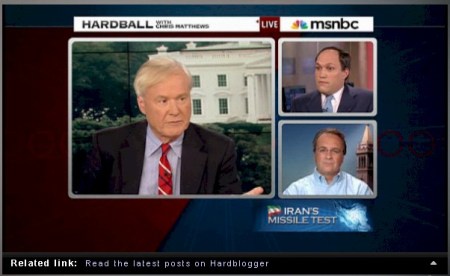
Hardball: Will Israel Attack Iran? – Better than 50% chance…

September 29, 2009

msnbc.com:Will Israel attack Iran?

hardball

Iran: The Nuclear Question – Video Library – The New York Times

September 29, 2009
Source: video.nytimes.com
The Times’s David E. Sanger discusses the issues surrounding the discovery of the Iranian enrichment site near the holy city of Qum.

Think Cuban missile crisis

September 29, 2009

Iran recently became aware that its adversaries had uncovered the existence of a nuclear facility in Qom. Last week, the US shared what it knew with Russia and China, trying to persuade them to support tougher sanctions against Teheran. Late Thursday, the mullahs abruptly “reported” the secret uranium enrichment plant still under construction to the International Atomic Energy Agency. And on Friday, the US, Britain and France announced that Iran had been exposed – for the third time – trying to deceive the world.

In this photo released by the...

In this photo released by the Iranian semi-official Mehr News Agency, Revolutionary Guard’s Zelzal missile is launched in a drill near the city of Qom, 80 miles (130 kilometers) south of Teheran, Iran.
Photo: AP

The underground facility, ensconced inside an Islamic Revolutionary Guards base, was described by US Defense Secretary Robert Gates as “part of a pattern” of “lies” that has characterized Iran’s nuclear program from “the very beginning.”

But don’t expect Teheran to show contrition when it meets in Geneva on Thursday with the five permanent members of the Security Council – the US, Russia, China, Britain, France, plus Germany; its first official “engagement” with Washington in decades.

Iran will express, as did Ali Akbar Salehi, head of its Atomic Energy Organization on Saturday, shock at the negative reaction to Qom. In 2003, it promised to reveal any new facilities to the IAEA as soon as it made plans to build them, but later backtracked, allowing Salehi to argue that Iran had had no obligation to tell the IAEA about Qom any sooner.

Add Qom to the scary list of facilities – at Bushehr, Isfahan, Natanz and Arak, and who knows where else – where Islamist fanaticism is being wedded to weapons of mass destruction.

The Iranian leadership’s unvarnished thinking on the Qom expose was enunciated by Mohammad Mohammadi Golpayegani, supreme leader Ayatollah Ali Khamenei’s bureau chief: “God willing, this plant will be put into operation soon, and will blind the eyes of the enemies.”

WHAT happens next? President Barack Obama declared that his “offer of a serious, meaningful dialogue to resolve this issue remains open.” But he wants Iran to “come clean” and “make a choice” – cooperation or “confrontation” with the international community. Obama says his policy of engagement and multilateral consultations means that if “diplomacy does not work, we will be in a much stronger position to, for example, apply sanctions that have bite.”

That is doubtful. Iran’s game continues to be a cunning combination of cooperation and recalcitrance. One step forward, two steps back. For example, Mahmoud Ahmadinejad told The Washington Post that he is willing to have his nuclear experts meet with scientists from the United States as a confidence-building measure. Of course these experts will be in no position to answer questions about Iran’s nuclear infractions.

The autocrat who stole a basically fixed Iranian election in which only vetted candidates could compete, who believes a cabal of Jews controls the world, that the Holocaust never happened and Israel should be wiped off the face of the earth, has now given his word that Iran has no interest in acquiring nuclear weapons: “We fundamentally believe nuclear bombs are the wrong thing to have.”

Iran’s stratagem is to “engage” as it pushes ahead with its bomb, thereby making it hard for the international community to impose meaningful sanctions. Once it feels certain it has all the pieces of the nuclear weapon’s puzzle in place – fuel, warhead, delivery system – it might offer Obama a stop just short of a test detonation, in return for a long list of Western concessions.

Anyway, the pace of economic sanctions is way out of sync with the progress the mullahs are making on their bomb. Even if Russia and China accepted a winter embargo on refined petroleum products entering Iran, is there any reason to imagine that the mere discomfort of the Iranian masses would take precedence for Khameini and Ahmadinejad over the bomb?

Obama should leapfrog over futile intermediate steps and place draconian sanctions on the table, now. To paraphrase John Kennedy during the Cuban Missile Crisis, this would mean that all ships and planes bound for Iran, from whatever nation, would be turned back.

Perhaps this prospect, coupled with a complete land, sea and air quarantine, can influence Iran’s leaders to rethink their one-step-forward-two-steps-back strategy, and save humanity from an Iranian bomb.

http://www.jpost.com/servlet/Satellite?cid=1254163536876&pagename=JPost%2FJPArticle%2FShowFull

ANALYSIS / How many more secret nuke sites does Iran have?

September 29, 2009

By Yossi Melman

Intelligence experts in the West and in Israel assumed for some time that a country that is seeking to acquire nuclear weapons would also develop a secret installation for enriching uranium so that it could hide its activities from the international community.

At such an installation, it would then be able to enrich uranium to a sufficiently high level that it would be usable as fissile material in a nuclear bomb. Indeed, what has taken place over the past few days has been the realization of those estimates, with Iran announcing that it had in place an additional installation for uranium enrichment, beyond the one the inspectors of the International Atomic Energy Agency were aware of in Natanz.

Iran’s announcement was made so as to preempt the news first being released by the media or foreign governments. However, Iran made no real gain with its admission. On the contrary, it has only aroused additional suspicions regarding its plans, incensed the international community, and embarrassed its few supporters. Even Russia, which has to date backed Iran and prevented the imposition of harsh sanctions against Tehran, appears to be losing patience.

Advertisement

Iran’s timing was especially bad, with the announcement about the Qom facility coming only days before the scheduled October 1 start of talks in Geneva with the permanent members of the Security Council and Germany. Those talks are intended to resolve the issue of Tehran’s nuclear program. The announcement also came a short while after the IAEA’s annual meeting, just after the UN General Assembly gathering, and on the day the G-8 met in Pittsburgh, Pennsylvania. In all settings, Iran was topped the agenda.

The announcement resulted in a demand from the leaders of the U.S., France and the United Kingdom that Iran allow international inspectors to enter the site at Qom. Iran confirmed that it intends to do just that and is trying to calm things by saying that only low-level enrichment took place at the facility, just like at Natanz – intended for the peaceful purpose of producing electricity.

But the world is now finding it difficult to believe a regime that has in the past been caught lying more than once. According to Tehran, the newly publicized installation is small, and can house only 3,000 centrifuges, which are too few for industrial production. This, coupled with Iran’s efforts to highlight the activities at Natanz while constructing a secret facility, leads to only one conclusion: that they were planning to use the installation to produce highly enriched uranium for military use.

If Iran does agree to let IAEA inspectors into the site, it will have to build a third enrichment facility – although there may already be one in place. Which raises a major question: How many other secret sites does Iran have for the production of the essential elements for its nuclear program? This is a question of particular importance to the military planners who are considering a military option against Iran.

Some analysts have said that the installation at Qom is the “smoking gun” that proves, beyond doubt, that Iran is seeking to develop nuclear weapons.

Nonetheless, global political interests do not seem to be any closer to converging on how to deal with Iran and its nuclear program. Meanwhile, Iran is getting closer to its goal of being in a position to produce nuclear weapons.

http://www.haaretz.com/hasen/spages/1117289.html

ANALYSIS / Why is Israel suddenly praising Iran sanctions?

September 29, 2009
By Amos Harel, Haaretz Correspondent
Tags: iran, israel news, obama
// <![CDATA[//
Just before Iran and the international community begin talks on Iran’s nuclear program, Israel is sending out messages of measured and cautions optimism. Israeli official are praising the proposed sanctions against Iran to journalists, explaining that a stiff cost could prompt the Iranians to rethink their actions, especially in light of the domestic troubles the regime of ayatollahs has faced over the past few months.

The New York Times, meanwhile, reported that Prime Minister Benjamin Netanyahu is lobbying U.S lawmakers, including House Speaker Nancy Pelosi to impose “crippling sanctions” on Iran.

This constitutes a certain change in the atmosphere surrounding Israel’s approach to the issue. Until a few weeks ago, Israeli officials expressed serious skepticism, bordering on cynicism, about American efforts to divert Iran from its gallop toward obtaining nuclear capability.

Advertisement

The official explanation for this stance is connected to the assertiveness that U.S. President Barack Obama and his administration are showing vis-a-vis Tehran, alongside the decision by the Obama administration to nix plans to deploy missile systems in Eastern Europe. That move is expected to help in getting Russia to hop on the sanctions wagon.

But there are other factors in the background. The dialogue is the penultimate exit stop before the scenario of a military attack on Iranian nuclear facilities. The talks are expected to go on intermittently until December, when harsher sanctions are expected.

Israel, from its point of view, now needs to show the Obama administration and the international community that it is a team player, one that supports exhausting all non-military options. At some point in the future, there will come a time when it would make sense to once again threaten to attack Iran in order to pressure Tehran, but now is still the time for negotiations.

All the intensive goings-on concerning Iran must be understood against the backdrop of the opening of talks the day after Wednesday, on October 1.

This is the context for the exposure of the new enrichment facility at Qom, secretly built by the Iranians. And it’s the context for Obama’s stern statements and for Iran’s defiance in holding a military maneuver that included launching long-range missiles capable of hitting Europe.

The most dramatic of these developments is the exposure of the Qom facility for uranium enrichment. This has enabled U.S. Defense Secretary Robert Gates to state clearly that Iran is moving forward with its efforts to obtain a nuclear bomb.

The U.S. is now starting to show its cards in more ways than the exposure of the Qom facility, which attest to Tehran’s true intentions. The New York Times reported that the U.S. is planning to halt foreign investments in Iran’s oil and gas industries and introduce new restrictions on banks operating in Iran.

But even if the sanctions are approved, will they serve to dissuade a country that has persistently struggled to obtain nuclear weapons for 15 years, now that it is relatively close to achieving the ultimate goal?

http://www.haaretz.com/hasen/spages/1117474.html