US must bolster its credibility
Source: Israel Hayom | US must bolster its credibility
The new administration will have to work hard to restore the U.S.’s superpower status, badly eroded in Obama’s presidency • A Trump administration will be more Israel-friendly, but we must always strive to improve Israel-U.S. relations even more.
|
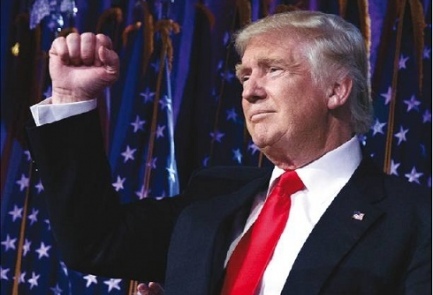
U.S. President-elect Donald Trump faces many challenges ahead
Photo credit: AP
|
If anyone had any doubt that the world is in the midst of a prolonged shockwave with no end in sight, the results of Tuesday’s U.S. presidential race should provide all the necessary proof. The impossible has become fact, and democracy has once again proved to be a volatile system, whose outcome will surprise you every time.
Again we learned that tracking polls are worthless, and that public opinion is a difficult thing to predict not only in the streets of the Middle East, but also on the streets of California or New York. Perhaps it is time to suspend such polls, which never cease to mislead the public.
A wise man told me that Western democracies are experiencing a crisis that is leading to the rise of extremist movements in Europe and of candidates outside the mainstream in the United States. The reasons are similar all over the world, he said: The public in each country expects the state to provide it with more than the state can, and there is no chance the state can satisfy the public’s demands without radically changing the system. The public disappointment is even greater if it turns out that newly elected officials cannot change harsh realities, as most campaign promises do not translate into the real world.
This pessimistic view is essentially correct. The massive backlash against governments that fail to meet their citizens’ expectations is something dictatorships and democracies share. In democracies, this sentiment is reflected on election day, while in dictatorships there are coups and bloodshed. Frustration over government dysfunction was the root of the unrest in the Arab world and the subsequent Arab Spring, and now it is driving some of the changes seen in Western democracies.
This was the case in Brexit, the British referendum to leave the EU that saw Britons vote en masse against the London-based elite and in favor of divorcing the 28-member bloc. In the U.S., the Republican Party did not hide its aversion to Donald Trump and the media and numerous culture icons rallied to prevent his election and ensure Democratic presidential candidate Hillary Clinton made it to the White House, but the public vote contradicted the predictions made by leaders of public opinion.
The media played a key role in what led to the Brexit shock and the surprises noted after the 2015 general election in Israel and Tuesday’s elections in the U.S., and in all three countries the media proved detached both from the public and reality.
Israel, Britain and the United States have three different systems of democracy, and all three experienced this phenomenon. This is obviously not a healthy situation for democracy, as the public’s faith in media fairness and objectivity is vital.
Still, strange as it may seem, it is unclear what, if anything, can be done. It is unlikely that taking government action is the right thing to do.
The media, especially the classical media — print, radio and television — would be wise to do some soul-searching over the loss of its credibility, and with it the loss of its ability to influence the public. This is true for Israel and the U.S. alike.
On majorities and minorities
For many Americans, President Barack Obama’s term in office is coming to an end on a disappointing note. Much will be written about the man who shattered the racial glass ceiling as the first African-American president, but he will also go down in history as a polarizing president, whose term left American society worse for wear.
The smear campaign waged by the Democrats and Republicans during the 2016 presidential race reflected the deep rift and mutual loathing between two political cultures in the U.S., and Obama’s behavior did little to mitigate tensions. If anything, he probably made things worse.
One example for this was the fight over the nuclear deal with Iran, when Obama completely ignored Congress — and apparently public opinion in the U.S. — and signed an agreement he called the most important achievement of his administration, without even presenting it to Congress. This is not how you foster consensus or build confidence in the country’s political culture and institutions.
This should serve as an important lesson to democracies struggling with serious disagreements: Such disputes should be resolved through compromise, where even those who can impose their opinions give a little, so those holding the minority opinion do not feel completely ignored. It is also important not to make critical decisions without a solid majority.
In Israel, those who make tough decisions that defy public opinion are often lauded as “courageous leaders,” especially if said decisions coincide with the positions expressed by the media and ignore the damage such decisions inflict on society.
American society today is plagued by hatred that in part, at least, stems from not keeping the most important rule of all: The majority cannot flaunt its decisions and it cannot ignore the minority’s protest. Israel would be wise to remember this lesson as well.
With a firm Republican hold on the House and Senate, things should be easier for Trump. Nevertheless, the general hope — and prayer — in the U.S. is that even though he has a majority, Trump would still see himself as “everyone’s president,” as he said in his acceptance speech, and that he does not shun the Democrats, thus doing his share to heal the rifts.
Reigniting the American dream
There is one field where Trump will leave his mark for many years to come: the U.S. Supreme Court. The next administration will need to appoint judges to the bench, but in the U.S. that includes confirmation hearings. As Republicans control the House and the Senate, they will appoint conservative judges, which could tip the balance in the Supreme Court, which in turn will affect the delicate sway it holds over shaping the character of American society.
Trump’s election reflects Americans’ deep fear of immigrants, who many in the U.S. see as a threat to America’s national character. The same is true for the U.K., where much of the Brexit vote was driven by British concerns over EU immigration policies. For many Americans, this was a chance — perhaps the last chance — to delay this change.
Trump was carried to the White House by the neglect and abandonment felt by blue-collar Americans wary of the globalization they feel is pulling the rug from under their feet.
There is another America outside New York and Washington, away from the bustling urban centers on the West and East coasts, and away from Ivy League universities — places the average American finds it difficult to reach without being from a wealthy family or an extraordinary genius.
The American dream has stalled, and Trump’s victory reflects the public’s desire to resuscitate it. There’s no wonder this issue was raised in the president-elect’s victory speech, and it is a worthy and difficult task.
What the new president’s policies in these areas will be is an open question, as it is impossible to magically stop immigration and there is little that can be done about the millions of illegal immigrants already living in the U.S. It is equally hard to see the U.S. forfeit the leading economic positions globalization has given it, especially in the fields of finance and technology. If Trump was to launch a trade war with the world, the U.S. would be heavily affected.
These phenomena are not unique to the United States. They are evident in Europe as well, and they will affect next year’s elections in Germany and France. Do Brexit and Trump’s election herald a new historic direction in the international system with regard to immigration and economics? It is too early to tell, but the signs are stronger than ever.
I do not know how much the deterioration in the U.S.’s international standing affected the current elections, but Trump clearly faces several tough tests with respect to foreign relations. The main problem is that the U.S. has lost its credibility as a superpower. Obama explained time and again why he did not believe superpower status was important, but as far as the international sphere is concerned, this status means a great deal.
Restoring America’s superpower status is the only way the U.S. can continue to alleviate global tension and prevent the deterioration of relationships in which it has a vested interest.
The feeling that the U.S. has abandoned the world and that it cannot be counted on is shared by its allies worldwide, including in the Far East, where America’s allies must contend with China’s aggression. Trump will face tough questions in the South China Sea, but also opposite Russia’s growing power in the Middle East. Dealing with these issues, especially given the cuts in U.S. defense spending is no easy thing.
Israel should act now
As for Israel-U.S. relations, it is unclear whom the president-elect plans to name to the critical positions of secretary of state, defense secretary and national security adviser. Trump will most likely also replace the heads of various organizations with which Israel maintains constant and important ties, so until it is clear who he surrounds himself with, it is difficult to formulate an opinion.
Trump has basic sympathy for Israel’s needs. He knows and has worked with many people who are familiar with these needs and can ensure Israel’s voice is heard. The next two months, during which he will shape policy and formulate his team, are important to create working relationships and influence the policy design phase.
Israel has several important advantages: It is a stable country; it is not asking for the U.S. to send troops to its aid; and you cannot blame it for not paying a price for its own defense. Even the financial aid that Israel receives from the U.S., considerable at it may be, will be reverted back to American defense industries in a few years, so Israel was wise to agree to that stipulation in the recent defense aid deal, and it would be difficult for anyone to complain.
The new administration is likely to be harder on Iran, even if it does not renege on the 2015 nuclear deal. What remains to be seen is how much Trump would be willing to invest to prevent the Shiite power from becoming stronger, especially given its ties with Russia which, like Iran, is heavily involved in Syria.
The new administration will likely to be less strict with Israel regarding the Judea and Samaria settlement enterprise. The latter was a red flag for Obama, who made settlements and any construction in east Jerusalem a key issue in Israel-U.S. relations. That was a big mistake, and one can only hope the new administration would compromise with Israel on the issue, especially if the government remains committed to the two-state solution.
There is a long and complex learning curve ahead of us, during which everything will slow down until the new administration feels secure enough to decide on its next strategy. Trump’s first steps as president would be crucial, so that the world understands that it is not just the rhetoric that has change, but also the willingness to invest and make a sacrifice to protect us interests, as well as its allies worldwide.
Israel should gear up to tell all the president’s men, as early as possible, which private and public understandings Israel prefers, which issues need more robust American involvement, and where Israel would prefer the U.S. to take a step back.
The United States will continue to be Israel’s most important — some would say only — mainstay, but Israel must strive to improve its relations with the new administration. As solid as Israel-U.S. relations were during the outgoing administration, there is great room for improvement. The time to start is now.


Leave a Reply