America voted for change
Source: Israel Hayom | America voted for change
The results of the U.S. presidential elections speak volumes about Americans’ desire for a change • This was a revolt against the establishment and anyone trying to dictate the American mindset • “Trumpquake” will go down in history.
|
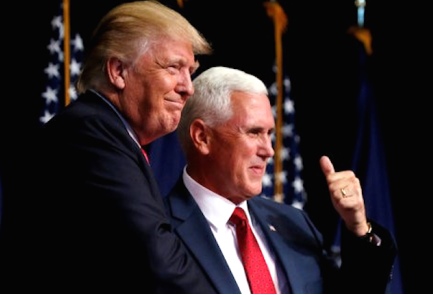
U.S. President-elect Donald Trump and Vice President-elect Mike Pence
Photo credit: Reuters
|
It was in March, during the presidential primaries in Florida and Ohio, that I realized something about the 2016 U.S. presidential elections just wasn’t right. Miami was another stop along my journey providing election coverage in the most insane presidential race anyone had ever seen.
There were days when the hype was all about the giant wall Republican candidate Donald Trump had promised to build on the Mexican border to prevent illegal immigrants from crossing into the United States. Trump’s rhetoric was something no other candidate dared utter, and the media across the board declared he didn’t stand a chance. Even the GOP couldn’t relate to him. “When Nov. 8 arrives, Latino voters will get their revenge — if he even gets the nomination,” they vowed.
So I toured Little Havana, a big Miami neighborhood densely populated by Cubans. I expected to hear blasphemy about the billionaire candidate, but instead I met many who told me, without hesitation, that they would vote for Trump, who at that time was still against two other presidential hopefuls with Cuban roots: Florida Senator Marco Rubio and Texas Senator Ted Cruz. I was shocked. American media was painting Trump as public enemy number one to Latinos, but here I was, in the heart of a Cuban neighborhood, and I was finding the opposite.
It was then that I understood that we had to draw a clear line between reality and what we read in the papers, heard on the news and saw in the polls.
Teresa, a cashier at a local department store, said Latinos are both Catholic and conservative and that Democratic presidential nominees Hillary Clinton and her rival Bernie Sanders were just too secular. Beyond that, she said, she and her relatives are not interested in seeing any more immigrants enter the country. Life is difficult enough already, she explained, and they can’t make ends meet as it is.
I asked her if she didn’t feel any solidarity with them. “We have solidarity,” she said. “It’s reserved for family.” As you may recall, after Trump won in the primaries, Rubio dropped out and the rest, as they say, is history.
Ten days ago, I went back to Miami. The same media that had bet Trump would not last more than one or two rounds in the primaries was continuing to cover the elections and managing to get it wrong. Trump continued to speak about building a wall during his campaign rallies in Florida, and the pundits continued to claim that his chances of winning the presidency were slim to none. One week before the election, the New York Times magnanimously gave him a 5% chance of being elected president.
I arrived in Miami the same day as a scheduled campaign rally. I headed over and was again surprised to see women everywhere. It was right in the midst of Trump’s latest scandal — numerous allegations of sexual assault spanning decades, following the release of a lewd audio recording of Trump from 2005. Trump was blasted as a misogynist, the enemy of women.
But the women were there. There were Latinos as well. And even quite a few Hispanic women, a demographic combination that according to the polls, the commentators and every single expert could not possibly be pro-Trump. A woman named Miguella told me that the Federation of Cuban Women was endorsing Trump, I saw the stark divide between what was being published in the papers and the reality in the field.
Maybe that’s why Trump’s victory in the presidential election was not really a surprise or some phenomenon that negates the laws of nature, as many tried to claim. Trump had supporters across a wide and diverse range of populations. Amongst Cubans, he beat Clinton with an overwhelming majority of 55% versus her 42%. Remember, the pundits explained that in Florida, Latinos were flocking to the polls and that this made Trump’s chances of winning in this vital states quite slim.
A vote of fury
In the ballroom of the Hilton Manhattan this week, the audience erupted into joyful cries each and every time another state fell into their colorful candidate’s lap. One cry stood out from the others came when Florida, a national symbol of voter dissidence in the U.S. since the 2000 election, turned red.
The same was true with other states. In Pennsylvania, the story was similar. Commentators explained that the state had not fallen into red hands since 1988. The last Republican to snag it was George H.W. Bush, who won the state in part thanks to his predecessor, Ronald Reagan.
But in reality the situation on the ground was entirely different. While the American media chose to highlight the drastic decline in the unemployment rate, celebrating a record low in 40 years with reports claiming 5% unemployment, I saw the despair, depression and distress that lined the streets of Mayfair, Philadelphia.
Who would believe it? Americans, promised the American dream by a president who sits in the White House, are being shut out. No matter where I went in the small town, I met Trump sympathizers upon Trump sympathizers. I couldn’t understand how they were not being polled, but they did promise to make themselves heard come Election Day.
Pennsylvania, much like Michigan, does not hold early voting. Meanwhile, the media constantly cited the 40 Million voters who fulfilled their civic duty before Nov. 8, like trophies in the pocket of the democratic candidate. No reference to the rage brewing in those small towns, not a word on the fact that Clinton wasn’t offering hope or more importantly, any enthusiasm.
In terms of communication there was just one important thing: Clinton, despite the negative polls, was still held in higher esteem than Trump. The polls pegged her disapproval ratings at 54% , versus Trump’s 61%. But, of course, this figure proved inaccurate as well. No one really wanted Clinton as president, aside from her own family, and she was kind of forced on everyone in the Democratic Party. On the other hand, while there were some that disliked Trump, there were many who admired the man and the phenomenon.
It was enough to attend one of Trump’s rallies and just compare them to Clinton’s. The Democratic candidate had audiences in the hundreds who showed restraint, while the Republican candidate had a fandom that turned out in droves. Since I was at Obama’s last rally in the 2008 presidential campaign, which was a huge, exciting and even historic event leading up to the election of the first African American president in U.S. history, I wanted to check out Clinton’s final rally, to compare.
In 2008, Obama didn’t need anyone at all. This week, Clinton needed famous artists like Jon Bon Jovi and Bruce Springsteen, as well as her boss from her time as secretary of state. President Obama and the First Lady Michelle Obama were there, as was Clinton’s husband, former President Bill Clinton, and their daughter, Chelsea. Later, by the way, Clinton went down to North Carolina because she had a feeling that something bad was going on among voters, and there, Lady Gaga joined the party.
Clinton thought that Beyonce, her husband rapper Jay Z or Lady Gaga could meet the cultural needs of all Americans. But in the small neighborhoods of Pennsylvania, Beyonce was the last thing on their minds. In the African-American neighborhoods in those states, people had trouble understanding why, after eight years of Obama, their children were still dying from crime, and they were still relying on food stamps instead of finding employment. But the Democrats and the media were adamant about maintaining their alternate universe, where everything was fine and everyone was voting, and voting right.
I left Clinton’s rally in Independence Square in Philadelphia and I saw how many left the event with me she still stood at the podium. I left in order to catch my train and they left because they saw what they came to see: the president and the first lady. And it was then that I understood that something really was wrong with the Clinton campaign. They claimed that the email scandal dogging her didn’t matter, neither did the Benghazi affair nor the millions in the bank, and not even WikiLeaks. But the feeling this week was tinged with a bitter taste. America hit the polls angry and reeling. They may not have liked either candidate but they were really vexed by one in particular.
Clinton was meant to be Obama’s successor, and he had failed them. Seventy-seven percent of the furious electorate chose Trump — a protest vote if ever there was one. The pundits failed to take that into account as well, as did Clinton’s campaign. They wanted to believe that Obama was the greatest thing since sliced bread. But this simply wasn’t true. The president’s economic policy doesn’t jive with the American spirit, with a nation that believes in a policy like Trump’s. The 8 million-person increase in Americans reliant on food stamps since Obama took office certainly didn’t help with national pride. We’re in America, remember?
Another claim also proved false: The media explained to us that educated people were voting for Clinton while the uneducated were voting for Trump. On the eve of the election, we learned that half of those with higher education voted for Trump. In other words, the pundits claimed that Trump’s voters needed to be white men, crude, uneducated, not particularly rich and living in the Rust Belt. But we found Trump everywhere we looked. The liberals may be the ones who were locked in. Even in Manhattan this week, I found that the man had quite a few supporters. At the newsstand, I wasn’t the only one who purchased a few copies as souvenirs, even when a young mother there looked at us with distaste and said, “I don’t let that kind of smut into my house.”
In the end, the election proved that while Clinton may have been the “right” choice, she was there at the wrong time, just as Trump was the “wrong” candidate at the right time. Only time will tell if Trump truly was the wrong candidate. This may be a good time to mention that during the election, there were some (though perhaps not many) who feared what Trump might do, but there were many more that feared what Clinton might do. And yes, that also made a difference.
Two terms and you’re done
Clinton was emotional as she gave her concession speech in New York Wednesday. She received applause but left the Democratic Party directionless. Sanders, the socialist, managed to undermine her candidacy and the foundations of the party. Her campaign often spoke about the problems in the Republican Party and predicted it would lose the House and the Senate in the parallel races on Nov. 8, but the end, the Republican maintained their tight grip on both.
Compassion for Clinton will soon turn to anger. She failed in two presidential elections (2008 and 2016) and if you examine voter distribution, the overall sentiment, and the person voters wanted as their candidate, you will conclude that the person who was supposed to lead the Democrats in this election was Joe Biden. But Clinton decided that it would be her. She was smug; she thought that she deserved it because “her time had come,” that the time had come for a woman to smash the glass ceiling, which for itself is certainly true. She was convinced that she could leverage Obama’s popularity, but she forgot that American voters were simply not excited about a third Democratic term, unless your name is Roosevelt, in which case they’ll go for a fourth as well. The last time that the same party managed to win a third consecutive campaign was when the Republicans won with Bush in 1988. Since then, it’s been two terms and you’re done.
Clinton also represented the past. Not just because of her name, but also because she was the kind of candidate that ran with programs, laws and detailed proposals — instead of on a vision. Trump, like Reagan and Obama, ran on a vision and knew how to pluck heartstrings, something that Clinton just couldn’t seem to muster. While she demonstrated knowledge and skills, both during the debates and during her rallies, she didn’t have the thing that makes the difference — that elusive thing that every American candidate needs to win the presidency. She needed to be larger than life.
Much has been said about the fact that both candidates in this insane rate were not particularly promising. Much has been said about the fact both had high disapproval ratings. The Wall Street Journal even ruled that these were the least popular presidential candidates in U.S. history. But when this was mentioned again and again, they forgot to take into account the fact that one of the candidates — Trump — had star power. After two terms with the Obama administration, during which many were left behind, it’s no wonder that millions saw Trump as a savior. Just as they saw Obama eight years ago.
Politico, yet another website that failed to predict the elections’ outcome, speculated that it might come a few days prior to the election but gave Trump a very tenuous path to victory. They admitted that they did not think that the “Trumpquake” would include aftershocks. But it did. And despite having been burned in the primaries, Politico didn’t learn their lesson.
There is no doubt that “Trumpquake” was an expression of protest. But it was also a revolt against the pundits, against Washington, against the establishment, the media, politicians; against anyone who tried to dictate the outcome to the America public; and against those who think that you need to abide by the rules – which, of course, are their rules. Trump has proven that you don’t have to be politically correct and you can still stay in the race. He was not endorsed by any major newspaper, unless you count the Las Vegas Review Journal.
Washington was furious when Trump, during the third debate, stated that he would not accept the results if he lost – claiming that it might indicate a rigged election. Later, he announced he would accept the results — but only if he won, of course. At Trump’s campaign headquarters, where staffing changes were a regular occurrence, they talked endlessly of rigged elections. Clinton might have experience as a senator and secretary of state under her belt, but in the 2016 presidential election, these were disadvantages. As far as voters were concerned, Trump had done more. While she toured the world on the taxpayers’ dime, he worked hard and built an empire.
The fact that university graduates were distributed equally among candidates only shows just how wrong the pollsters were. The contrast between his appeal versus her lack of charisma, particularly in swing states, which have high concentrations of minorities, made a difference as well. Clinton just couldn’t get the number of Hispanic, African-American and particularly young people that she needed. It’s true, at her rally that I attended this week, there were a lot of young people.
Trump defeated Clinton in the small towns of the Rust Belt in Michigan, Wisconsin and Pennsylvania, with huge margins.
She won fewer votes then the polls predicted, and as Trump’s campaign manager Kellyanne Conway predicted, we saw that even in the best cases, Clinton couldn’t make it past 45%. That’s when we realized that she was in trouble. There is no doubt that Clinton just couldn’t deliver.
But we must remember that Trump’s victory was not just a matter of luck or mathematics. He was a once-in-a-generation — once-in-a-lifetime, really — nominee. He managed to flip blue or light blue states that had long been stored in the Republican history books. Michigan since 1988, Wisconsin since 1984, Pennsylvania since 1988.
Pennsylvania in particular became the epicenter of Trumpquake. Now you can say that anyone who wins over the microcosm that is the keystone state can also be expected to win the presidential election.
History will focus on just how Donald Trump became the 45th president of the United States. Books will be written on this election, which will serve as the topic for many a thesis. Experts will take stock. This was a historic election that will be remembered hundreds of years from now. Trump was right when he told a group of supporters that ate lunch with him before the third debate that what would take place on Nov. 8 would be 10 times as huge as Britain’s Brexit.
The New Yorker magazine admitted their grave error this week. “We believed the polls more than we believed our own eyes,” they wrote. And that sentence summarized the 2016 election perfectly. Analysts and journalists chose to see the numbers, when what they should have been looking at were the people.
It is precisely because many forgot to look that they did not notice that something big was happening in America. And that’s precisely why they didn’t bet correctly on who the new tenant would be in the White House on Jan. 20, 2017. That’s right. That’s no lady, sir. That’s a man.


Leave a Reply