Khamenei sacks Qassem Soleimani from command of the Syrian war
Khamenei sacks Qassem Soleimani from command of the Syrian war, DEBKAfile, June 14, 2015
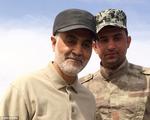 Gen . Qassem Soleimani on the Iraqi warfront
Uproar in Iran’s Revolutionary Guards Corps: Ayatollah Ali Khamenei has relieved Gen. Qassem Soleimani, the Al Qods Brigades chief and supreme commander of Iranian Middle East forces, of his Syria command after a series of war debacles. He was left in charge of Iran’s military and intelligence operations in Iraq, Yemen and Lebanon. This is revealed by DEBKAfile’s exclusive Iranian and intelligence sources.
Since Soleimani last visited Damascus on June 2, in the aftershock of the historic town of Palmyra’s fall to the Islamic State, the situation of President Bashar Assad and his army has gone from bad to worse.
The Iranian general’s bravado in stating then that “In the next few days the world will be pleasantly surprised from what we (the IRGC) working with Syrian military commanders are preparing,” turned out to be empty rhetoric. The thousands of Iranian troops needed to rescue the Assad regime from more routs never materialized. Since then, the Syrian forces have been driven out of more places. Hizballah is not only stymied in its attempts to dislodge Syrian rebel advances in the strategic Qalamoun Mountains, it has failed to prevent the war spilling over into Lebanon. There is strong evidence that the high Iranian command in charge of the Syrian and Lebanese arenas are stuck.
These reverses have occurred, our military sources report, owing to Tehran’s failure to foresee five developments:
1. The launching of a combined effort by the US, Saudi Arabia, Qatar and the UAE – among the wealthiest nations in the world – in support of rebel groups fighting Bashar Assad. Their massive injections of military assistance, weapons and financial resources have thrown Iran’s limitation into bold relief.
2. The ineptitude of the Shiite militias mustered by Soleimani in Iraq, Pakistan and Afghanistan to fight Iran’s wars in Syria and Iraq. None of those imported troops met the combat standards required in those arenas and become liabilities rather than assets.
3. Those shortcomings forced Tehran to admit that it had come up short of military manpower to deploy in four ongoing warfronts: Syria, Yemen, Lebanon and Iraq. Soleimani took flak for the over-ambitious plans he authored which pulled Iran into military commitments that overtaxed its resources and did not take into account the messy political and military consequences which followed. Above all, he miscalculated the numbers of fighting strength needed on the ground for winning battles in those wars.
4. In the final reckoning, Iran finds has been drained of the strategic reserves that should have been set aside for the contingency of a potential ISIS encroachment of its territory.
Explore posts in the same categories: Iran - Iraq war, Iran - Syria war, Khamenei, Qassem Soleimani, Syria warTags: Iran - Iraq war, Iran - Syria war, Khamenei, Qassem Soleimani, Syria war
You can skip to the end and leave a response. Pinging is currently not allowed. WarSclerotic
June 24, 2015 at 10:07 PM
Good article and good news. So Soleimani is full of baloney after all.
June 24, 2015 at 10:34 PM
No good news, what if the replacement is a lot more competent
June 24, 2015 at 10:53 PM
True. Maybe we’ll get a Major Pepperoni this time.
June 24, 2015 at 11:05 PM
Extra goat cheese ?
June 24, 2015 at 11:09 PM
LOL
June 24, 2015 at 11:39 PM
More fun, the bright future, not even a common sense reaction.
June 24, 2015 at 11:34 PM
A real General speaks to us yesterday and today:
“You won’t have to say…well…I shoveled shit in Louisiana.”
June 24, 2015 at 11:53 PM
General George Patton was a real American hero—a legendary tactician with exceptional oratory skill, a giant of such combat prowess that the first tank designed after World War II bore his name.
He was also a professional grade anti-Semite.
After liberation, Patton oversaw United States operations for displaced persons camps in Europe. Well, not so much “oversaw” as treated Jews horrendously. In response to U.S. inspections of the camps, Patton journaled, “[The inspector believes] that the Displaced Person is a human being, which he is not, and this applies particularly to the Jews who are lower than animals.” He went on to say that the Jews had “no sense of human relationships,” and likens them to locusts.
Unfortunately, Patton wasn’t all talk. He let Nazis bunk with Jews and gave them positions of authority, disobeying General Eisenhower’s command to “de-Nazify” the camps.
Patton’s overseeing was so dreadful and cruel that after the inspection, President Truman, in a letter to Eisenhower, wrote, “We appear to be treating the Jews as the Nazis treated them except that we do not exterminate them…One is led to wonder whether the German people…are not supposing that we are following or at least condoning Nazi policy.”
June 25, 2015 at 4:06 AM
I guess I should have just shoveled shit in Louisiana.
June 25, 2015 at 10:34 AM
If we wanna go forward we have to know or to learn our past , that is progress, not shit shoveling.
June 25, 2015 at 2:52 PM
I, for one, couldn’t imagine a past without General Patton. I’ll research this matter of anti-Semitism on the part of one of our greatest Generals and get back with you. Meanwhile, I’ll continue to educate myself in my own time and manner. Thanks.
June 25, 2015 at 3:01 PM
of course , that is your prerogative .
1) http://www.jewishpost.com/archives/news/the-power-of-prejudice.html
2) http://thejewniverse.com/2015/general-patton-hero-anti-semite/
3) http://www.southerninstitute.info/holocaust_education/dsindex.html
special in this context http://www.southerninstitute.info/holocaust_education/ds9.html#america
June 25, 2015 at 3:21 PM
Obviously, I won’t have the last word here, so here’s something to further our education about General Patton:
Source:
https://www.jewishvirtuallibrary.org/jsource/Holocaust/usarmy_holo.html
Excerpts:
Concerning Patton seeing the horror left behind by the Nazis:
“Patton became physically ill. Eisenhower turned white at the scene inside the gates, but insisted on seeing the entire camp.”
“Bradley later wrote about the day: “The smell of death overwhelmed us.” Patton, whose reputation for toughness was legendary, was overcome. He refused to enter a room where the bodies of naked men who had starved to death were piled, saying “he would get sick if he did so,”
“General Patton was so angry at what he found at Buchenwald that he ordered the Military Police to go to Weimar, four miles away, and bring back 1,000 civilians to see what their leaders had done, to witness what some human beings could do to others.”
June 25, 2015 at 3:35 PM
why not quoting complete LS ?
American troops who liberated the concentration camps felt sympathy for the Jewish DPs, and many Jewish GIS and officers went out of their way to assist the survivors. But that sympathy did not extend to men who arrived on following troop rotations. Unfamiliar with history and facts, they had little or no sympathy for the Jews. It did not help that concentration camp survivors mistrusted people, were hypersensitive, and had acquired habits that did not compare favorably with the local German and Austrian population. Some objected to the fact that they took care of their biological needs in hallways and outside; one officer provided a simple solution of latrines and the problem ceased.
Americans’ contacts with antisemitic Germans stirred up innate personal prejudices held by troops. Some American commanders suspected that the DPs from Eastern Europe included Soviet agents, and that Jews had a predisposition to communist beliefs. The Army also treated the DPs as if they stood in the way of the pre-Cold-War rush to rehabilitate Germany. By June 1945, conflicts were heated enough for President Truman to send Earl G. Harrison to the American Zone on a fact-finding mission. His visit was complete with political overtones and his report was a bombshell.
His conclusions were harsh, even overstated:
We appear to be treating the Jews as the Nazis treated them except that we do not exterminate them. They are in concentration camps in large numbers under our military guard instead of SS troops. One is led to wonder whether the German people seeing this are not supposing that we are following or at least condoning Nazi policy.
His recommendations were equally dramatic:
Jews must be recognized as Jews. They should be evacuated from Germany quickly. One hundred thousand Jews should be admitted to Palestine. President Truman endorsed the Report, rebuked the army, and intensified pressure on Britain. He opened up the United States for limited immigration.
https://www.jewishvirtuallibrary.org/jsource/Holocaust/usarmy_holo.html
June 25, 2015 at 3:40 PM
From April 1945 to the summer of 1947, the Jewish DP population in the American Zone exploded from 30,000 to 250,000 as the Jews fled the Soviet Bloc. The Jews had no place else to go, since no one would take them in. As their needs grew, and U.S. Army charged with caring for them was being restricted by budget cuts, the U.S. tried to transfer control of the Jews to the local German governments, which the Jews refused to accept under any circumstances.
On April 19, 1947, General Lucius Clay, commander of the American forces in Germany closed the borders to the American Zone and denied UN aid to newcomers, but 12,000 Jews from Romania and Hungary managed to enter. The American Army usually closed their eyes to illegal immigration, especially when the immigrants were Jews. But as time went by, and troops were replaced, the communication, tolerance, and relationships deteriorated between the Americans and the Jews, especially in matters concerning the black market, which led to raids and even violence.
When Israel was established in May 1948 and Congress passed the Wiley-Revercomb Displaced Persons bill allowing 100,000 DPs to come to America, the situation changed again. The camps were essentially empty and changed the Army’s attitude to those who remained behind.
At the end of the day, the Army has been praised by some historians and scholars, and reviled by others. Typical are Abraham Hyman who calls the postwar period and the Army’s treatment of the Jewish DPs the Army’s finest hours. Leonard Dinnerstein, a historian, criticized the Army for being insensitive and unduly harsh.
June 25, 2015 at 4:13 AM
He did beat the hell out of the Nazis. That ought to be worth something. Besides, he’s an American hero and I admire the man. I had the priviledge of seeing his son in person at a demolition derby in Houston years ago. He drove an M40 tank over several cars at a high rate of speed becoming airborne on each pass. Poor fellow ended up breaking his collar bone in the process.
June 25, 2015 at 10:30 AM
No doubts about his quality as general , historical as being a FACT ,and that is worth A LOT ,and we can be thankful for that, but for the rest just a lunatic .
Very useful in times of war, after the war just park him in a nice place and keep him quiet.
Personally i have more with Mac Arthur , he handles the Japanese very good after the war , by understanding the culture.
If you look at a figure as Paul Bremer , who has no fricking clue about the culture in Iraq and force against all advise his ideas on the people and so create the resistance where we have to pay the price for till today.
He had the exceptional ability to change in a short time the atmosphere from USA liberators to USA enemy
Mac Arthur would handled this a way better, but why would you read a book or 2 if you have to handle something easy as the middle east.
That is just a prime example of the arrogant attitude from a lot of USA citizens, the exceptional occupants of the shinning house on the hill, outside the borders of the USA the world is grey on the map.
That is the whole time in all my comments the point , come down from your ivory tower ( not personally meant )
This attitude reflect in the politics on both sides of the ally and endanger the world, in times of trouble this attitude will gain strength and will lead to war.
June 25, 2015 at 5:27 PM
Reblogged this on boudicabpi2015 and commented:
Khamenei sacks Qassem Soleimani from command of the Syrian war