2014: Iran out, Global Jihad in
(That seems unlikely, but when surrounded by alligators it’s difficult to decide which to try to fend off first. DM)
2014: Iran out, Global Jihad in — Haaretz, Amos Harel and Gili Cohen | Jan. 30, 2014
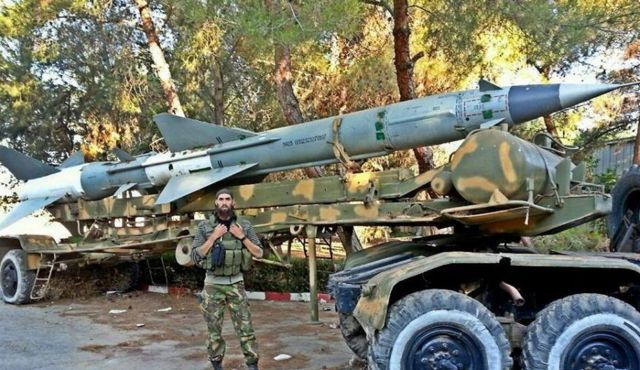 A member of the Mujahideen militia in Syria, last month. Photo by AP
If one of Israel’s enemies had chosen to launch a surprise attack on the country this past Wednesday, the defense establishment might not have been completely prepared. In a rare situation, the four top officers in the Israel Defense Forces were busy giving long, comprehensive talks that day. A day earlier, the defense minister, Moshe Ya’alon, gave a detailed strategic address of his own. Maybe it’s a good thing that Syria and Hezbollah have other things to worry about just now.
The dense cluster of speeches was sheer coincidence. Senior IDF officers don’t usually give public lectures, still less media interviews. But this week, a number of conferences took place. The director of Military Intelligence, Maj. Gen. Aviv Kochavi, spoke at a conference organized by the Institute of National Security Studies at Tel Aviv University. The chief of staff, Lt. Gen. Benny Gantz, and his deputy, Maj. Gen. Gadi Eizenkot, addressed a conference at the Interdisciplinary Center in Herzliya; and the commander of the air force, Maj. Gen. Amir Eshel, was one of the speakers at a conference held by the Fisher Institute for Air and Space Strategic Studies.
The retired general Ya’alon, also speaking at INSS, and the four generals under him sounded quite coordinated. No glitches cropped up in the message conveyed by the defense establishment, despite the unusually complex strategic circumstances prevailing at this time. Here are some of the key points of the five speeches:
• Iran: “Our focal point in the period ahead and overall will be Iran,” Gantz said a year ago, at the last INSS conference. But this week, the chief of staff barely mentioned the Iranian nuclear project in his talk. Maj. Gen. Eshel identified a positive trend “when inspectors arrive in Iran and dismantle centrifuges.” DMI Kochavi was more circumspect: “The nuclear project is continuing, but it has been slowed. We now have to wait and see whether the [diplomatic] process will bring about something effective.”
Only the defense minister was somewhat more expansive – and pessimistic. The Geneva agreement of this past November, Ya’alon said, is “a historic missed opportunity.” The Iranians, he explained, are deceiving the international community. Their goal is to consolidate themselves at a starting point that will allow them to become a nuclear power when they wish. The “messianic regime” (not the first time the defense minister has used that word of late) in Tehran, Ya’alon said, is “the No. 1 threat to regional and world stability.”
An Israeli military threat against Iran is not in the cards now, one can conclude. Israel is in a waiting posture until the results of the Geneva agreement become clear.
• Global Jihad: The thousands of words that were devoted to Iran a year ago gave way this week to the new threat on Israel’s borders: Tens of thousands of terrorists from jihadist organizations that identify with the ideas of Al-Qaida are now present not only in Syria, but also in Lebanon and the Sinai Peninsula. Kochavi noted that some of the jihadist volunteers are from Europe, North America and Australia. Ya’alon said that the developing threat should be seen in the proper proportions: At this stage, the extremist groups are occupied mainly with trying to topple the Arab regimes. Implicit in his remarks was the notion that their hostility to Israel will be given concrete expression only at a later stage. The defense minister pointed out that Israel had twice exercised caution in its responses to Katyusha rocket fire from Lebanon, in order not to play into the hands of the Sunni jihadist organizations, which want to trigger a confrontation between Israel and Hezbollah.
• The upheaval in the Arab world: All the speakers described this development as presenting a mixture of threats and opportunities to Israel. “The IDF does not generate threats with the aim of enlarging its budget,” the air force commander emphasized. Kochavi observed that the Syrian army is at its lowest level of fitness since its founding, as a result of the prolonged civil war. Ya’alon painted a picture that is neither black nor white, “but diverse and colorful” – a clash between the radical Shi’ite axis and Sunni jihadist forces, with the ensuing concern of the more moderate Sunni states (Egypt, Jordan and some of the Gulf states) creating a positive confluence of interests with Israel.
Gantz remarked, “If I look at Syria in terms of what the future holds, and do a strategic heads or tails, it comes out negative in either case.” The victory of either side – whether President Bashar Assad or the extremist Sunni organizations now in the forefront of the opposition’s struggle – will not be good for Israel, the chief of staff said. However, Gantz did not go on to draw the logical conclusion from his analysis, namely that Israel therefore would probably like to see the fighting continue, despite the dangers it holds for regional stability.
• The rocket and missile threat: It turns out that this threat both increased and decreased during the past year. A year and two years ago, Kochavi referred to 200,000 rockets and missiles that were aimed at Israel. This year the news is a bit better: The number has fallen to 170,000. This is due primarily to the fact that the Syrian army has used tens of thousands of rockets in its war against the rebels. The bad news, though, is that the number of rockets in Hezbollah’s possession has grown to “more than 100,000” (Ya’alon), whereas the conventional estimate until recently had been 75,000.
Furthermore, the missiles have become “heavier and more accurate,” and, says Kochavi, Hezbollah has a larger missile arsenal than most countries. According to Eizenkot: “The enemy uses civilians [as human shields] to attack our civilians. The question is how to legitimize a move against him. Everyone is familiar with the international criticism sounded against us because of combat in built-up areas, but the enemy created that reality. We will have to defend our civilians.”
• The Palestinians: The ranking officers shied well away from this issue. Ya’alon was more open, in a forum that was problematic for him – the INSS this week put forward a proposal for a “coordinated unilateral” Israeli withdrawal from most of the West Bank if the initiative by U.S. Secretary of State Kerry fails. The defense minister said that the Palestinian Authority is not a responsible neighbor that Israel can trust. He went on to dwell on the education issue. As long as the Palestinian educational system continues to incite its students against Israel, he said, it could take many more decades to achieve peace. Recalling that he had originally supported the Oslo process, he stated that for him, “it is not land that is holy but human life that is holy.” On the other hand, he said, if the area that Israel vacates is then used to launch terrorist attacks against its civilians, as happened in the past, the risk will not be worthwhile.
• Cyberspace, technology and intelligence: Gantz believes that Israel needs to do a lot more in the cyber realm. “We must not wait with this story,” the chief of staff said, without elaborating. Kochavi revealed that there were dozens of attacks in the past year against computerized systems of Israel’s security branches, “most of them, happily, unsuccessful.” The realm of cyber warfare, he predicted, “will turn out to be a greater revolution than the discovery of gunpowder and the potential of air power in the last century… The same intelligence work that used to be done with 40 people is now done with four.” Eshel spoke about tremendous advances in the air force’s ability to strike at multiple targets simultaneously. That ability is 15 times as great as it was seven and a half years ago, in the Second Lebanon War, he said.
• The defense budget: As was to be expected, most of the speakers took the opportunity to respond to the recent attacks on the size of the defense budget and especially on the contribution of the members of the career army. “The assault on career personnel is irresponsible,” Eshel said. “They are not the problem the state faces. On the contrary.” Gantz complained about the cancellation of two IDF multiyear plans and about the delay in approving the alternative program – the third submitted by the IDF to the cabinet. “We will not be able to allow ourselves a hollow or wretched army,” he said. “An army that does not project might invites others to take it on.”
The last remark bore an outward thrust. Ya’alon, Eizenkot, Eshel and Kochavi all spoke about the importance of Israel’s neighbors perceiving its strength if it is to maintain deterrence. The fact that Israel is seen as militarily strong and as being determined to attack anyone who threatens it, contributes to the relative security quiet that has prevailed here in the recent past, despite the chaos in the surrounding Arab world. Most of Israel’s preemptive activity takes place far across the border and far from the attention of the public and the media, but is well understood by the organizations and states in the region.
But Gantz’s comment can also be read in the opposite direction: inwardly. Without intending to, apparently, the chief of staff voiced what can be interpreted as self-criticism. Gantz deserves high regard for the businesslike, collegial atmosphere he has introduced in the General Staff following the grim years of confrontation that prevailed during the tenures of Ehud Barak and Gabi Ashkenazi. But there is also a certain disadvantage to this approach from the army’s point of view. Even though the defense establishment finally prevented the significant budget cut planned by the Finance Ministry, the atmosphere in the IDF in connection with these developments has been rather sour in recent months.
Most officers are unable to come to terms with the apparent contradiction: Why does the army have to fire 5,000 career personnel (to be replaced by 1,000 younger career people), even as the treasury insists that the budget was not actually cut? And above all, how did it come about that in the public mind, it has suddenly become legitimate to attack career army personnel for being parasites who take early retirement at the expense of the public?
If no major wars break out in Gantz’s final year as chief of staff, which will start next month, it’s possible that these questions, along with the structural reforms in the IDF and his status in the eyes of the public will shape the memory of his term. But the impression of many officers is that the relatively easygoing personality traits shared by the current defense leadership – Ya’alon, Gantz, Eizenkot and the director general of the Defense Ministry, Dan Harel – are not exactly tailor-made for this particular campaign.
Explore posts in the same categories: Uncategorized WarSclerotic
January 30, 2014 at 9:38 PM
Reblogged this on Dead Citizen's Rights Society.
January 30, 2014 at 9:49 PM
“That seems unlikely, but when surrounded by alligators it’s difficult to decide which to try to fend off first.”
Do like any good Cajun gator hunter would do. Take them out one by one in order of proximity. Usually, the bigger beasts will keep their distance waiting for the outcome and flee when the threat gets too close. 😉