
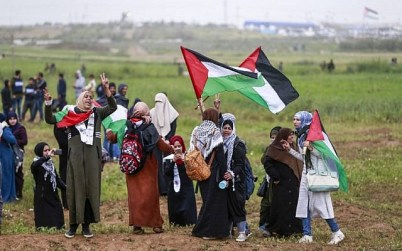
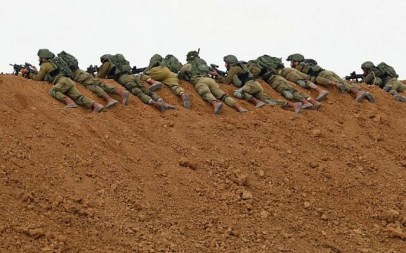
The Israel Defense Forces said 30,000 Palestinians took part in riots at the Gaza border Saturday afternoon, with some protesters throwing grenades and explosives toward the security fence as well as lobbing rocks and burning tires.
The army said soldiers responded with “riot dispersal means” and live fire in accordance with IDF regulations, noting that most Palestinians attending the anniversary of the “March of Return” protests remained at a distance from the border.
The Palestinian Red Crescent said 33 people were treated for injuries, including four who sustained wounds from live fire.
The Hamas-run Gaza interior ministry announced it deployed 8,000 security personnel along the border to prevent demonstrators from approaching the fence, Army Radio reported.
Meanwhile, a fire broke out in a farming community in southern Israel near the Gaza Strip on Saturday afternoon. Authorities said they were looking into whether an incendiary balloon launched from the enclave sparked the blaze.
Earlier on Saturday, Gaza health officials said Israeli troops shot and killed a Palestinian man near the perimeter fence, hours before the mass rally to mark the annual Palestinian Land Day and the one-year anniversary of the start of weekly March of Return border protests.
Mohammed Saad, 21, was killed by Israeli army fire east of Gaza City near the perimeter fence, Gaza’s Hamas-run health ministry said, adding he was hit by shrapnel in the head.
A Gaza hospital worker, speaking on condition of anonymity because he was not authorized to brief the media, said Saad was a member of the so-called “night disturbance unit.” Such groups routinely burn tires, flash laser lights and detonate explosives near the fence at night to distract soldiers and disturb residents of nearby Israeli communities.
Witnesses said Saad had been taking part in an overnight demonstration when he was hit.
The fatal shooting raised tensions at a time when Egyptian mediators, shuttling between Israel and Gaza’s Hamas rulers, were trying to broker a ceasefire deal that reportedly included proposed arrangements for preventing violence during Saturday’s protest.
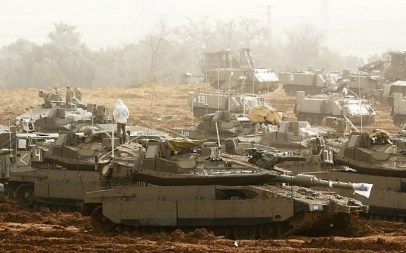
An Israeli army spokesman said about 200 Palestinians “rioted during the night along the fence” and that the army used riot dispersal means against them. There was no further elaboration or comment on Saad’s case.
On Saturday morning, Israeli troops arrested two Palestinian minors armed with knives attempting to breach the Gaza border fence, the IDF said in a statement. The teens were questioned and returned to the Strip.
Gaza’s health ministry announced Saturday morning that it had completed preparations for the planned protests, with hospitals and ambulances on stand-by ahead of the demonstrations. Field hospitals were set up at various points, and medical facilities in the Strip are on an emergency footing.

Meanwhile, Israel warned Palestinians against approaching or breaching the security fence during Saturday’s border protest. Through phone calls, messages, public statements and pamphlets dropped from aircraft, the IDF has told Palestinians in the Strip that any attempts to break through the border fence will be met with live fire.
The IDF’s Arabic-language spokesman on Saturday appealed directly to Gazans, saying benefits could be in store if they refrain from violence.
“According to Palestinian reports, if you don’t act violently or with terror today, significant measures will be implemented that can improve a variety of civilian fields in the Gaza Strip,” Avichay Adraee wrote on Facebook.
The Israeli military’s primary concern in the March of Return protests is that large groups of people will break through the fence, armed with guns, grenades and knives, and either enter one of the Israeli communities located a few hundred meters from the border and attack those inside, or kidnap soldiers stationed along the security fence.
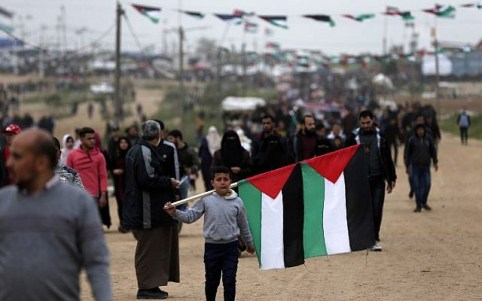
Palestinian Land Day marks a 1976 decision by the Israeli government to seize thousands of dunams (acres) of Arab-owned land in the Galilee region of northern Israel.
This year’s Land Day also marks a year since the start of weekly violent protests along the Israel-Gaza border, known as the “March of Return,” which at times have escalated into full-blown exchanges of fire between Israel and Palestinian terror groups in the coastal enclave, most recently earlier this week.
Israel maintains that the Hamas terror group appropriated the campaign for nefarious purposes, using the civilian protesters as cover for violent military activities.
The timing of the anniversary rally is sensitive for both sides.
Prime Minister Benjamin Netanyahu, who also serves as defense minister, is seeking his fourth consecutive term in April 9 elections, but is facing a serious challenge from a group of ex-army chiefs who have criticized what they say is his failed Gaza policy. He is also coming under attack over his policies from members of his coalition, including Education Minister Naftali Bennett, who has repeatedly called for wider military action in the enclave.
Hamas, meanwhile, faces growing unrest in Gaza, as a result of worsening humanitarian conditions.
Late Friday night, Hamas officials announced that a deal had been reached that would see the protesters refrain from approaching the border fence, in exchange for Israeli concessions. But there was no confirmation from Israel and it was unclear to what extent Hamas can control the protesters.
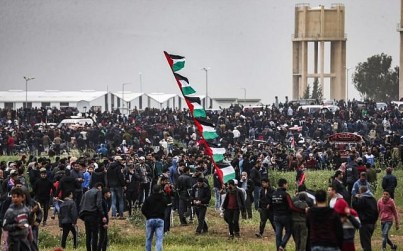
While demonstrations have taken place at least weekly since March last year, Hamas has been building up the anniversary protests for several months.
The group’s leader Ismail Haniyeh called for a million people to gather across five protest sites, and mosques in Gaza late Friday used loudspeakers to encourage a mass turnout. Palestinian media reported Haniyeh arrived at the border on Saturday afternoon, close to Gaza City.
Egypt has repeatedly tried to broker a ceasefire between Israel and Hamas, stepping up efforts in recent days after a Gaza rocket struck a house in central Israel earlier this week, injuring seven Israelis and threatening renewed escalation.
Palestinians with knowledge of the talks said that as part of the proposed deal, Gaza protesters were to keep away from the fence Saturday and Israeli troops were to hold their fire.
Under the Egyptian plan, Israel was to offer economic incentives for Gaza in exchange for calm, according to Palestinian officials.
Judah Ari Gross contributed to this report.
 WarSclerotic
March 30, 2019 at 3:15 PM
Haniyeh said that Hamas continues to “coordinate intensely with our brothers in Qatar.”
Hamas spokesperson Fawzi Barhoum said that “today’s marches are a message of power from the rightful owners of occupied lands.”
The Palestinian resistance is ready for any scenario,” Barhoum continued. “If Israel does not meet our demands, the resistance is ready to respond and change the equation. Today, we are at a crossroads in dealing with Israel, which is now being tested as to whether it will continue with murder and violence.”
https://www.jpost.com/Arab-Israeli-Conflict/Haniyeh-arrives-at-Gaza-border-demonstration-6000-protesters-along-fence-585223