
Iran controls the new Lebanese government via its proxy Hezbollah group, Prime Minister Benjamin Netanyahu said Sunday, in his first public comments on the government formed in Beirut last week.
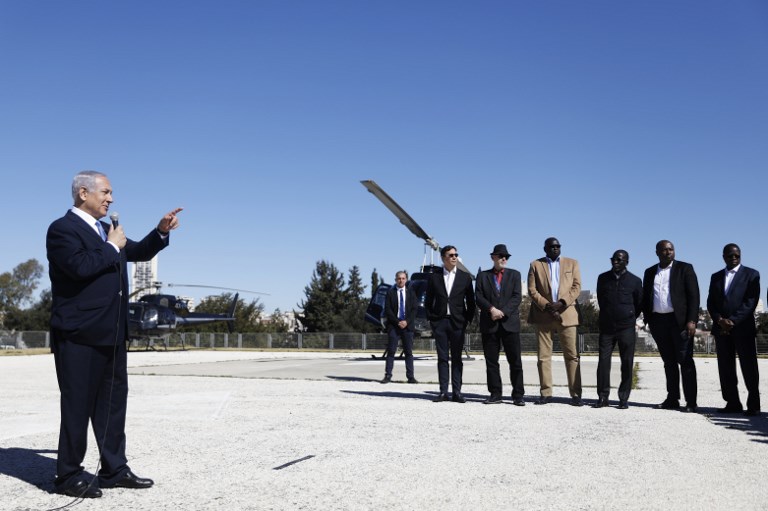
“Iran has proxies. One of them is Hezbollah. Hezbollah just joined the government of Lebanon. That’s a misnomer; they actually control the government of Lebanon. It means that Iran controls the government of Lebanon,” he told a group of 40 ambassadors to the United Nations.
Netanyahu was briefing the delegation, headed by Israel’s UN envoy Danny Danon, just before they headed to Israel’s northern border to inspect one of Hezbollah’s cross-border attack tunnels.
“It’s important to send this very powerful message just as we stop the terror tunnels coming into Israel: We will stop all the aggression, from Lebanon or from Syria or from Iran itself,” Netanyahu said.
“We are committed to preventing this aggression, and in so doing we’re not only protecting Israel itself, but also protecting our neighbors and world peace.”
On Thursday, political factions in Lebanon ended a nine-month deadlock and agreed on a new government, which saw a strengthening of the Shiite terrorist group.
Hezbollah now holds two ministries and a ministry of state, including for the first time the Health Ministry, which has one of the country’s largest budgets. The Finance Ministry remains in the hands of a Hezbollah ally, Ali Hassan Khalil.
Speaking to the ambassadors outside his Jerusalem residence, Netanyahu lambasted the UN’s perceived anti-Israel bias, urging the diplomats to work toward improving their respective capitals’ voting pattern on Israel.
“The fact that you’re here represents the fairness and integrity of your approach. I wish that this characterized the UN,” he said. In 2018, the UN General Assembly passed 20 resolutions against Israel and only six against the rest of the world.
“It’s obviously absurd,” he said. “But the important thing is not only merely to see the truth, as you will during this visit, but also to speak the truth and, may I say, to vote the truth.”
Netanyahu agreed to host the ambassadors because he has a “non-hidden agenda,” he added.
“We want to see you change your votes. To those of who have already done it, thank you. To those who will do it, thank you in advance,” he said.
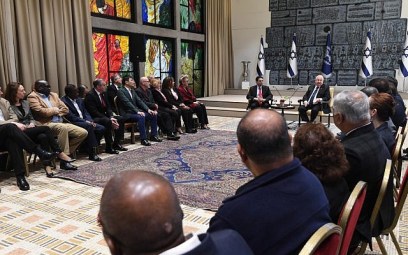
Earlier on Sunday, President Reuven Rivlin told the delegation about the importance Israel attaches to the UN, but also lamented the “unfair decisions” some of its agencies make.
“The UN is the most important international forum for us and for the world,” he said. “Some UN bodies take unfair decisions about Israel. Double standards and discrimination must not detract from the UN’s important work.”
It was in the hands of the ambassadors to effect a change in the UN’s attitude toward Israel, the president added. “Please ensure that our good bilateral relations are also how you relate to Israel at the UN.”
The ambassadors hailed from all continents, including countries such as Panama, Ukraine, Hungary, Czech Republic, Liberia and Mongolia.
Also on Sunday, Danon took the ambassadors on a tour through Jerusalem, including a visit at the Western Wall.
Bringing UN envoys to Israel is important, “because some of them continue in their careers and become leaders,” Danon told The Times of Israel.

 Ambassador Danny Danon | דני דנון
✔@dannydanon
It was an honor to bring together the Ambassadors’ Delegation with Prime Minister @netanyahu. The visit of the Delegation is further proof that #Israel diplomatic ties are flourishing.
Last year, for instance, Danon brought Sierra Leone’s UN ambassador, Adikalie Foday Sumah, to Israel. The visit left such an impression on the diplomat that after his term he returned to his country and established a Sierra Leone friendship organization that hopes to change the West African nation’s voting patterns at the UN and to strengthen bilateral relations.
“Sumah’s initiative is yet another welcome testimony to the enormous contribution of the Ambassadors’ Delegations to the State of Israel,” Danon said.
“These ambassadors return to their positions at the United Nations and to their countries with a positive attitude toward Israel. This is reflected in the voting patterns toward Israel, in ongoing cooperation and, as we see in Sierra Leone, in the establishment of local pro-Israel organizations.”
AP contributed to this report.
 WarSclerotic
Leave a comment