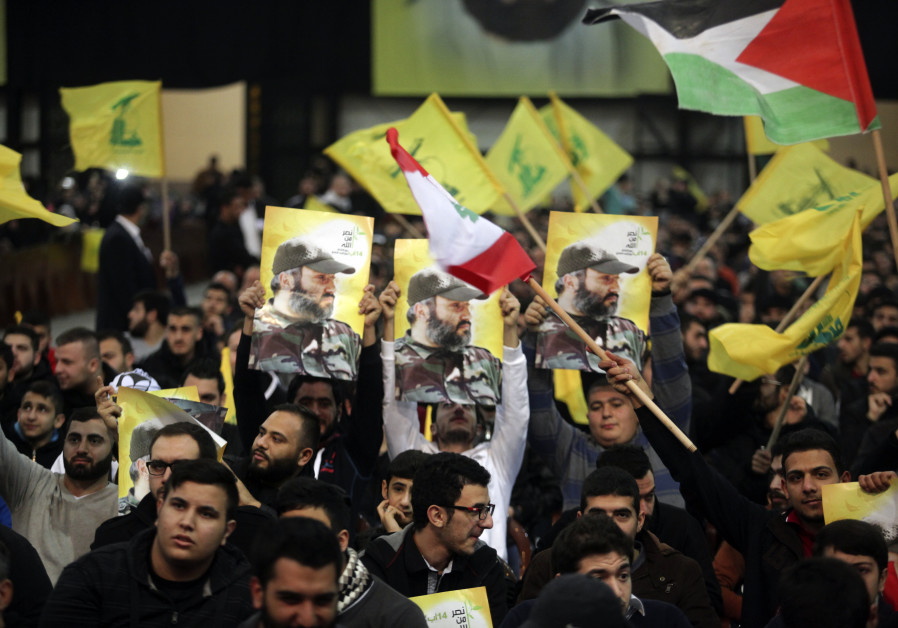
Hezbollah senior leaders and members were travelling to Damascus during the airstrikes that rocked areas west of the Syrian capital on Tuesday evening. They were reportedly hit during the air strikes leaving many questions as to why they were targeted and who they were.
Newsweek reported on Wednesday that Hezbollah leaders were targeted in the airstrikes. According to several sources, including the Lebanese website NewLebanon.info, the Hezbollah delegation was journeying to Damascus to board a flight bound for Tehran. They were heading to the funeral for Grand Ayatollah Mahmoud Hashemi Shahroudi, an important Iranian cleric who was head of the Expediency Discernment Council. He passed away on December 24 and senior Iranian religious figures buried him on Wednesday. Supreme Leader Ali Khamenei presided at the ceremonies according to Iranian Fars News. It now appears the Hezbollah delegation may have been heading to Damascus to board a flight to Tehran for the important event. Hezbollah and Iranian regime leaders regularly attend each others funerals and ceremonies. For instance IRGC Quds Force Commander Qasem Soleimani went to the grave of Jihad Mughniyeh in 2015 in Beirut.
The claim that the Hezbollah members were targeted and that they were traveling for the Shahroudi funeral has not been confirmed. Newsweek reported that a Department of Defense source had told them the strike was “conducted minutes after the leaders board a plane bound for Iran.” Strikes also targeted ammunition warehouses that held precision ammunition. The claim that the Hezbollah members had already boarded a plane has not been corroborated with any footage on the ground that shows a plane being hit. A strike on a plane at a Damascus airport would be a serious escalation. The report may be only partly accurate and may indicate the men were struck on the way to board a blame, not after they had boarded.
Syria’s state media SANA claims that Syrian air defense had “intercepted hostile missiles fired by Israeli warplanes from Lebanese territory and managed to drop most of the rockets before reaching their targets.” SANA says the airstrikes hit an ammunition depot and wounded only three soldiers. Several Syria observers, including the Twitter account @Syria_SR claimed the airstrikes were more complex than that, involving “55 munition, four waves [of cruise missiles] in 35 minutes and managed to hit 7 times in 2 different locations.” In response Syrian air defense fired 60 missiles to intercept the attack. Several Syrian SA-125 anti-air missiles misfired during the attempt to stop the attack, hitting areas around Damascus and causing confusion.
If the Hezbollah members were targeted it would not be the first time Hezbollah members have been struck in the same location on the roads that lead from Damascus over the mountains to Lebanon. For instance two Hezbollah members were killed in an airstrike near Dimas in December 2014. In addition in January 2015 “senior Hezbollah figures,” including Jihad Mughniyeh were killed near Quneitra. Mezzeh military airport was also struck in December 2016. Airstrikes also targeted an area near Saboura on the mountain road in November 2016 and in April 2017. The road that passes from Damascus via the Mezzeh military airport and Saboura, Dimas and then over to Lebanon is a 116km stretch of beautiful mountain driving that takes around 2 and a half hours on a normal day of traffic.
The allegation that the senior Hezbollah members were targeted on their way to the Shahroudi funeral has now been repeated by many sources on social media and online. Why would Hezbollah members expose themselves on the road to Damascus knowing that there have been tensions in the region in recent months. Did they feel safe, hoping Syria’s S-300 air defense system, supplied by Russia in the wake of the downing of a Russian IL-20 in September during an Israeli air strike, would provide them security? Targeted in the past on the same stretch of road they would have known its dangers. It doesn’t answer the final question of why they didn’t board a flight directly from Beirut and save themselves the drive and exposure.
Hezbollah media and pro-Syrian regime media has been silent on this issue. Iranian regime media has also been silent, discussing only the Syrian air defense system’s “success” at targeting the attack and continuing the story that only a warehouse was hit and several soldiers injured. In coming hours or days the Syrian regime or pro-Hezbollah media may begin to reveal what happened, especially if senior members of the group were killed they will want to hold lavish funerals for the “martyrs.” Hezbollah is often outspoken about these kinds of events. On December 3, for instance, Hezbollah claimed its member had not been hit in an alleged November 29 airstrike south of Damascus. This was to respond to rumors that its members had been targeted. Now the ball is in Hezbollah’s court once again to see if it will respond to the rumors from December 25 regarding its members being targeted.
 WarSclerotic
Leave a comment