Iran’s leader says Tehran-Moscow cooperation can isolate US
Source: Iran’s leader says Tehran-Moscow cooperation can isolate US – Israel Hayom
Ayatollah Ali Khamenei says Iran and Russia should work together to foster stability in the Middle East • Iranian President Hassan Rouhani says Tehran and Moscow are working together to end the civil war in Syria, fight against terrorism in the region.
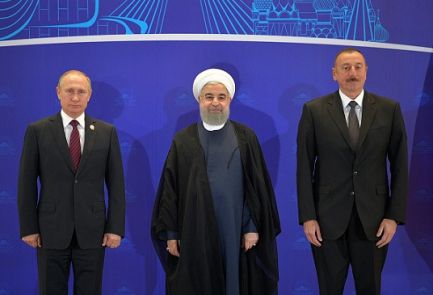 Russian President Vladimir Putin, Iranian President Hassan Rouhani and Azerbaijan’s President Ilham Aliyev in Tehran, Wednesday | Photo: EPA
|
Iranian Supreme Leader Ayatollah Ali Khamenei told visiting Russian President Vladimir Putin on Wednesday that Tehran and Moscow must step up cooperation to isolate the United States and help stabilize the Middle East, local media reported.
Iran and Russia are the main allies of Syrian President Bashar Assad, while the United States, Turkey and most Arab states support the rebel groups fighting to overthrow him.
Putin met Iranian political leaders in an effort to nurture a relationship strengthened since U.S. President Donald Trump threatened recently to abandon the international nuclear deal with Iran reached in 2015.
“Our cooperation can isolate America. The failure of U.S.-backed terrorists in Syria cannot be denied but Americans continue their plots,” Khamenei told Putin, according to Iranian state television.
Since Russia’s military intervention in Syria’s civil war in 2015, and with stepped-up Iranian military assistance, Assad has taken back large areas from rebels as well as swathes of central and eastern Syria from Islamic State terrorists.
Moscow is now trying to build on that success with a new diplomatic initiative, including a congress of Syria’s rival parties it is planning in the Black Sea resort of Sochi on Nov. 18, though a major opposition bloc has refused to take part.
The rapprochement between Iran and Russia is worrying for both Saudi Arabia, Shiite Muslim Tehran’s main Sunni rival for dominance in the Middle East, and the United States. Putin praised cooperation with Iran as “very productive.”
“We are managing to coordinate our positions on the Syrian issue,” Putin said.
Moscow is also an important ally for Iran in its renewed confrontation with the United States. “We oppose any unilateral change in the multilateral nuclear deal,” Putin told Khamenei, Iranian state TV reported.
Russia has criticised Trump’s disavowal of the nuclear agreement, which has opened a 60-day window for the U.S. Congress to act to reimpose economic sanctions on Iran, lifted under the 2015 accord in return for Tehran curbing its nuclear activity.
“This is a very important visit [by Putin]. It shows the determination of Tehran and Moscow to deepen their strategic alliance … which will shape the future of the Middle East,” an Iranian official said.
“Both Russia and Iran are under American pressure. … Tehran has no other choice but to rely on Moscow to ease the U.S. pressure,” the official said .
Another Iranian official said Trump’s hawkish policy on ran had united the Islamic republic’s often feuding leadership – split into hard-line conservative, pragmatist and reformist factions – in alignment with Russia.
During Putin’s visit, Russian oil producer Rosneft and the National Iranian Oil Company agreed on an outline deal to work on a number of “strategic” projects in Iran together worth up to $30 billion.
The deal appeared to dovetail with Putin’s strategy to reassert Russian political and economic influence in the Middle East that faded after the 1991 collapse of the Soviet Union.
Pragmatist Iranian President Hassan Rouhani echoed Khamenei, saying Iran and Russia together could tackle “regional terrorism” – an allusion to Sunni Muslim groups hostile to Iran, Assad and many other Arab states.
“Our cooperation has helped the fight against terrorism in the region … Together we can establish regional peace and security,” Rouhani said in a televised joint press conference with Putin and Azerbaijan President Ilham Aliyev, who took part in a three-way summit in Tehran.
Putin stressed that no one country could resolve the Syrian crisis on its own and upcoming November peace talks in Sochi to try to resolve the civil war crisis were positive.
The same day Syrian officials in the anti-Assad opposition rejected the meeting and insisted any talks be held under United Nations sponsorship in Geneva, the scene of a string of failed peace efforts.
 WarSclerotic
Leave a comment