Riding alongside the new sheriff
Source: Israel Hayom | Riding alongside the new sheriff
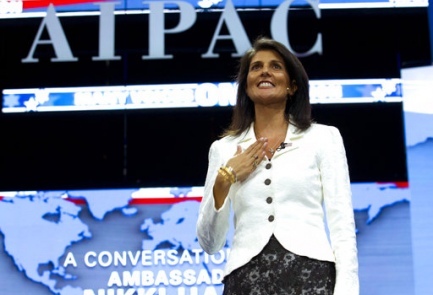
When U.S. Ambassador to the U.N. Nikki Haley told the AIPAC conference this week that the days of Israel-bashing at the U.N. were over, she received a standing ovation • The new political star may become the first woman to break the highest glass ceiling.
|
U.S. Ambassador to the U.N. Nikki Haley addresses the AIPAC conference in Washington this week
|
When U.S. Ambassador to the United Nations Nikki Haley was 5 years old, her parents signed her up for the Miss Bamberg pageant in her South Carolina hometown. The pageant traditionally crowned two winners, a white girl and a black girl. When Haley, the daughter of Indian immigrants, competed, the judges couldn’t decide to which group she belonged, and opted to disqualify her.
This week, it appears, the woman who was kicked out of the running for Miss Bamberg became the Jewish community’s Miss America.
But we’ll get to that in a moment.
Rewind to June 2015, when Dylan Roof’s shooting massacre at a black church in Charleston, South Carolina, horrified America. The murders touched on a raw nerve in an America that under then-President Barack Obama had hoped the interracial violence that had shaped the nation for the past 200 years was a thing of the past. Although there was no lack of incidents between police officers and black youths, or outrageous expressions of racism, a slaughter of black worshippers at a black church, in a southern state with a complicated past on race, exposed what the U.S. would have preferred to hide.
The massacre also reminded America, both black and white, that when it came to the painful, loaded issue of race, Obama had sold the U.S. a bill of goods. Even under the first African-American president, interracial tensions remained alive and kicking.
In the midst of the sorrowful, painful incident, one woman — Nikki Haley, then the governor of South Carolina — managed to turn lemons into lemonade. Almost overnight, Haley gave the American people an important lesson in citizenship. She harnessed the shared sense of shock to unite all parts of the state, across the political spectrum, and create a consensus virtually unprecedented in modern U.S. politics. The person who would become the anti-racism standard-bearer for an entire nation succeeded where many politicians had failed for decades — on the contentious matter of getting the Confederate flag removed from over the state house.
The Confederate Stars and Bars is seen by many as a flag that commemorates slavery and racism in America, even though others, including Haley, see it as the symbol of the rich legacy of the South. The battle over keeping the flag had created a decades-long rift, first when it flown over the state house itself, and then, following a compromise, in its courtyard. Attempts to fold up the flag and put it in a museum failed repeatedly.
Then Haley arrived. In a month she managed to bring the dispute to a respectable close and broadcast a sense of echoing optimism. From an obscure governor, Haley blossomed into America’s therapist, and her star began to rise in the national firmament. Her words convincing her fellow Republicans to support the bill to lower the flag (a two-third majority was necessary to pass the measure) will be long remembered: “That flag, while an integral part of our past, does not represent the future of our great state.”
America the beautiful
The brief, catchy campaign Haley led to remove the flag, and her ability to appeal to hearts and minds simultaneously, did not go unnoticed by businessman Donald Trump when he declared his candidacy for president. A little more than a year later, after he astonished the country by winning, he seems to have recalled how Haley managed to play on people’s optimism and feelings. We can assume he thought: We need a woman like this in the U.N., so she can do in international diplomacy what she did in politics in her southern state. Despite the mutual loathing the two had for each other during the presidential campaign, Haley took him up on his offer.
Looking back, we can say that Haley’s handling of the horrific slaughter in Charleston made her the new star of American politics.
At the annual AIPAC conference in Washington this week, Haley continued to shine. Without a doubt, she was the superstar of the event: For minutes at a time, the audience gave her a standing ovation, as did the interviewer on stage.
“The days of Israel-bashing are over. … There’s a new sheriff in town,” she said in a speech that moved the audience to tears.
Haley, a 45-year-old mother of two, was not just mouthing slogans. Barely two months have passed since Trump entered the White House, and the new U.S. ambassador to the U.N. is already signing, sealing, and delivering. She torpedoed the appointment of former Palestinian Authority Prime Minister Salam Fayyad as U.N. special envoy to Libya; she had a U.N. report that accused Israel of apartheid policies shelved, leading to the resignation of United Nations Undersecretary General and Executive Secretary for the Economic and Social Commission for Western Asia Rima Khalaf; and she boycotted the special (and biased) session of the U.N. Security Council held every year on Israel’s conduct in the “occupied territories,” a move that prompted Britain to take a new, refreshing line.
The staunchly pro-Israel AIPAC audience was amazed at what the new U.N. envoy was saying. Even when she described her bitter feelings over the damage done by the previous administration when it allowed the U.N. Security Council to pass Resolution 2334 (which declared the Israeli settlements an “obstacle to peace”), giving the Palestinians an important moral victory: “When Resolution 2334 happened, and the U.S. abstained … we had just done something that showed the United States at its weakest point ever. Never do we not have the backs of our friends. We don’t have a greater friend than Israel.”
Haley added that the passing of Resolution 2334 was “not only embarrassing, it was hurtful.”
Ironically, it was Trump — who has a deep loathing for the U.N. — who turned the organization into an important tool with which to improve the status of the U.S. He demonstrated how the U.N. has become a symbol of helplessness and international hypocrisy about Israel, and Haley is waging the campaign with an iron fist. U.S. Secretary of State Rex Tillerson may be conducting official negotiations and conduct, but the battle for hearts and minds and the U.S.’s stature in the world falls under Haley’s purview. She is America’s face in the important international forums that until now were handled by colorless officials. Haley’s appearance at the AIPAC conference sent another message: Trump doesn’t intend to sell out Israel to curry favor with anyone. Haley said that in the corridors of the U.N., everyone was “afraid” to discussed Resolution 2334 with her. And when it comes to the Iranian issue, Haley promised that Trump “will watch them [Iran] like a hawk.” Now that there’s a new sheriff in town, she is riding at his side, pistol drawn, ready for any showdown.
Looks of pity
Haley was born in Bamberg, South Carolina, on Jan. 20, 1972. Her parents, proud Sikhs Raj Kaur and Ajit Singh Randhawa, had immigrated to the U.S. from the Punjab region of India. Her father is a professor of biology; her mother has a master’s degree in education. They gave Haley her great love for America.
When she ran for governor of South Carolina in 2010, Haley began all her speeches with the same phrase: “I am the proud daughter of Indian immigrants who reminded my brothers, my sister and me every single day how blessed we were to live in this country.” This sentence was also the opening for her speech at the Republican national convention in Florida two years later, when Mitt Romney won the Republican presidential nomination.
I was in the audience that day. I heard her talking about her parents, who had such a profound influence on her worldview.
“They loved the fact that only in America could we be as successful as we wanted to be and nothing would stand in our way,” she said. “My parents started a business out of the living room of our home and, 30-plus years later, it was a multimillion dollar company.”
The audience was enchanted. Already she was being talked about as the future of the party, as the woman who could go far. Maybe all the way.
In the land of endless possibilities, Haley’s mother set up a small clothing shop. Haley studied accounting, and when she completed her degree began working as an accountant for a waste management company. She later transferred to the family business, Exotica International, and turned it into a flourishing textile venture.
It was actually a 2003 speech by then-New York Senator Hillary Clinton that prompted Haley to enter politics. Clinton urged people like her to listen to their hearts. But Haley says that her main role model was former British Prime Minister Margaret Thatcher.
Haley began her political career in 2004, when she ran for a seat in the South Carolina House of Representatives to represent a district in Lexington County. In her autobiography, “Can’t Is Not An Option: My American Story,” published in 2012, she describes the responses to her decision to run. There were people who gazed at her with pity, she writes. Other told her that she might be reaching a little too high, and suggested she consider running for the local school board. Only her parents and her husband, Michael Haley, supported her.
But this was only the beginning of her struggle. A political adviser she wanted to bring on board apologized and refused from the start, explaining that while she might be an “attractive woman,” she was only 31 and Indian, and her father wore a turban. The adviser said Haley’s district just wasn’t “ready for that.”
The adviser made a grave mistake. She won her district’s race for the state house, of course, and was eventually elected and re-elected governor.
A star for 2024?
Hillary Clinton had led her to realize anything was possible if a person wanted it enough. Haley became the first woman to serve as governor of South Carolina, and now she is the first Indian-American to represent the U.S. in the U.N. No one will hear any shame from her about her roots — she maintains close ties with the Indian community in the U.S., which insists on calling her by her birth name, Nimrata. On this, she differs greatly from former Louisiana Governor Bobby Jindal, the first Indian-American governor in the country, who has chosen to distance himself from his community.
Jindal, a year older than Haley, tried to win the Republican presidential nomination, but dropped out of the race in November 2015. Some claim that even if he became governor before she did, she is likely to beat him to the higher office at 1600 Pennsylvania Ave.
This was, without a doubt, Haley’s week. Jewish American websites vied to be most complimentary to her, and the 20,000 people who were present at the Verizon Auditorium in Washington still feel as though they took part in an historic event.
After the Charleston massacre, Haley was marked as someone who could put the Republicans back into the White House, thanks to her ability to approach the conservative, traditional base and minorities who are not particularly attracted to the Republican Party — much like Republican Cuban-American Sen. Marco Rubio.
This is also the reason why Haley was picked to make a rebuttal speech to Obama’s 2016 state of the nation address. In that speech, she criticized his conduct in the Middle East, saying America should sign deals that would give Israel, not Iran, cause to celebrate.
In 2016, some suggested naming Haley as the Republican vice presidential candidate. On May 4, 2016, when Trump had in effect won the Republican primaries, she rejected the idea.
But the Trump era is just beginning, and the president hopes it will continue for several more years. Haley is still young. Who knows? Maybe she’ll be the one to break the glass ceiling and be the first woman to lead the free world. The Republican Party recognizes her wonderful abilities.
“If you want to hear an inclusive leader who’s visionary, who’s got a path for the future, who’s brought people together, who’s unified, it’s Nikki Haley,” House Speaker Paul Ryan said in an interview with CNN last year.
This week, too, he was full of praise, and who knows? Maybe in 2024 he’ll be her vice presidential candidate when she runs for president. This could be the kind of full circle they make movies about: Clinton inspired her, Trump gave her experience and fame, and maybe Haley will fulfill the dream.
 WarSclerotic
Leave a comment