Syrian militia leader killed in alleged Israeli drone strike
Source: Israel Hayom | Syrian militia leader killed in alleged Israeli drone strike
Yasser al-Sayed, who commanded Iranian-backed Druze and Palestinian militias loyal to Bashar Assad, was apparently planning attacks against Israel • Israel will destroy Syrian air defenses “without hesitation” if fired upon again, defense minister warns.
|
The destroyed vehicle of Yasser al-Sayed
|
||||
|
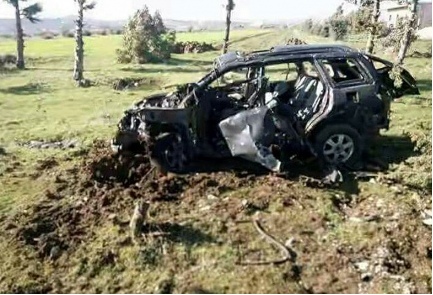
At approximately 4 p.m. on Sunday, a militia commander loyal to the Bashar Assad regime was killed in an alleged Israeli drone strike in Syria.
According to various reports in Lebanon and Syria, the drone fired a missile at a private vehicle traveling on the highway from Quneitra, in the Syrian Golan Heights, to Damascus. The driver was later identified by the Arab press as Yasser al-Sayed.
The U.K.-based Syrian Observatory for Human Rights said the alleged Israeli strike was carried out near the town of Khan Arnaba on the Syrian Golan Heights, shortly after the vehicle exited the town via the Damascus highway.
Syrian media said al-Sayed was affiliated with President Bashar Assad’s regime and commanded armed militias operating on the Syrian Golan Heights.
According to the reports, al-Sayed commanded militias comprised of Druze and Palestinian residents of the Syrian Golan Heights, and that recently he had been in contact with senior members of Iran’s Islamic Revolutionary Guard Corps, which are helping Assad’s forces fight rebel groups in the Quneitra area. Al-Sayed was assassinated after apparently planning and trying to carry out terrorist attacks against Israel, with the support of his Iranian colleagues and his militia fighters.
Israel has responded to the finger-pointing following al-Sayed’s assassination with deafening silence.
‘Not for Assad, not against him’
In contrast to Friday morning’s airstrike against a Hezbollah weapons convoy, news of al-Sayed’s alleged assassination was met with complete silence.
On Sunday morning, however, hours before the reported assassination and two days after Friday’s attack on the weapons convoy, Defense Minister Avigdor Lieberman said, “You have to understand the context; if we strike there is a real reason for it.”
Speaking during a visit to the IDF Induction Center at Tel Hashomer in Ramat Gan, Lieberman said, “We have no interest in intervening in the civil war in Syria, either in favor of or against Assad. We do not want to clash with the Russians. Our main issue is with the transfer of advanced weaponry from Syria to Lebanon, and so whenever we detect an attempt to smuggle weapons [to Hezbollah], we will act to prevent it. We will not compromise on this issue.”
Lieberman also warned the Syrian regime not to fire at Israeli jets when they carry out missions over its territory, saying that if it happens again, “we will also destroy those air defense systems without hesitation. … The Syrians must understand — they are responsible for these arms transfers to Hezbollah. As long as they continue to allow them then we will do what we have to do. We have no interest in taking part in that war, but the security of Israel is above all else.”
The Russians are still furious
It should be noted, meanwhile, that it is still uncertain Damascus gave the order to fire anti-aircraft missiles at the Israeli jets. The missile fire was possibly the work of a local cell; or perhaps, in fact, greenlighted by the Russian high command.
What appears to be troubling IDF generals more than anything these days, however, is military coordination with Russia. Ever since the Russians deployed anti-aircraft systems to the region in the fall of 2015, Israel has made considerable efforts to minimize the potential for mistakes and prevent an unnecessary clash with them. In that vein, Prime Minister Benjamin Netanyahu has met with Russian President Vladimir Putin, and a mechanism was established by the countries to coordinate military activity. Israeli officials have said on more than one occasion, however, that the IDF does not intend to notify the Russians in advance of Israeli airstrikes in the area, despite the fact that Russia’s sophisticated air-defense systems can detect, as far as the Negev Desert in southern Israel, every time an Israeli warplane takes off.
Israeli defense officials had hoped the understandings on the political level, between Netanyahu and Putin, would not limit Israel’s ability to act. The Russian decision to summon Israeli Ambassador Gary Koren, following Friday’s attack in Syria, apparently caught senior defense officials in Israel off guard and perhaps even angered them. It is unclear they understand why the Russians are incensed, because dozens if not hundreds of similar airstrikes in Syria have been attributed to Israel in recent years.
Russian news outlets reported Monday that Koren has been summoned for a second time.
The Kremlin’s anger is palpable. Russia’s deputy foreign minister, who is Putin’s envoy in Syria, said in an interview Sunday that “the Defense Ministry in Moscow has to analyze the incident and understand it and the motives that led Israel to attack in Syrian territory.”
The question now is how the latest incidents will impact Israeli decision makers, and in what manner will Israel continue to act to prevent Hezbollah from acquiring certain weapons.
A surprise attack in Damascus
In the meantime, the Syrian civil war continues to rage on. Syrian rebels launched a major offensive on Sunday that brought them close to the heart of the Old City of Damascus, and government forces responded with intense bombardments of rebel-held areas.
The escalation, reported by witnesses, state TV, rebel sources, and a monitoring group, marked a bid by the rebels to relieve army pressure on besieged areas they control to the east of the capital.
The Free Syrian Army and jihadist groups were both involved in the assault on the districts of Jobar and Abbasiyin, some 2 kilometers (1.2 miles) east of the Old City walls.
Syrian state television said the army had repelled infiltration attempts by the militants and bombarded them with artillery, inflicting heavy losses.
Witnesses said the army deployed tanks in some adjacent neighborhoods, and troops could be seen patrolling on foot.
With the recapture of the city of Aleppo last December, Assad’s army reinforced its dominant position across most of the country. Since then it has been trying to break down rebel resistance in Damascus and reassert full control of the capital after six years of war.
The Syrian Observatory for Human Rights said rebels had captured several industrial sites and buildings between Jobar and Qaboun after launching their surprise attack.
An official of Ahrar al-Sham rebel group said the capture of large swathes of the industrial area that has long been an army line of defense for the capital could help a bid to push deeper into the heart of the capital in the coming days.
 WarSclerotic
Leave a comment