ANALYSIS: This time, the Russians are mad
Source: Israel Hayom | ANALYSIS: This time, the Russians are mad
Departing from their usual discreet style, the Russians publicly summon Israel’s ambassador for clarifications after Israel acknowledges striking an arms convoy in Syria • While the exact reason is unclear, the situation in Syria is clearly escalating.
|
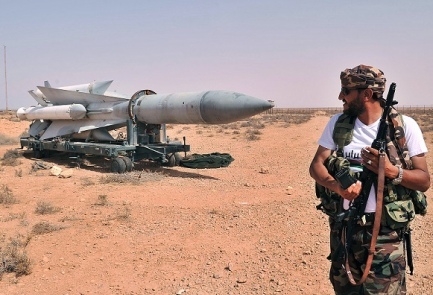
A Syrian SA-5 missile, the kind that was fired at Israeli jets over the weekend
|
A conflict has erupted between Israel and Russia following the Israeli strike on a Hezbollah-bound arms shipment in Syria over the weekend.
Early Friday, Israeli Air Force jets targeted an arms convoy delivering advanced weapons to Hezbollah. The planes were detected by the Syrian army and sustained anti-aircraft missile fire. One missile entered Israeli airspace and was immediately intercepted by Israel’s Arrow missile defense system. This interception, witnessed by Israelis in the Jordan Valley and parts of Jerusalem, prompted Israeli authorities to officially acknowledge the attack, in a departure from the usual policy of ambiguity and neither confirming or denying a strike had occurred.
This unexpected development, only a week after Prime Minister Benjamin Netanyahu’s visit to Moscow, is cause for concern. The Russians, who have until now been uninterested in Israel’s actions in Syria, may soon begin to actively care.
It was not exactly clear what sparked the Russians’ ire and prompted them to publicly summon the Israeli ambassador for a clarification meeting, in a departure from their usual discreet communication style. The strike may have hit too close to adjacent Russian forces, as some news outlets suggested, or perhaps it was Israel’s public acknowledgment of the strike that made Russia appear unable to protect its Syrian ally from Israeli aggression.
Whatever the reason, it is in Israel’s best interests to keep Russia out of the battle it is waging against advanced weapons smuggling to Hezbollah. The reason is not just to avoid unwanted friction between Israeli and Russian forces, but mainly because if Russia decides to offer wider and stronger protection in Syria it could allow Iran to deepen its foothold in Lebanon and in the Golan Heights and make it very difficult for Israel to prevent that.
It stands to reason that Israel will make every effort to dissuade Russia from making this potential policy shift, but we will only know if the shift has occurred after the next strike. In light of Hezbollah’s accelerated smuggling efforts, as it arms itself with quality weaponry (mainly guided rockets), and Israel’s express vows to prevent Hezbollah from arming itself, there is almost no doubt that such a strike will occur soon. Next time, however, Israel will likely be more careful.
And still, even with extra precautions, the situation will not be under exclusive Israeli control. The Syrian response to Friday’s attack was also unusual, and it forced Israel into two firsts: the first operational interception for the Arrow defense system, and the first public confirmation that a strike in Syria had taken place.
There is a logical explanation for this. The interception was necessitated by the fear that the Syrian projectile — an SA-5 missile, or part of one — would strike an Israeli community and threaten Israeli civilians. The consequent acknowledgment was prompted by fears that the rumors (like the unfounded claim that Syria had downed an Israeli jet) surrounding the obvious interception would lead to unwanted escalation.
The Syrian missiles themselves at no point jeopardized Israeli aircraft, but the response did attest to Syrian President Bashar Assad’s self-confidence. Secure in Russia’s support and in light of the continuous blows to Islamic State and opposition groups in Syria, Assad feels that his regime is no longer under immediate threat, and he is trying to communicate to Israel that he intends to raise the stakes should Israel continue launching attacks in his territory.
At this time, Assad is unlikely to take the Syrian response all the way — he has no interest in all-out war with Israel — but like Israel and Russia, he too has taken things to the next level.
 WarSclerotic
Leave a comment