US deploys hundreds of troops to Syria to combat ISIS
Source: Israel Hayom | US deploys hundreds of troops to Syria to combat ISIS
Deployment of several hundred U.S. Marines is temporary, but signals White House is leaning toward giving Pentagon greater flexibility • U.S. troops in position to help local Syrian forces • U.N. envoy says next round of Syrian talks to start March 23.
|
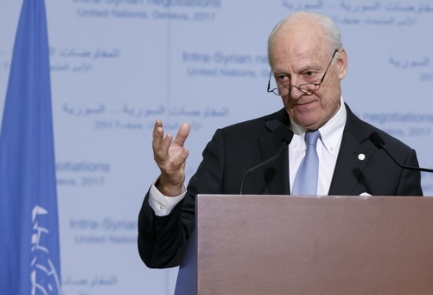
U.N. Special Envoy to Syria Staffan de Mistura addresses the media at the United Nations headquarters in Geneva, Friday
|
Several hundred U.S. Marines with heavy artillery have been deployed to Syria in preparation for the fight to oust the Islamic State group from its self-declared headquarters of Raqqa, a senior U.S. official said Wednesday.
The deployment is temporary but is a sign U.S. President Donald Trump’s White House is leaning toward giving the Pentagon greater flexibility in making routine combat decisions in the fight against Islamic State.
Military commanders frustrated by what they considered micromanagement under the previous administration have argued for greater freedom to make daily decisions on how best to fight the enemy.
The marines moving into Syria are positioning howitzers to be ready to help local Syrian forces, the official said.
In addition, the U.S. is preparing to send hundreds of troops to Kuwait to be ready to fight Islamic State there if needed, the official said. The number would be fewer than 1,000, the official said.
The latest troop movements come on the heels of the recent temporary deployment of dozens of forces to the outskirts of Manbij, Syria, in what the Pentagon called a “reassure and deter” mission. Flying American flags and moving in large, heavily armored vehicles, the troops were there to keep a lid on tensions in the area, the Pentagon said.
It appeared the forces were largely there to ensure Turkish fighters and Syrian opposition groups focused on battling Islamic State rather than each other.
Under the existing limits put in place by the previous administration under President Barack Obama, the military can have up to 503 U.S. forces in Syria. But temporary personnel do not count against the cap.
Pentagon leaders sent a new plan to defeat Islamic State to the White House late last month. It outlined a strategy that was likely to increase the number of U.S. troops in Syria to better advise and enable the Syrian fighters who will take on the battle for Raqqa.
The military has mapped out options for the Syria fight, including increased artillery support, more Apache helicopters and a more robust training campaign.
U.S. officials say the battle for Raqqa will look much like the fight in neighboring Iraq, where local forces are fighting to retake the northern city of Mosul from the hands of the Islamic State group. As troops were preparing to move into Mosul, the U.S. set up bases outside the city to use as logistical hubs and sites for heavy artillery.
UN envoy says next round of Syrian talks to start March 23
Meanwhile, the United Nations special envoy for Syria said Wednesday he intends to bring the Syrian government and opposition back to Geneva on March 23 for a fifth round of talks on a transition agreement to end the six-year war.
After briefing the Security Council behind closed doors, Staffan de Mistura told reporters the U.N. will be promoting substantive talks on four issues: governance, a new constitution, elections and counterterrorism, “including the security organization and confidence-building measures.”
He appealed to those who will be attending a meeting in Kazakhstan’s capital, Astana, ahead of the next Geneva talks to address the challenges of the cease-fire in Syria. Those talks are organized by the three guarantors of the cease-fire, Russia, Iran and Turkey.
Russia’s military on Tuesday announced a cease-fire until March 20 between rebels and government forces in the eastern suburbs of the Syrian capital of Damascus, but activists reported a number of airstrikes and artillery strikes by government forces and said two civilians were killed.
The announcement from Russia came the same day that top generals from Turkey, the United States and Russia met in Turkey to discuss mutual suspicions over military operations in northern Syria.
De Mistura said it was very important that the military commanders of the three countries invested in a solution in Syria meet to avoid conflicts and focus on counterterrorism.
“Without a strong cease-fire, the talks [in Geneva] will be fragile,” he warned.
He said the fifth round of talks will continue the fourth round, which ended March 3, and the participants would be the same.
U.S. Ambassador to the United Nations Nikki Haley said the United States supports de Mistura and the U.N.-led talks, but added that “we do think there are people missing from the table.”
She did not elaborate, but stressed that the United States wants to see an end to the conflict.
“This is very much about a political solution now. That basically means that … Syria can no longer be a safe haven for terrorists,” she said. “We’ve got to make sure that we get Iran and their proxies out. We’ve got to make sure as we move forward we’re securing the borders for our allies as well, so that they can have confidence in the secure borders.”
British Ambassador Matthew Rycroft, the current Security Council president, said all council members support de Mistura and are urging the parties at the next round of talks “to engage constructively.”
He said de Mistura came to him during the closed consultations “with some cautious optimism this time, that he had been able to keep all of the different parties at the Geneva talks in the fourth round despite some difficult moments, and there was agreement on these four baskets of issues which will form the agenda for the talks.”
De Mistura said he had asked the council for support in ensuring that the fifth round goes “upwards” from the fourth, not backwards.
“Above all, I have appealed to all Syrians and outsiders to abandon the fantasies that still are there of a military victory. One side or the other still sometimes believes that is possible. It is pure fantasy,” he said.
In the fourth round, de Mistura said, “we did not expect miracles, and frankly we didn’t have miracles.”
“But we achieved much more than many people imagined we could have. No one left. Everybody stayed. They were focused. We got an agenda. We got a timeline. We got some agreements even on substance,” he said.
“There is a lot of common ground” on what a Syria settlement could be, but disagreements remain on how to get there, he said. De Mistura said that in the fifth round, the parties will work in parallel on the four major issues.
“What you should see is four cars that are moving,” he said. But he added that the parties must determine how to put “the fuel in each car.”
 WarSclerotic
Leave a comment