Trudeau expresses “deep sorrow” on the death of Fidel Castro
Trudeau expresses “deep sorrow” on the death of Fidel Castro, CIJ News, Ilana Shneider, November 26, 2016
(I guess someone has to revere a murderous dictator. Heck, many leftists believe that Castro’s enforcer, “Ché” Guevara, was a great and good man. — DM)
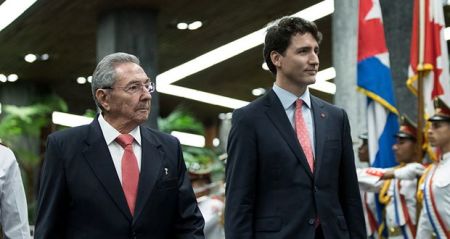 Prime Minister Justin Trudeau in his first official visit to Cuba. Photo: PMO pm.gc.ca
On November 26, 2016, Prime Minister Trudeau issued the following statement on the death of former Cuban President Fidel Castro:
“It is with deep sorrow that I learned today of the death of Cuba’s longest serving President.
“Fidel Castro was a larger than life leader who served his people for almost half a century. A legendary revolutionary and orator, Mr. Castro made significant improvements to the education and healthcare of his island nation.
“While a controversial figure, both Mr. Castro’s supporters and detractors recognized his tremendous dedication and love for the Cuban people who had a deep and lasting affection for “el Comandante”.
“I know my father was very proud to call him a friend and I had the opportunity to meet Fidel when my father passed away. It was also a real honour to meet his three sons and his brother President Raúl Castro during my recent visit to Cuba.
“On behalf of all Canadians, Sophie and I offer our deepest condolences to the family, friends and many, many supporters of Mr. Castro. We join the people of Cuba today in mourning the loss of this remarkable leader.”
Earlier this month, Trudeau paid an official to Cuba where he met with Fidel Castro’s brother and current President Raul Castro.
In an interview with a Toronto-based Farsi language blog in August of 2010, while he was still a Liberal MP, Trudeau said amongst other things the following (translated from Farsi): “Fidel Castro talked to my younger brother Michel. During my father’s funeral I met Castro. My father was a staunch supporter of relations with Cuba. This relationship still exists and we can be proud about it. We show that we are different from America. We need a positive and a balanced policy towards Cuba versus the American hegemony (imperialism). This role is very important and I’d like it to continue.”
Following the announcement of Castro’s death, Cuban dissidents and exiles around the world labelled the revolutionary a dictator whose “crimes against his own people” must not be forgotten. To them, Castro represented a repressive regime that jailed political opponents, repressed freedom and democracy, and destroyed the national economy.
Jubilant crowds took to the streets in Little Havana – a Miami neighbourhood home to thousands of Cuban exiles.
Orlando Guiterrez, founder of the opposition Cuban Democratic Directorate in Miami, condemned Castro’s legacy. “I regret that this criminal never faced a tribunal for all the crimes he committed against his own people,” Guiterrez said, according to a translation by the BBC.
“This is a man who leaves a legacy of intolerance, of setting up a family-run dictatorship which had no tolerance for anyone who thought differently, who set up a vicious totalitarian regime where people were persecuted for the most slight deviation from official ideology.”
After coming to power in 1959, Castro banned the democratic elections he once promised, expropriated private property, created a one-party Communist state, ruthlessly suppressed all forms of dissent and opposition and dismantled the once thriving Catholic Church.
Little has changed in Cuba since Castro stepped down as president in 2008 and passed control of the country to his brother. According to Human Rights Watch and Amnesty International, despite renewed relations with the United States, the Cuban government continues to harass and detain peaceful human rights demonstrators and activists, represses dissidents and discourages public criticism. Independent journalists are frequently arrested by authorities and held incommunicado for days. From January to August 2014 alone, there were over 7,188 documented arbitrary detentions.
The Cuban judicial system is controlled by the government and there is an almost complete lack of freedom for human rights and civil associations. All media outlets are overseen by the government and access to information is severely restricted.
According to Armando Valladares, a Cuban dissident who spent 22 years in prison, “hostility to religion is especially enflamed, with one human rights group counting 2,000 churches marked as ‘illegal’ by the government” in 2015.
Explore posts in the same categories: Canada, Castro, Trudeau You can skip to the end and leave a response. Pinging is currently not allowed. WarSclerotic
November 26, 2016 at 6:01 PM
Wow. What does Canada get from Cuba that matters so much…? Or, is Trudeau really a giant Schmuck?