The continuing education of the reluctant scholar
The continuing education of the reluctant scholar, Washington Times editorial, Wesley Pruden, November 21, 2016
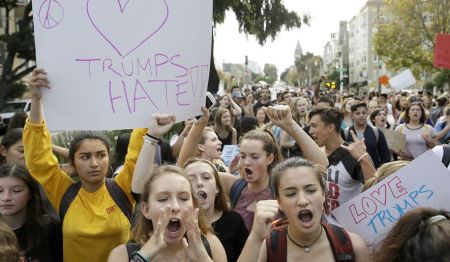
In this Thursday, Nov. 10, 2016, file photo, high school students protest in opposition of Donald Trump’s presidential election victory in San Francisco. Thousands of high school students have taken to the streets in cities across the country.
It’s an ill wind that blows nobody good, and some of our history class dropouts are at least getting the lesson they missed in seventh-grade civics.
The ill wind blowing across the fruited plain is teaching all those dropouts how America elects the president, and they’re having trouble with the idea that when you have winners and losers somebody has to lose.
There’s abundant bitterness everywhere over this election because nearly everyone expected Hillary Clinton to win it. It was her moral right, after all. The “legacy” media threw away all its long-held traditions of objectivity and joined the Democratic campaign not as observers but as participants.
Losing was not always like this. The late George McGovern, a thoroughly decent man who offered thoroughly wrong ideas about how to transform America and lost 49 of the 50 states in 1972, told with a wry chuckle how a man and his small son approached him at an airport a fortnight or so after the election to commiserate.
“I was heartbroken when you lost,” the man told him, “and I’m glad to have the opportunity to thank you in person and to shake your hand for all you’ve done for America.”
Mr. McGoo, an authentic American hero who flew dozens of combat mission as a bomber pilot in World War II, returned the thanks, and the boy put out his hand, too. “You shouldn’t feel bad,” he told Mr. McGoo. “Second place is still pretty good.”
Well, close is only good in horseshoes, and losing always hurts plenty. But the Democrats stayed out of the streets, nursed their hurt the way grown-ups always deal with their disappointments, and soon returned to the sound of the guns to fight on another day. They eventually won again. That’s how it’s done.
But the aftermath of this election is different, if not necessarily unique. The left, including many of the merely liberal, thought Hillary Clinton was entitled by right to win the election. She won more than a million more popular votes than Donald Trump, which is impressive but not unprecedented, and the Donald won more electoral votes (and by an impressive margin). Those are the rules, and both candidates knew the rules when the campaign started.
In the homestretch of the campaign of 2000, Al Gore and the Democrats felt the race tightening, as it usually does, and calculated that they might win more electoral votes but fewer popular votes than George W. Bush. Mr. Gore rightly reminded everyone in several late speeches that it was the electoral votes that count. In the event, it was he who won the popular vote and George W. the electoral vote.
When that happened this year the grumbling started quickly because most voters are ignorant of how things work. The only thing most Americans know about the Electoral College is that it must be in the Western Division of the Southeastern Conference, the toughest in all of college football, and might be the only college that could beat Alabama.
So naive are many of these voters that some of them are writing to the 290 Republican members of the Electoral College (or 306 if the popular vote in Michigan holds up) to urge them, occasionally under threat of death, to put aside their sworn allegiance to Donald Trump and vote for Hillary Clinton instead. A petition seeking this highly unlikely result has so far acquired more than 4 million online signatures. It’s legal, though in certain cases such an unfaithful elector could be sentenced to prison and fined besides.
In the nation’s history only 157 faithless electors declined to vote for the candidates they promised to support, and 71 of those cast an unexpected ballot because their man died before the Electoral College met in session. No elector has been “faithless” since 2004, when an elector, promised to John Kerry, voted instead for his running mate, John Edwards (and misspelled his name to boot).
The dead-enders trying to deprive the Trump-Pence ticket of their promised electors imagine their task is not so hard; “all” they have to do is persuade 37 of the 306 Republican electors to switch their votes, which would deadlock the election at 269 to 269. That still wouldn’t change the final result because it would throw the election to the House of Representatives, where each state would cast one vote. The Republicans would likely still win. It just wasn’t a Democratic year.
Explore posts in the same categories: 2016 elections, Electoral College, History, Popular vote, President Elect TrumpTags: Electoral College, History, Popular vote, President Elect Trump
You can skip to the end and leave a response. Pinging is currently not allowed. WarSclerotic
November 23, 2016 at 1:00 AM
Damn having again read this powerful and deeply moving reflection of both the personal revelations and historical significance wipe a fear to read it again damn suffice to say thank you so much the thought provoking portrait painted bold vibrant colors of American exceptional experience your red white and blue damn