Who Is the Real Ted Cruz?
Who Is the Real Ted Cruz? Commentary Magazine, Noah Rothman, April 11, 2016
(Commentary Magazine has with substantial consistently opposed Trump and favored Cruz. This article, which deals with Cruz’s positions on immigration, does neither. — DM)
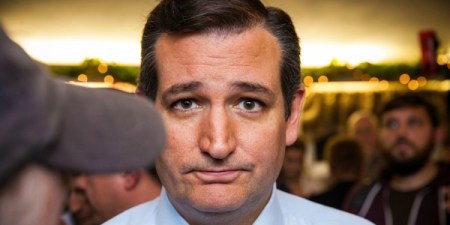 Image by © Porter Gifford/Corbis
The New York Times noted the indisputable similarities between this statement and that made by Jeb Bush, who said that families coming to the United States illegally are performing “an act of love.”
Ted Cruz is whoever he needs to be whenever he needs to be it. In a fashion, that’s no liability when it comes to running campaigns and winning elections. It does, however, give pause to voters concerned with authenticity and judgment. Who is the real Ted Cruz? That’s a subject of debate.
**************************
From the moment he embarked on a political career, Ted Cruz had his finger on the pulse of the core Republican electorate. For this key voting bloc, he calibrated his appeal to satisfy the largest number of conservatives without sacrificing his brand as a principled truth-teller. It is a clever strategy, but one that only works when executed skillfully. For years, Cruz was that skillful operator. He probably never anticipated that he would be outmaneuvered at his own game.
Cruz’s approach to navigating the bramble thicket of center-right sentiment by presenting himself as the most conservative candidate that can still appeal to a majority of the GOP primary electorate has not been without cost. To preserve his image as the most conservative figure in the room, Cruz sacrificed authenticity. For Republicans who concern themselves little with such qualities as predictability in their standard-bearers, this was no sacrifice at all. Cruz did not foresee that an even more skilled executor of the populist bombast tone that the Texan had spent years cultivating would outflank him. Donald Trump keenly demonstrated that conservative purism was never the quality for which the “angry” electorate was pining. A deft negotiator of the political game, Cruz is again changing tactics. In adopting yet another persona to overcome the adversity of the moment, though, Cruz is once again giving up on genuineness.
There is perhaps no better barometer to gauge the sentiment of the activist right than the issue of immigration. Ramesh Ponnuru presciently forecast a political storm on the horizon when, in February of 2015, he observed that the Republican Party’s class of political professionals had reached a consensus on the matter of immigration. That consensus diverged sharply from that of a small but committed faction within the Republican coalition. For many months,public opinion surveys and state-level exit polls have demonstrated that only a small minority of GOP voters believe immigration is the most important issue facing the nation. Occasionally, Republican majorities even tell pollsters they favor a pathway to legalization or even citizenship for the nation’s illegal immigrant population. There is, however, an intensity gap on the issue that favors the anti-immigration reform GOP voter – their passion is a marked contrast from the lukewarm pro-reform voter – and Cruz picked up on this sentiment early.
There may be no better example of the pose Cruz struck for the benefit of his admirers on the right than a November 2014 speech on the Senate floor in which the Texas senator postured as the successor to Marcus Tullius Cicero himself. In adapting a passage from Cicero’s famed orations against the Catilinarian Conspirators, Cruz indicted the president’s anti-republicanism on matters ranging from border security to the IRS. The Texas senator’s dramatics sent eyes rolling right out of their sockets among his myriad critics, but they were not the intended audience. Similarly, Cruz cemented animosity among his Senate colleagues when he helped organize opposition to a House measure intended to address the crisis of unaccompanied minors surging across the border in the summer of 2014. His stated concerns were that the emergency measure would not include pre-2012 election language designed to stop the implementation of that year’s executive orders on immigration (which would have failed in the Democrat-led Senate).
From the perspective of establishmentarian Republicans, the conservative wing had imposed paralysis on the GOP. Ted Cruz fatally undermined the Republican position — that what was occurring on the border was a crisis precipitated by the president’s leadership – by robbing the GOP of agency and leaving it to the president to resolve what the GOP had for weeks been calling a national emergency. For anti-immigration reform activists on the right, however, this was a noble display of opposition to any border measure that was judged insufficiently compromising. Indeed, Cruz made his opposition to immigration reform along the lines of the 2013’s “Gang of Eight” reform bill central to his campaign. So, this must be the real Ted Cruz: an immigration maximalist and the tribune of the conservative wing of the GOP.
Not so fast. The anti-immigration reform absolutist is no Ted Cruz that any of the senator’s colleagues on George W. Bush’s 2000 presidential campaign would recognize. In a five-page 1999 memo for Bush on the issue of immigration, Cruz said he opposed “amnesty” but noted that the Republican nominee should strike a calibrated tone on the matter. He advised Bush to advocate for higher caps on the number of skilled workers coming to the country. As for illegal immigration, Cruz advised Bush to state his opposition to the phenomenon and to advocate stricter border security measures. “At the same time,” Cruz wrote, “we need to remember that many of those coming here are coming to feed their families, to have a chance at a better life.” The New York Times noted the indisputable similarities between this statement and that made by Jeb Bush, who said that families coming to the United States illegally are performing “an act of love.” Even amid deliberations and maneuvering in the Senate over the reviled “Gang of Eight” bill, Cruz supported an amendment that would, in his own words, get illegal immigrants “out of the shadows” and allow them to apply for legal status.
That is not the real Ted Cruz, says Ted Cruz. No, this Ted Cruz was merely playing a republican game designed to scuttle the reform bill. Don’t believe him, Cruz’s colleagues who worked with him on immigration matters during the 2000 campaign insist. “I’m disappointed in Ted because he’s a very bright, articulate lawyer with a substantial base of knowledge about immigration,” said Houston attorney Charles Foster, who worked with Cruz on Bush’s immigration team. “But instead of using that knowledge, he’s acting like a typical politician and just talking about the border being out of control.” Indeed, Ted Cruz has begun to adopt the language of the “typical politician.”
To continue to compete with Donald Trump for the mantle of most uncompromising figure in the race is a losing prospect. Cruz will always be outbid in that contest. Instead, the Texas senator is talking like something he and his supporters dismissed as a contrivance: an electable, bridge-building centrist.
In an April 9 speech to the Republican Jewish Coalition (according to the invaluable dispatches ofAtlantic editor David Frum and CNN reporter Teddy Schleifer), Cruz softened his approach in an effort to expand his appeal to the GOP’s “electability” voter. Cruz hyped his appeal to Hispanic voters, noting his own ability to win 40 percent of this demographic in the recent Texas primary. He touted the necessity of expanding the Republican map into purple states like Pennsylvania, where the party has not on the presidential level since 1988. He repeatedly touched on the issue of tone, and noted to this socially liberal group of voters that campaigns based on divisive cultural issues are rarely produce general election winners. “Nobody wants to elect a hectoring scold,” he said.
Cruz noted that he is better positioned today than any of his competitors to unite the GOP behind him and that unity will maintain critical party cohesion in November. Frum observed that Cruz touted the United States and Israel as the only two nations on earth founded to serve as “havens for the oppressed.” “Immigration must serve the needs of the American people,” Cruz added. “Business wants wages low. I want to see wages rise because businesses are competing for labor.” This is a tough-on-immigration tone that nonetheless appeals to pro-reform voters – voters the party’s maximalists probably convinced themselves they had defeated.
Is this the real Ted Cruz? Who knows? Ted Cruz is whoever he needs to be whenever he needs to be it. In a fashion, that’s no liability when it comes to running campaigns and winning elections. It does, however, give pause to voters concerned with authenticity and judgment. Who is the real Ted Cruz? That’s a subject of debate.
Tags: Republicans, Ted Cruz
You can skip to the end and leave a response. Pinging is currently not allowed. WarSclerotic
April 12, 2016 at 1:24 AM
Ted Cruz’s Father: My Son “Anointed” To “Take Control of Society”..
http://tinyurl.com/nqtlu7l
“….thus helping to bring about a prophesied “great transfer of wealth”, from the “wicked” to righteous gentile believers” (WTF??? Are WE, the “Jews” the “Wicked?)
[2013 – TEXAS] In a sermon last year at an Irving, Texas, megachurch that helped elect Ted Cruz to the United States Senate, Cruz’ father Rafael Cruz indicated that his son was among the evangelical Christians who are anointed as “kings” to take control of all sectors of society, an agenda commonly referred to as the “Seven Mountains” mandate, and “bring the spoils of war to the priests”, thus helping to bring about a prophesied “great transfer of wealth”, from the “wicked” to righteous gentile believers.
Cruz Father: Ted Cruz “Anointed” To “Bring the Spoils of War to the Priests”
Keep your hands out of my Jewish pockets Teddy!