Turkey to Host UN’S First Global Humanitarian Summit
Turkey to Host UN’S First Global Humanitarian Summit, Front Page Magazine, Joseph Klein, March 30, 2016
(Please see also, Turkish Gov’t Children’s Magazine Promotes Martyrdom. — DM)
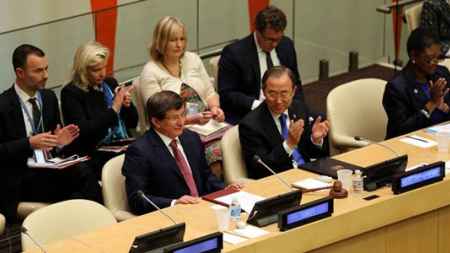
The first-ever United Nations-sponsored World Humanitarian Summit is scheduled to take place May 23-24, 2016 in Istanbul, Turkey. UN Secretary General Ban Ki-moon praised Turkey’s “compassionate leadership” in hosting the summit and its “admirable commitment to humanitarian action.”
Turkey’s hosting of the UN humanitarian summit is a travesty. Ban Ki-moon’s praise of Turkey’s “compassionate leadership” and “admirable commitment to humanitarian action” is a disgrace. Did perhaps the Secretary General have in mind the so-called Turkish “charity” known as the Foundation for Human Rights and Freedoms and Humanitarian Relief (IHH)? Despite its name and some programs that have delivered aid to areas in genuine need, IHH has an overtly political Islamist agenda. It has had a particular interest in directing assistance to terrorist organizations such as Hamas, and has had ties with al Qaeda and the Muslim Brotherhood. It is looking forward, in its words, to when “Muslims may show up in Tel Aviv and Jerusalem one day unannounced and we will erect the flag of Islam everywhere.”
The IHH is best known for sponsoring the 2010 Gaza flotilla, which had been sent to break Israel’s legal naval blockade of Gaza against the shipment of weaponry to Hamas. Nine armed Turkish Hamas supporters on one of the ships were killed by Israel Defense Force personnel, whom had acted in self-defense after they had boarded the ship to prevent it from reaching Gaza. Never mind that a UN investigatory committee subsequently concluded that Israel had legally boarded the IHH ship in the first place. Turkey’s leader Recep Tayyip Erdogan sided with the IHH and Hamas, and accused Israel of engaging in “state terrorism.” Erdogan’s government has coordinated with the IHH and has given it cover as a so-called “humanitarian” charity so that it could carry on its support of Hamas against Israel. Erdogan’s loyalists even went so far as to fire a senior police official who thought he was simply doing his job by conducting a police raid of IHH offices. The raid which so displeased Erdogan had led to the detention of at least 23 people with alleged ties to Al Qaeda.
Apart from its ties to the misnamed Foundation for Human Rights and Freedoms and Humanitarian Relief, Erdogan’s government has made a mockery of the “core responsibilities” outlined in the Agenda for Humanity, which will be the focus of discussion at the Istanbul UN World Humanitarian Summit in May.
For example, one of these core responsibilities is “a commitment to address forced displacement.” Turkey has a huge internal displacement problem, primarily involving the forced displacement of members of its minority Kurdish population. Between 954,000 and 1.2 million people were forced to flee their homes between 1986 and 2005. Turkey’s attempts to address this situation, with such measures as compensation for the victims, have been fitful at best. Most internally displaced persons (IDPs) have been left to fend for themselves, living in poverty. According to the Internal Displacement Monitoring Centre, “Poverty has forced IDPs’ children to work rather than going to school, and some women have resorted to negative coping mechanisms including prostitution to get by.”
In Cyprus, Greek Cypriots were forcibly expelled from their homes after Turkey invaded the northern area of the Republic of Cyprus and placed it under military occupation in 1974. Turkey’s illegal occupation of the northern third of the island continues to this day. The European Court of Human Rights concluded in a judgment against Turkey for damages that “Greek-Cypriot owners of property in northern Cyprus are being denied access to and control, use and enjoyment of their property as well as any compensation for the interference with their property rights.” The Court noted “the protracted feelings of helplessness, distress and anxiety” suffered by the victims of Turkey’s actions. Turkey’s Foreign Minister angrily rejected the Court’s verdict.
Another “core responsibility” outlined in the Humanitarian Summit’s Agenda for Humanity is “catalyzing action to achieve gender equality.” Turkey’s President Erdogan declared in November 2014 that “men and women are not equal; it is against nature.” In the 2015 Global Gender Gap country rankings, Turkey is near the bottom of the list – 130th out of 145 countries surveyed. It placed only four countries above Saudi Arabia.
According to an article written in 2015 by Meltem Müftüler-Baç, a Professor of International Relations and Jean Monnet chair at Sabanci University, Istanbul, “when it comes to protecting Turkish women against violence, ensuring their rights of education and employment, and even their right to choose their own spouse, women face layers of discrimination. Child marriages and domestic violence are the most visible forms, with around 30-35% of all marriages in Turkey involving under-age girls, rising in rural southeastern Turkey to up to 75%.”
Two other “core responsibilities” outlined in the Humanitarian Summit’s Agenda for Humanity are “leadership to prevent and end conflicts” and “upholding the norms that safeguard humanity.” Turkey has engaged in policies that have heightened conflicts and caused human suffering.
In September 2015, for example, the Turkish Armed Forces besieged the Kurdish town of Cizre in southeastern Turkey. Civilian residents have been cut off from receiving food, medical supplies, water and electricity for days on end. In one incident, people were trapped inside a burning, multi-story building, surrounded by Turkish troops who reportedly would not let them out. Unconfirmed reports have estimated the number of people killed in the fire as at least 150, and perhaps several hundred more.
“This was a residential building where women and children lived. Erdogan killed them all with heavy artillery. He destroyed this building. They say they’re fighting terrorists. But where are the terrorists? All victims were local civilians,” a local resident told journalists. “They were old men, women, and children. They even killed pregnant women.”
Turkey’s claim to humanitarian action is its hosting of 2.5 million refugees from Syria, more than any other country worldwide. However, while Turkey can spin the sheer number of refugees it has admitted and the billions of dollars it has spent to host them on its soil, Turkey has also contributed to creating the problem in the first place. It has served for years as a passage way for foreign jihadists to reach Syria and exacerbate the conflict. Moreover, many of the refugees living in Turkey are treated poorly. They “still live in terrible conditions, some have been deported back to Syria and security forces have even shot at Syrians trying to cross the border,” said Gauri van Gulik, Amnesty International’s Deputy Director for Europe and Central Asia.
Until very recently, Turkish authorities have looked the other way as smugglers transported self-proclaimed “asylum-seekers” and economic migrants – mostly young adult males – from Turkey’s shores to Greece. From Greece, they began their trek through European Union member states to reach Germany or other desirable destinations. These include ISIS fighters embedded in the masses of refugees reaching Europe from Turkey, as well as garden variety criminals whom have responded to the welcome they received in Germany, Sweden and other EU member states with gang rapes, armed robberies and murder.
Erdogan used the prospect of a continued flow of refugees from Turkey to Europe as a bargaining chip to win key concessions from his European counterparts. Most importantly, he extracted a pledge of €6 billion from Europe (approximately US$6.7 billion based on the current currency conversion rate) to be paid by 2018. For its part, Turkey agreed to take back new refugees seeking to enter Europe and to implement other measures to stem any future refugee flow. The amount Europe will be paying Erdogan’s regime is the equivalent of over 3 years of Turkey’s expenditures on Syrian refugees, based on its own report of US$1.8 billion for all of its humanitarian related expenditures in 2014. No doubt, Turkey will have its hand out for more money from the European Union well before the end of 2018.
Erdogan is an autocrat. His government tramples on basic human rights such as freedom of expression. It has committed what could be considered crimes against humanity in its treatment of its Kurdish population. It scoffed at a judgment by the European Court of Human Rights, which sought to hold Turkey accountable for its illegal occupation in Cyprus and the human suffering it caused. Erdogan’s government has an abysmal record on women’s rights. It is extracting a large sum of money and other concessions from the European Union in order to stem the flow of Syrian refugees from Turkey to Europe that it helped to worsen in the first place. And it supports terrorist organizations such as Hamas.
In short, Turkey is one of the last places on earth that should be hosting a global summit devoted to addressing genuine humanitarian concerns.
Explore posts in the same categories: Human rights, Turkey, United NationsTags: human rights, Turkey, United Nations
You can skip to the end and leave a response. Pinging is currently not allowed. WarSclerotic
March 31, 2016 at 10:36 AM
Turkey’s operation on Cyprus in 1974 is completely legal
(1) Till now, there is NO sanction applied on Turkey due to 1974 Cyprus war
If a country invades another one, UN imposes sanctions on that country. Iraq invaded Kuwait, and UN imposed sanctions on Iraq. Turkey did not invade Cyprus, hence UN did not impose any sanction on Turkey!
(2) There is no UN Security Council resolution that calls the Turkey’s 1974 action as “invasion”!
(3) The Parliamentary Assembly of the Council of Europe (PACE) (29.07.1974, Resolution 573): “The Turkish military INTERVENTION was the exercise of a RIGHT EMANATING FROM AN INTERNATIONAL TREATY and the fulfilment of a LEGAL and MORAL obligation.”
(4) Greece’s Athens Court of Appeals (21.03.1979; Case No: 2658/79): “The Turkish military INTERVENTION in Cyprus, which was carried out in accordance with the Zurich and London Accords, was LEGAL. Turkey, as one of the Guarantor Powers, had the right to fulfill her obligations. The real culprits . . . are the Greek officers who engineered and staged a coup and prepared the conditions for this INTERVENTION.” Note: Just after 5 years later than 1974, in 1979, Greece’s Highest Court decided Turkish military intervention is legal without making any difference between 1st and 2nd military operation!
(5) Makarios (1ST PRESIDENT OF CYPRUS) (the UN Security Council Speech, 19 July 1974):
MAKARIOS: “CYPRUS WAS INVADED BY GREECE”. Sound record of the speech: http://www.cypnet.co.uk/ncyprus/history/republic/makarios1.wav
(6) Turkey acted on Cyprus via Art. IV(2) Treaty of Guarantee (“In the event of a breach of the provisions of the present treaty, Greece, Turkey and the United Kingdom undertake to consult together with respect to the representations or measures necessary to ensure observance of those provisions. IN SO FAR AS COMMON OR CONCERTED ACTION MAY NOT PROVE POSSIBLE, EACH of the three GUARANTEEING POWERs reserves THE RIGHT TO TAKE ACTION with the sole aim of re-establishing the state of affairs created by the present Treaty.”), hence in compatible with Art. 2(4) UN Charter.
March 31, 2016 at 2:24 PM
The United Nations Security Council has challenged the legality of Turkey’s action, because Article Four of the Treaty of Guarantee gives the right to guarantors to take action with the sole aim of re-establishing the state of affairs.[98] The aftermath of Turkey’s invasion, however, did not safeguard the Republic’s sovereignty and territorial integrity, but had the opposite effect: the de facto partition of the Republic and the creation of a separate political entity in the north. On 13 February 1975, Turkey declared the occupied areas of the Republic of Cyprus to be a “Federated Turkish State”, to the universal condemnation of the international community (see United Nations Security Council Resolution 367).[99] The United Nations recognizes the sovereignty of the Republic of Cyprus according to the terms of its independence in 1960. The conflict continues to affect Turkey’s relations with Cyprus, Greece, and the European Union.
United Nations Security Council Resolution 367
United Nations Security Council Resolution 367, adopted on 12 March 1975, after receiving a complaint from the Government of the Republic of Cyprus, the Council again called upon all States to respect the sovereignty, independence, territorial integrity and non-alignment of the Republic of Cyprus.
The Council noted its regret over the unilateral declaration of a “Federated Turkish State”, though it did not wish to prejudge the final political settlement of the problem. The resolution then goes on to call for the urgent and effective implementation of General Assembly resolution 3212,
General Assembly resolution 3212,
Reaffirming the principle of the inadmissibility of occupation and
acquisition of territories by force,
Greatly concerned at the prolongation of the Cyprus crisis, which poses a
serious threat to international peace and security,
Deeply regretting that the resolutions of the United Nations on Cyprus
have not yet been implemented,
Recalling the idea of holding an international conference on Cyprus,
Deploring the fact that part of the territory of the Republic of Cyprus
is still occupied by foreign forces,
Note