Assad’s fate hangs on the Palmyra battle – and on Russian air support
Assad’s fate hangs on the Palmyra battle – and on Russian air support, DEBKAfile, March 26, 2016

Forces loyal to Syria’s President Bashar al-Assad drive a tank during their offensive to recapture the historic city of Palmyra in this picture provided by SANA on March 24, 2016. REUTERS/SANA/Handout via Reuters ATTENTION EDITORS – THIS PICTURE WAS PROVIDED BY A THIRD PARTY. REUTERS IS UNABLE TO INDEPENDENTLY VERIFY THE AUTHENTICITY, CONTENT, LOCATION OR DATE OF THIS IMAGE.
Cracks in the united US-Russian front over the Syrian ruler’s fate surfaced – even before the ink was dry on the joint announcement issued in Moscow Friday, March 25, by US Secretary of State John Kerry and Russian Foreign Minister Sergey Lavrov, setting August as the deadline for a political solution of the five-year Syrian conflict.
Shortly after Kerry’s departure for Brussels, Russian Deputy Foreign Minister Sergey Ryabkov told reporters, “Washington now accepts Moscow’s argument that Assad’s future shouldn’t be open for negotiation right now.” However, taking exception to the phrase “right now,” State Department spokesman John Kirby immedieately snapped back, “Any suggestion that we have changed in any way our view of Assad’s future is false.”
Did this exchange spell another Washington-Moscow impasse on the future of the war and the Syrian ruler? Not exactly; Our military and intelligence analysts report that the two powers are in accord on the principle that Assad must go, but are maneuvering on the timeline for the war to end and the Syrian ruler’s handover of power.
The Americans want it to be sooner. The transition should start in August and result in adding opposition parties to the regime in positions of real influence.
President Barack Obama, when he conducts his farewell Gulf tour in April, would like to show Saudi Arabia and Gulf emirates that he has finally kept his word to them to evict Bashar Assad from power before he leaves the White House next January. The US would also be better placed for bringing the Syrian opposition into line for a negotiated deal.
But Putin prefers a delay because he has problems to solve first. The six-month long Russian military intervention in the Syrian conflict turned the tide of the war. The Syrian army and its Iranian and Hizballah allies were able to stabilize their positions and even score some important victories against rebel forces in central and northern Syria. Last year, Putin and Iran’s supreme leader Ayatollah Ali Khamenei were definitely on the same page and fully coordinated.
That cordial relationship was thrown out of kilter by the Kremlin’s decision to work with the White House for bringing the disastrous Syrian war to an end and terminating the Assad era.
From November, Iran’s Gen. Qassem Soleimani’s frequent visits to Moscow on liaison duty petered out.
Khamanei is adamantly opposed to Russia and the US commandeering the decision on Assad’s departure and its timetable. He is even more outraged by the way Putin has moved in on Syria and made it Russia’s home ground in the Middle East.
The rift with Tehran prompted Putin to announce on March 14 the partial pullback of his military forces from Syria. It was a threat to pull the rug that had turned the tide of the war in favor of Damascus and Tehran.
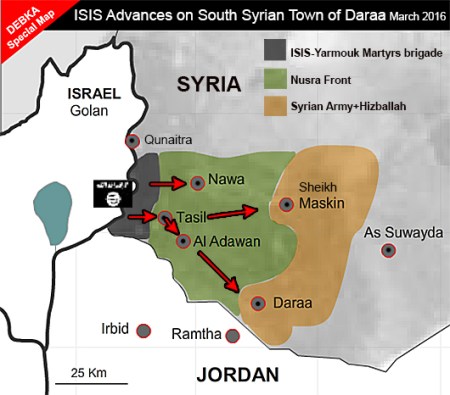
Reluctant to burn those boats, Moscow has been juggling its balls in the air, trying not to drop any. At first, he suspended Russian air cover for government-led battles. The Islamic State immediately seized on this opening in the south and advanced on the towns of Nawa, Sheikh Maskin and Daraa.
Moscow hoped that this setback would teach Bashar Assad to toe the Russian line.
Then, in the second part of last week, Putin ordered the Russian air force to renew its air strikes in the east in support of the Syrian army’s march from central Syria on the historic town of Palmyra. Friday and Saturday, the Syrian army and its allies were battling for control of the UNESCO World Heritage city, nearly a year after the Islamic State overran it and vandalized its historic remains.
DEBKAfile’s military sources stress that their capture of the reconstructed ancient Citadel perched on a hill over the city would have been beyond their strength without Russian air support. Finishing the job and recovering the entire city of Palmyra will depend heavily on Russian air strikes continuing to hammer the jihadist occupiers.
Putin faces a momentous decision. He has already taught Assad and Tehran a harsh lesson: with Russian air support, they win battles, but not without it, as their failure in the south has demonstrated.
Will he help Assad win Palmyra?
Crowning the Syrian dictator with such a striking victory would stiffen his resistance to American pressure for him to quit in short order. He would stand out as the only Syrian war leader capable of pushing ISIS back. But if the Russian leader decides to cut off air support in mid-battle for Palmyra, Assad and Iran will be forced to face the fact that without active Russian military support, they are in hot water.
The Syrian ruler would then have to accept his approaching end. That is the dilemma facing Putin.
Explore posts in the same categories: Assad, Iran - Syria war, Palmyra, Putin, Russia - Syrian warTags: Assad, Iran - Syria war, Palmyra, Putin, Russia - Syrian war
You can skip to the end and leave a response. Pinging is currently not allowed. WarSclerotic
Leave a comment