Addressing terrorism: what’s the plan?
Addressing terrorism: what’s the plan? Sharyl Attkisson, March 24, 2016

[W]e’ve been convinced that we’re disallowed from taking most any action that would be logical or effective in protecting ourselves. That’s not to argue that all or even one of these specific measures should be taken. But the fact is, more Americans can probably cite the list of things we won’t do; it would be helpful for us to understand what we will do.
********************
In early 2014, I was in a small meeting with a high-ranking Obama administration official who was involved in counterterrorism. When asked, he made several candid assertions:
- Al-Qaeda was never on the run. The President’s terrorism experts never told him it was. They were mystified by his 2012 campaign claims that seemed to the contrary.
- Al-Qaeda and related terrorists had vastly expanded to other nations and grown more powerful during President Obama’s tenure.
- The wave of terrorist violence had spread from the Mideast to North Africa and would next hit Europe, then the U.S. The official said this matter-of-factly, with no visible sense of urgency or distress, as if a fait accompli.
- The terrorists, he acknowledged, had a better and more developed strategy than did the U.S. In fact, he said the U.S. did not have a strategy for addressing the terrorist threat.
In the two years since that conversation, the official’s predictions about terror spreading to Europe and then the U.S. have come to pass. ISIS has emerged as a driving force. And most Americans would say there’s still no discernible plan.
The debates over securing the border and tightening the screening of immigrants are an outgrowth of the absence of a national plan. In order to feel a sense of security, Americans need to believe there’s a cohesive strategy with stated goals and explicit tactics. We don’t need to know all the fine points. Sensitive tactical details, for example, should be protected. But we should be able to understand how our leaders are using their authority and our billions of tax dollars to protect us. What’s the plan?
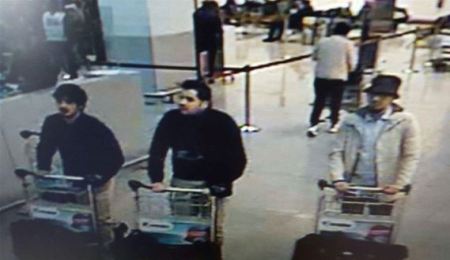 March 2016 Brussels terrorist suspects
n the defense of this (or any) administration, it’s the most difficult plan to devise. It’s hard to imagine a more daunting task than defeating terrorist fighters who play by no rules; while the U.S. is bound by ethics, politics, guidelines and international agreements. And there’s little disincentive for Islamic extremists to join the jihad. After all, what’s the worst that can happen to these barbaric fighters who may come from primitive and destitute circumstances? They get captured by the U.S. and get a better way of life: three meals a day, a roof over their head, a shirt on their back, security, interrogation that promises not to get too tough, free health care and American advocates who will fight to make sure they have recreation, literature and religious expression.
Yet the academic and military discussions about strategy to date have been a source of confusion rather than clarity. The administration may say it’s not changing strategy while the military says it is. At best, the expressed “battle plans” are piecemeal. We’re working to retake cities we already once controlled…but walked away from? Then what? What’s the plan?
 President Obama in a sensitive compartmented information facility (SCIF)
The conundrum evokes complaints from Vietnam War-era soldiers who said they never really knew what they were doing. They would battle to the death to take a village or a hill, then be ordered to simply walk away from it a few days later, relinquishing it back to the enemy. What was the plan?
It reminds me of the border. While some politicians claim the southern U.S. border is secure, federal and local law enforcement who are there say that couldn’t be farther from the truth. They insist there’s no will or leadership from Washington to bring the border under control, and no strategy to do so. In fact, the only strategy they can verbalize, when asked, is the one they infer: to be as lax as possible in policing the border and enforcing immigration law. What’s the plan?
We’re left with presidential candidates who have attempted to put plan to paper. Because of her experience and knowledge, Hillary Clinton may seem best positioned to verbalize a clear strategy. Yet as secretary of state, her own miscalculations arguably hastened the rise of ISIS from the ashes of Libya. Her emails from the time confirm that she took the lead in aggressively pursuing the poorly-conceived ouster of Libyan dictator Muammar Ghaddafi without foreseeing the vacuum it would create. In its wake: the tragedy of Benghazi, and the transformation of Libya into a new proving ground for Islamic extremists. It doesn’t inspire confidence that a Clinton leadership would competently address what she failed to foresee as a top Obama official. On the other hand, it could be argued that mistakes of the past provide important lessons for those open to learning from them.
 Hillary Clinton as secretary of state
There’s little doubt that, left its own devices, the world’s strongest military and best intelligence structure could do much better. But they’re hampered by the growing list of what we won’t do.
We won’t secure our southern border that FBI and Homeland Security officials have warned terrorists seek to exploit.
We won’t tighten up visa and immigration security because of the special interests who would cry racism.
We won’t send more terrorists captured in the field to Guantanamo Bay, lest we be criticized.
We won’t question detainees harshly to get information; that’s viewed as inhumane.
We won’t bomb targets in a way that may hurt a civilian or destroy assets. Obviously, the enemy has thus learned to live and work among civilians.
We’re told to report suspicions by the same authorities that view suspicion as racist.
In short, we’ve been convinced that we’re disallowed from taking most any action that would be logical or effective in protecting ourselves. That’s not to argue that all or even one of these specific measures should be taken. But the fact is, more Americans can probably cite the list of things we won’t do; it would be helpful for us to understand what we will do.
It’s an arduous question. But answering it is under the purview of our chosen leaders. What’s the plan?
Tags: Islamic slaughter, Islamic State, Obama and Islamic terrorism, What's the plan?
You can skip to the end and leave a response. Pinging is currently not allowed. WarSclerotic
Leave a comment