The New Cold War: The Russia-Shia Alliance VS the Islamic State
The New Cold War: The Russia-Shia Alliance VS the Islamic State, Counter Jihad Report, Brian Fairchild, October 31, 2015
(An excellent summary and analysis of the consequences of the Obama Middle East vacuum. — DM)
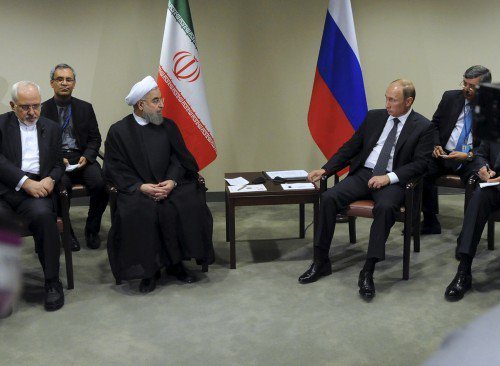 Russia’s President Vladimir Putin (2nd R) meets with Iran’s President Hassan Rouhani (2nd L) on the sidelines of the United Nations General Assembly in New York, September 28, 2015. REUTERS/Mikhail Klimentyev.
Just one month ago, the US was the only major military player in the Middle East, but that has all changed. Russia’s aggressive and well-planned military campaign in Syria has tilted the balance of power in the region away from the US and toward Russia and its new Shia-dominated quadrilateral alliance. As a result, the US plan to effect regime change in Syria is now impossible, but more importantly, US influence in Iraq is steadily diminishing, and thus, the number of options available to American military commanders to degrade the Islamic State are also diminishing.
***********************
The New Cold War:
In late-September 2015 Russia and Iran launched a clandestine strategic military campaign to support Syria’s Bashar al-Assad. Russia’s bold move took the West by surprise and changed the balance of power in the Middle East in Russia’s favor. It will go down in history as the milestone depicting Russia’s first aggressive military action outside of its own sphere of influence since the fall of the Soviet Union, and, when viewed from a global strategic perspective, will be remembered as the first clear sign that a New Cold War had erupted between the US and Russia.
Russia’s Middle Eastern campaign is formed around the new “quadrilateral alliance”, which has divided the region into two sectarian blocs: the Russian-led Shia Muslim alliance, which forms a powerful “Shia Crescent” stretching from Iraq, through Iran and Syria, to Lebanon, and the Sunni Arab bloc led by Saudi Arabia with minimal backing by the United States.
Thus far, Russia’s campaign has been executed seamlessly. Upon entering Syria clandestinely, Russian forces immediately deployed sophisticated surface to air missile defense batteries as well as top-of the-line jet fighters to protect Russian and Syrian forces from the US coalition. Once air defenses were in place, Moscow began a barrage of airstrikes targeting anti-Assad rebels in order to re-establish and consolidate Assad’s power. The airstrikes were subsequently integrated with ground operations carried-out by Syrian military units, Iranian Quds forces, Shia militia from Syria and Iraq, and Hezbollah fighters. There are also credible news reports that Cuban Special Forces have joined the fray for the first time since Cuba’s proxy wars in Angola and central Africa in the 1970’s on behalf of the Soviet Union.
The Russia-Shia Alliance and its Effect on Iraq, Jordan, and the Kurds:
Iraq:
In tandem with its military campaign, Russia launched a diplomatic campaign that has been just as effective. Iraq is the geographical base for US coalition operations against the Islamic State in Iraq and Syria, but American influence in Iraq has steadily diminished over the past year.
In early October 2015, Iraq secretly established a new Russia-Iran-Syria-Iraq intelligence center in the middle of Baghdad that surprised and angered American military commanders. Worse, after Russia’s increasingly effective Syrian air campaign, Iraqi Prime Minister Haider al-Abadi called for Russia to begin unilateral airstrikes against the Islamic State in Iraq. The Pentagon became so alarmed by the possibility that Russia might get a strategic foothold in Iraq that on October 21, 2015, it dispatched Chairman of the Joint Chiefs of Staff General Joseph Dunford to Baghdad to deliver an ultimatum to the Iraqi leadership. Dunford told the Iraqi Prime Minister and Defense Minister that Iraq had to choose between cooperating with Russia or the US. Upon his departure from Baghdad, General Dunford told the media that he received assurances that Iraq would not seek Russian assistance, but just three days later, Iraq officially authorized Russian airstrikes in-country.
Jordan:
On that same day, another of America’s most dependable allies, the Kingdom of Jordan, announced its agreement to create a new Russian-Jordanian military coordination center to target the Islamic State and that this center would go well beyond just a formal information exchange. According to Jordan’s Ambassador to Russia:
- “This time, we are talking about a specific form of cooperation — a center for military coordination between two countries. Now we will cooperate on a higher level. It will not be just in a format of information exchange: we see a necessity ‘to be on the ground’ as Jordan has a border with Syria”
The Kurds:
Moscow is attempting to undermine US relations with the Kurds. Since the rise of the Islamic State, the US has sought to provide anti-Islamic State military support to the Kurdish Regional Government (KRG) in northern Iraq via the Iraqi central government, but the Iraqi government has no desire to see the KRG gain additional power in the north so this mission has been largely ineffective. The US has had a measure of success providing limited support to the Kurdish People’s Protection Units (YPG), but has balked at providing full support because any support whatsoever angers Turkey due to contacts between the YPG and the Kurdish Worker’s Party (PKK), a separatist organization, that seeks to overthrow the Turkish government. On October 29, 2015, Turkish president Erdogan demonstrated this anger when he vehemently criticized US support for the YPG and stated that Turkey would attack the YPG on the Iraqi side of the border if it attempts to create a separatist Kurdish administrative zone. Because Turkey is a NATO ally, Turkish threats cause the US significant political and diplomatic problems, but they will not deter Putin from moving to organize and utilize Kurdish forces in pursuit of his goals; in early October, he went out of his way to show disdain for Turkey and NATO by allowing his Syrian-based jets to illegally invade Turkish airspace.
No Kurdish group is happy with the current situation of getting limited support from the United States to fight the Islamic State, but all of them have expressed interest in cooperating with Russia. Significantly, Sergey Ivanov, the head of the Kremlin administration, specifically urged cooperation between the Syrian Kurdish militia and the US-backed YPG.
The Russia-Shia Alliance and the Islamic State:
The Shia composition of the quadrilateral alliance is extremely significant because it plays directly into the Islamic State narrative. The Islamic State and the majority of the world’s Muslims are Sunni, but in the heart of the Middle East, the Shia governments of Iran, Iraq, Syria, and Lebanon, with Russian support, dominate, and these countries surround the Islamic State’s new “caliphate” on three sides. Understanding this strategic disadvantage, the Islamic State knows that it must muster as much international Sunni support as possible to survive, so it carries-out a relentless policy to polarize the international Sunni population against the Shia.
The chance to remove Bashar al-Assad, who represents the Shia Alawite sect, was the primary reason the Islamic State moved to Syria from Iraq, and removing al-Assad from power served as its initial rallying cry to the global Sunni community. It was this rallying cry that created the dangerous “foreign fighter” phenomenon that subsequently brought more than 30,000 radical Sunni Muslims from around the world to the new caliphate.
The Islamic State repeatedly emphasizes in its official publications and statements its contention that Shia Muslims are not true Muslims and must be eradicated, and, in these communications, it refers to Shia Muslims as “Rafidah” (rejecters). But of all the Shias in the world, the Islamic State has a particular hatred for the Shia Iranians, who are Persian rather than Arab, and who ruled Islam during the ancient Safavid (Persian) empire, which the Islamic State regards as religiously illegitimate. It therefore refers to Iranians as the “Safavid Rafidah”.
Moreover, the Islamic State accuses the US and Russia of being modern day “crusaders” who have joined forces with the Iranians to destroy Sunni Islam, a contention made clear on March 12, 2015, when its spokesman Abu Mohamed al-Adnani stated:
- The Safavid Rāfidah (Shia Iranians) today have entered a new stage in their war against the Sunnis. They have begun to believe that it is within their power to take areas of the Sunnis and control them completely. They no longer want a single Muslim from the Sunnis living in the empire they desire…O Sunnis…if the Islamic State is broken…then there will be no Mecca for you thereafter nor Medina…Sunnis! The Crusader-Safavid (Christian-Iranian) alliance is clear today. Here is Iran with its Great Satan America dividing the regions and roles amongst each other in the war against Islam and the Sunnis…We warned you before and continue to warn you that the war is a Crusader-Safavid was against Islam, and war against the Sunnis…”
The Shia Alliance and the Saudis:
Saudi Arabia considers itself to be the leader of the world’s Sunni population and the custodian of Islam’s two most holy places: the mosques of Mecca and Medina where the prophet Muhammad received Allah’s revelations. Because Iran is the Kingdom’s religious and regional nemesis the Islamic State’s anti-Shia narrative resonates greatly among many Saudis who are increasingly alarmed at Iran’s growing military influence and power. In a letter signed by 53 Saudi Islamic scholars in early October 2015, the clerics lashed out at Iran, Syria and Russia and echoed the main points made by the Islamic State:
- “The holy warriors of Syria are defending the whole Islamic nation. Trust them and support them … because if they are defeated, God forbid, it will be the turn of one Sunni country after another”
Saudi King Salman was willing to allow this unofficial letter to be published because it permitted the Saudi government an indirect manner to issue a warning to Iran, but as the Russian-Iran alliance continued to make military gains throughout October, the Kingdom’s anxiety was such that it decided to allow its Foreign Minister to issue the following direct warning to Iran:
- “We wish that Iran would change its policies and stop meddling in the affairs of other countries in the region, in Lebanon, Syria, Iraq and Yemen…We will make sure that we confront Iran’s actions and shall use all our political, economic and military powers to defend our territory and people…”
Conclusion:
The New Cold War:
Just one month ago, the US was the only major military player in the Middle East, but that has all changed. Russia’s aggressive and well-planned military campaign in Syria has tilted the balance of power in the region away from the US and toward Russia and its new Shia-dominated quadrilateral alliance. As a result, the US plan to effect regime change in Syria is now impossible, but more importantly, US influence in Iraq is steadily diminishing, and thus, the number of options available to American military commanders to degrade the Islamic State are also diminishing.
Five days after Iraq rejected General Dunford’s ultimatum and authorized Russian airstrikes in Iraq, Secretary of Defense Ashton Carter ignored this fact in his testimony before the Senate’s Armed Forces Committee when he stated that the United States plans to increase the number of airstrikes in Iraq as well as direct action raids by US special operations forces in Iraq.
Unfortunately, such an increase in US military actions require Iraqi permission, and for the second time in a week, Iraq rejected the United States. On October 28, 2015, Prime Minister al-Abadi’s spokesman told the media that Iraq has no intention of allowing increased American participation because:
- “This is an Iraqi affair and the government did not ask the U.S. Department of Defense to be involved in direct operations…”
If Iraq enforces this restriction, and limits the US to only training and arming Iraqi forces while allowing Russia to conduct aggressive operations in-country, the situation could become untenable for the United States, further reducing America’s ability to degrade the Islamic State.
The Islamic State:
Once Russia consolidates Assad rule in Syria, Putin will undoubtedly use the new Russia-Shia alliance to move against the Islamic State. Because the alliance dominates the geographical terrain on three sides of the “caliphate” and has demonstrated a willingness to engage in unified military air and ground operations, it is likely that Russian airpower and Shia ground forces will succeed in dismantling many Islamic State elements in Syria and Iraq.
Such success by the Russia-Shia alliance, especially if it forces the evacuation of the capital of the Islamic State’s “caliphate” in Raqqa, Syria, will further polarize and enrage radical Sunnis and likely increase the number of foreign fighters from Europe and the Middle East. It will also likely result in more domestic lone jihad attacks in the US and Russia, a call the Islamic State has already made in its October 13, 2015statement:
- “…the Islamic State is stronger today than yesterday, while at the same time America is getting weaker and weaker…America today is not just weakened, it has become powerless, forced to ally with Russia and Iran…Islamic youth everywhere, ignite jihad against the Russians and the Americans in their crusaders’ war against Muslims.”
If the Islamic State experiences set-backs and defeats in Syria and Iraq such defeats would likely motivate it to launch mass casualty attacks in the United States and Europe in order to prove to its followers that it remains relevant. Mass casualty attacks in tandem with increased lone jihad attacks would make an already bad domestic security situation, grave.
On October 23, 2015, FBI Director Comey revealed that the FBI is pursuing approximately 900 active cases against Islamic State extremists in the United States and that this number continues to expand. Comey added that should the number of cases continue to increase, it won’t be long before the FBI lacks the adequate resources to “keep up”. Europe, too, faces grave security challenges. A few days after Comey’s revelations, the head of MI5, Britain’s domestic intelligence service, stated that the terror threat in the United Kingdom from the Islamic State and al Qaeda is the highest he has “ever seen”.
Explore posts in the same categories: Assad, Obama - Middle East, Putin, Russia - Middle EastTags: Assad, Putin, Russia - Middle East
You can skip to the end and leave a response. Pinging is currently not allowed. WarSclerotic
Leave a comment