In Iraq, Regionalism Another Casualty of Islamic State
In Iraq, Regionalism Another Casualty of Islamic State, World Politics Review, December 5, 2014
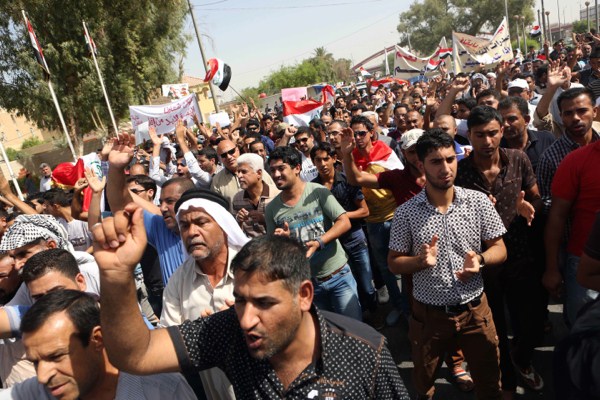 Residents chant slogans supporting the creation of Basra region, in front of the Basra provincial headquarters, Basra, Iraq, Sept. 27, 2014 (AP photo by Nabil al-Jurani)
As for regional governments, there will be no more of them. Iraqi Kurdistan will become independent at some point; it is a matter of when rather than if. The Sunni autonomy effort is dead, and the Shiite establishment will use all means fair and foul to ensure Basra is never autonomous. Right now the Sumer movement is mostly an Internet phenomenon without a mass street following, but were it to take off, it would destroy the state, not create an autonomous region.
*****************
The Iraqi government agreed Tuesday to a long-term oil wealth sharing deal with the Kurdistan Regional Government (KRG). In an email interview, Kirk Sowell, a political risk analyst who is the publisher of the biweekly newsletter Inside Iraqi Politics, discussed regionalism in Iraq.
WPR: What are the main non-Kurdish regional movements (i.e., potential autonomous regions) in Iraq, and what grievances are driving their regional aspirations?
Kirk Sowell: There are three. The first, chronologically speaking, is what might be called the “southernist tendency,” which has existed in two variants. One focused on Basra province, and another on combining Basra with the other southern oil producers, Maysan and Dhi Qar provinces. These were driven by a feeling of material deprivation, despite the wealth these provinces produce. The second is the Sunni Arab autonomy movement, driven by the abuses of former Prime Minister Nouri al-Maliki’s government, in particular illegal arrests. It started in Salah al-Din and Diyala provinces in late 2011 and made a second push through the Sunni protest movement of 2013. The third, newer tendency might be called “Sumerism,” and is essentially a Shiite effort to break the south and the center away from the Sunni Arabs and just have a state from the city of Samarra southward.
WPR: How have these movements been affected by the rise of the Islamic State, the post-Maliki political shifts in Baghdad and the oil revenue-sharing deal with the KRG?
Sowell: The southernist tendency has never really gotten off the ground. Referenda efforts have failed. The main party pushing it, the Islamist Fadhila, has lost seats, and its main secular proponent, Wael Abd al-Latif, failed to win a seat in Basra in the last election. The Sunni autonomy movement has essentially been destroyed by the jihadists’ dominance of more nationalist Sunni movements, and their leaders are now just trying to get more decentralized local control without full autonomy. The “Sumer” movement, on the other hand, was basically created by the jihadists’ unexpected success; its backers have lost patience with Sunni uprisings of any kind.
As for the potential Baghdad-Irbil oil deal, which is rather vague at points and will not be final until and unless it is passed into law, it is just a holdover deal until the Kurds are ready to declare independence. If it succeeds, the Kurds will have less need to rush that process, but it will not last forever.
WPR: What role can provincial and regional governments play in addressing Iraq’s challenges, including sectarianism, security and governance in general?
Sowell: Provincial governments could potentially play a role in improving governance, but their lack of independent revenue sources makes them dependent on Baghdad’s willingness to let them take control of service functions. So far a mixture of deliberate suppression and bureaucratic paralysis has frozen efforts at localization. Even where enshrined in statute, such as governors’ control over local security, Baghdad has held a firm grip, and it is unclear whether Prime Minister Hayder al-Abadi’s rhetorical support for a stronger provincial role will mean anything.
As for regional governments, there will be no more of them. Iraqi Kurdistan will become independent at some point; it is a matter of when rather than if. The Sunni autonomy effort is dead, and the Shiite establishment will use all means fair and foul to ensure Basra is never autonomous. Right now the Sumer movement is mostly an Internet phenomenon without a mass street following, but were it to take off, it would destroy the state, not create an autonomous region.
Explore posts in the same categories: Iraq, Kurds, Regional governmentsTags: Basra, Iraq, Kurds, Regional governments
You can skip to the end and leave a response. Pinging is currently not allowed. WarSclerotic
Leave a comment