A deadly battle for Gaza
A deadly battle for Gaza, The Australian, John Lyons, September 9, 2014
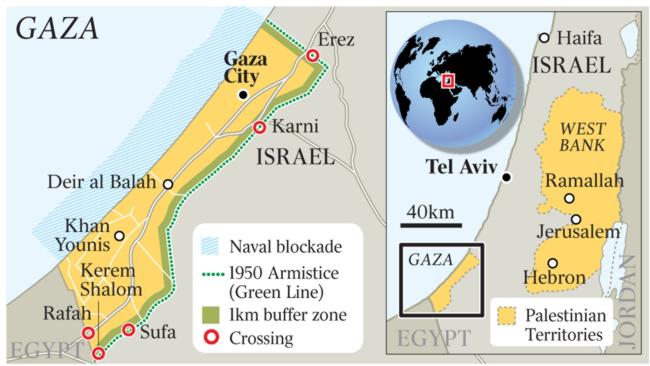
Salafists are extremist Islamic groups that believe in caliphates rather than the “artificial boundaries” of countries.
The Islamic State is the highest profile example, but many of these groups in Gaza share that organisation’s views.
An investigation in Gaza by The Australian has found nine significant Salafist groups engaged in a secret war against Hamas.
They are: Jaish al Oumah (Army of the Nation); Jaljalat (Rolling Thunder); Jaish al-Islam (Army of Islam); Ansar al-Sunnah (Loyal Followers of Sunnah); Jund Ansar Allah (Soldiers of Followers of Allah); the Al Tawheed Brigades (The One God Brigades); the Al Haman Mohamed Bin Maslamah Brigades; the Mujahideen Shoura Council (the Defenders of God Council); and Ahrar al-Watan (the Free of the Homeland).
All are Sunni, all want sharia law immediately and some endorse kidnappings.
***********************
SITTING on a beach in Gaza as a deep rich sun sinks into the Mediterranean, one of Gaza’s jihadist leaders is explaining why sharia law would be good for Australia.
“Please tell people back home that under sharia there will be no more poor people, that everyone will be equal,” he says. “All the natural resources of Australia will be divided equally among all Australians.”
He must sense I’m not convinced. “I know that if you adopt sharia Australians will express sorrow and say to themselves, ‘Why didn’t we do this earlier?’ ”
Abu Hafs al-Maqdisi is leader of Jaish al-Oumah — the Army of the Nation — one of nine Salafist groups in Gaza that believe Hamas is not pushing sharia quickly enough.
Salafists are extremist Islamic groups that believe in caliphates rather than the “artificial boundaries” of countries.
The Islamic State is the highest profile example, but many of these groups in Gaza share that organisation’s views.
Hamas, which controls Gaza, does not like stories about these groups being written and sometimes even denies they exist — but the groups are armed and organised.
“Hamas tried but did not succeed to establish sharia in Gaza,” says Maqdisi. “We are working with all those who want sharia.”
I ask him what he thinks of the present wave of beheadings by the Islamic State.
“You must ask Islamic State,” he says. But then he adds: “You are a foreign journalist and have asked me that question, but I am not going to try to behead you.”
While Israel has just had a 50-day war with Hamas, these groups may pose a greater danger.
“For Jews, as humans, they have the right to live,” he says. “But Jews as a state, and an occupier, must not exist in Palestine and it must be destroyed from the universe. Israel must be destroyed.”
But before these groups can launch their own attack against Israel, they need to defeat Hamas.
An investigation in Gaza by The Australian has found nine significant Salafist groups engaged in a secret war against Hamas.
They are: Jaish al Oumah (Army of the Nation); Jaljalat (Rolling Thunder); Jaish al-Islam (Army of Islam); Ansar al-Sunnah (Loyal Followers of Sunnah); Jund Ansar Allah (Soldiers of Followers of Allah); the Al Tawheed Brigades (The One God Brigades); the Al Haman Mohamed Bin Maslamah Brigades; the Mujahideen Shoura Council (the Defenders of God Council); and Ahrar al-Watan (the Free of the Homeland).
All are Sunni, all want sharia law immediately and some endorse kidnappings.
The Army of Islam helped Hamas kidnap Israeli soldier Gilad Shalit in 2006 and kidnapped BBC journalist Alan Johnston in 2007.
It was the Al Haman Mohamed Bin Maslamah Brigades who kidnapped Italian pro-Palestinian activist Vittorio Arrigoni in 2011, then hanged him after saying he had come to Gaza “only to spread corruption”.
“Hamas are not happy to have such groups in Gaza,” says Palestinian journalist Hasan Jaber. “They (Hamas) don’t want anyone in competition, to gain the thoughts or support of people who believe in Islam.
“They were very worried when they discovered the majority in these groups had left Hamas.”
The rivalry has spilled into gunfights.
In 2009 Jund Ansar Allah declared the south of Gaza a caliphate. Hamas surrounded the group’s mosque and opened fire, with 28 members killed.
So deep is the hatred that Hamas then kidnapped the bodies of the dead to try to prevent funerals.
Hamas often raids the Salafists to seize weapons.
“At first when these groups began to emerge, Hamas began a campaign by their Islamic scholars to convince these groups to return to Hamas, but they failed,” says Jaber.
“So Hamas began to fight and arrest them.”
Nathan Thrall, of the International Crisis Group, says: “Salafi-jihadis are regularly arrested and suppressed by Hamas.
“They have also made repeated allegations of having been tortured by (Hamas) Gaza security forces. Salafi-jihadis have attacked a number of sites within Gaza that they believe to have been places of immorality.”
Many in Israel say these groups pose a greater danger than Hamas: former Israeli ambassador to the US, Michael Oren, says Israel’s preferred outcome in Gaza was a “de-fanged Hamas”.
The ICG warned in 2011 that isolating Gaza benefited Salafists.
“The international community’s policy of snubbing Hamas and isolating Gaza has been misguided from the outset, for reasons Crisis Group long has enumerated,” it reported. “Besides condemning Gazans to a life of scarcity, it has not weakened the Islamist movement, loosened its grip over Gaza, bolstered Fatah or advanced the peace process.
“To that, one must add the assistance provided to Salafi-jihadis, who benefit from both Gaza’s lack of exposure to the outside world and the apparent futility of Hamas’s strategy of seeking greater engagement with the international community, restraining, until recently, attacks against Israel and limiting Islamising policies advocated by more zealous leaders.”
Added to this lethal cocktail is Islamic Jihad, a formidable rival to Hamas.
While Hamas has aligned itself with Sunni powers — particularly Qatar — Islamic Jihad has aligned itself with Iran, leader of the Shia world.
One Western intelligence source who specialises in arms movements in the Middle East tells The Australian that in the recent war with Israel Islamic Jihad had more lethal weapons than Hamas, because theirs had been supplied by Iran, while many of Hamas’s were made in Gaza.
The Salafists are not just at war with Hamas but also with Islamic Jihad.
Three months ago masked men attacked a Salafist scholar with metal bars. Salafist groups accused Islamic Jihad of the bashing, citing their alliance with Iran.
The threat to Hamas is increasing as the Salafist groups consider becoming one entity.
“It could be bad for Hamas but it may also have benefits,” Palestinian journalist Jaber says. “Instead of talking to eight or nine groups, they will talk to one.”
As with the Islamic State, their Islamist soulmate cutting a swath of terror across Syria and Iraq, the Salafists in Gaza want a caliphate, or Islamic state and do not recognise borders.
Under pressure from these groups, Hamas has tried to push sharia law harder.
Last year Hamas banned girls from the annual Gaza marathon, despite a record 1500 schoolchildren registering.
The UN Relief and Works Agency, which organised the marathon, pulled out in protest.
Hamas and UNRWA organise separate summer camps for children each year. Hamas will not allow boys and girls to attend the same camps, while UNRWA does.
In 2010 a Salafist group called the Free of the Homeland said UNRWA was “teaching schoolgirls fitness, dancing and immorality”. Two days later the camp was attacked, prompting UNRWA chief John Ging to declare: “It is an attack on the happiness of children.”
The Salafist groups have two main differences with Hamas — they believe Hamas is not implementing sharia law quickly enough and that Gaza should be a caliphate.
“The chief rivals of Salafi-jihadis are political Islamists, especially the Muslim Brotherhood, of which Hamas is the Palestinian branch,” says the ICG’s Thrall.
“Hamas is a Palestinian nationalist movement, it seeks to establish a Palestinian state with borders that are based on lines drawn by European officials less than 100 years ago.
“Salafi-jihadis, by contrast, do not have any interest in Palestinian nationalism or in the current borders of the Middle East.”
Back at the beach in Gaza, the leader of Army of the Nation is nervous about meeting, changing the venue several times.
He has reason to be anxious — both Israel and Hamas would be pleased to see the end of him. Hamas imprisoned him during a recent crackdown. He hobbles to our table because of injuries from battles with Israel.
He asks whether there is any chance sharia will be implemented in Australia.
I tell him I think it will be a challenge — for starters, 50 per cent of the electorate, women, may not like sharia status.
“Women are weak,” he responds. “Men can protect them. Men can work more than women.”
He clearly needs to do some focus group research before he tries selling sharia to Australia.
Explore posts in the same categories: Uncategorized You can skip to the end and leave a response. Pinging is currently not allowed. WarSclerotic
Leave a comment