Few “moderate” Muslims oppose an Islamic Caliphate
Few “moderate” Muslims oppose an Islamic Caliphate, Dan Miller’s Blog, August 16, 2014
Most who appear to be “moderate” approve of or refuse to acknowledge what their “extremist” brethren of the Islamic State are doing.
(The views of even “moderate” Muslims on an Islamic Caliphate and the Islamic State suggest that Israel needs to be cautious in dealing with and relying on Islamic nations, with the possible exception of Egypt, to help resolve her problems in Gaza and the West Bank. — DM)
In this video, seven young British Muslims discuss their understandings of the meaning of an Islamic Caliphate and their views on the Islamic State. Five of them approve an Islamic Caliphate, as they understand it.
This article (hat tip to The Counter Jihad Report for the link) may provide a basis for understanding the different views articulated by the young Muslims who support their versions of an Islamic Caliphate: Defensive or offensive Jihad: History, exegesis vs. contemporary propagation.
The issue at stake is the deep gap between the horrific acts of terrorism coming from the World Jihad groups, and, at the same time, the propagation emanating from Islamists, Muslims and Westerners; firstly, that Islam is a religion of peace and tolerance, hijacked by extremists; secondly, that there is only one Jihād, the spiritual, that means to worship Allah; and thirdly that the Muslims are ordered to fight their enemies only defensively. [Emphasis added.]
. . . .
The Arab-Islamic terrorist organization’s strategy against the Free World is comprised of two parallel but coordinated arms: Jihād – a holy war against the infidels, and Da`wah – the persuasive methods used to convince people to join Islam. Both arms are intended to achieve the same objectives, yet both are used at the same time by different activists and are aimed against different targets. However, between both, Da`wah is more dangerous to the Free World. Jihād appears 41 times in 18 Suwar (plural of Sûrah) in the Qur’ān, mostly coupled with fi-Sabīlillah (in the way of Allah; for the sake of Allah), which transforms it into a religious sanction. Da’wah is the Islamic concept of missionary activity, aimed at persuading all human beings to believe in Allâh. Da`wah is the moderate and graceful opening address used to approach non-believers and convince them to submit to Islam, and if it fails, it is the duty of Jihād to achieve the Islamic goals. [Emphasis added.]
. . . .
All four Islamic Schools of Jurisprudence and most of Islamic exegetes agree that the aims of Jihad are to remove the infidel’s oppression and injustice, to eliminate the barriers to the spread of Allah’s truth, and, to establish Islamic justice universally. There are four different ways in which the believer may fulfill his obligations: a) by his heart; b) by his tongue; c) by his hands; d) by the sword. This demonstrates the close connection between Jihād and Da’wah, as well as the fact that they are aimed at establishing Allah’s rule on earth, until either the non-believers embrace Islam (as a result of Da’wah), or submit to Islamic rule and agree to pay the tax poll, the Jizyah; or be killed in the battleground (as a result of Jihad war). [Emphasis added.]
From the Islamic viewpoint, all wars in Islam are religious; the concept of “secular war” does not exist; and Jihād is the only just war known. So, even according to Islamic Jurisdiction, one can wage the most aggressive war using atrocious evil deeds and still see it as a defensive war. The Muslim legal theory states that Islam cannot exist in conjunction with idolatry. This is Shirk, meaning association of other gods and idols with Allah. According to a Hadīth related to Muhammad, he declared: “I am ordered to fight polytheists until they say there is no God but Allah.” Muslims are under the Qur’ān Commandments’ obligation to slay the idolaters. Hence, terrorizing Islamic enemies is Allah’s commandment. [Emphasis added.]
According to Majid Khadduri, Muslims view peace as a tactical means for achieving their strategic objective, by defeating the enemy. Peace constitutes a temporary break in the ongoing war against the enemy, until Islam controls the whole world. They might come to terms with the enemy, provided that they resume the Jihād after the expiration of the treaty. Defeated Muslims maintained that their battle with the enemy would resume, however long they had to wait for the second round. By their very nature, treaties must be of temporary duration, for the normal relations between Muslim and non-Muslim territories are not peaceful, but war-like. [Emphasis added.]
Khadduri states that Muhammad has set the classic example by concluding the Khudaybiyah Treaty, in 628 with the Meccans: a peace treaty with the enemy is a valid instrument. That is, if it serves Muslim interests. Muhammad and his successors always reserved their right to repudiate any treaty or arrangement which they considered as harmful to Islam. Muslim authorities might have come to terms with the enemy, provided it was only for a temporary period. In practice, however, Jihād underwent certain changes in its meaning to suit the changing circumstances of life. This change, did not imply an abandonment of the Jihād duty; it only meant the entry of the obligation into a period of suspension – it assumed a dormant status, from which the leader may revive it at any time he deems necessary. [Emphasis added.]
Assuming that the young people in the video — evidently long exposed to Western culture while immersed in Islamic culture — are representative of their peers, it is unfortunately their prevailing view that Islam will conquer the world, either by persuasion or the sword. If persuasion does not work, the sword will be used. Why not ask “moderate” Muslims of your acquaintance about their understandings of “jihad,” the Islamic State, other versions of an Islamic Caliphate and what fate they think they hold for themselves and for non-Muslims?
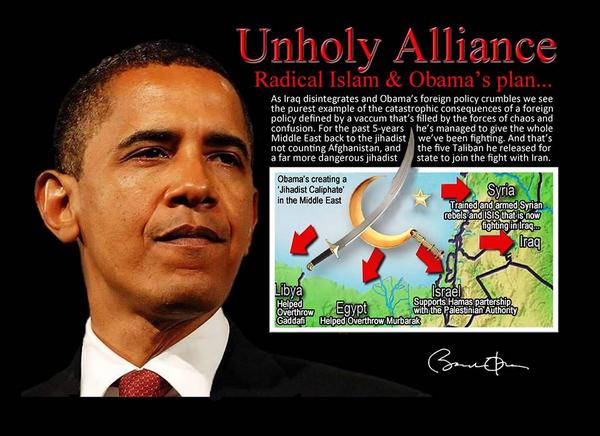
A candid expression of President Obama’s views would be even more interesting. He spent His early years in a Muslim environment and apparently continues to believe that Islam is the religion of peace. Does His 2009 Cairo Address provide a candid expression of His views?
I have come here to seek a new beginning between the United States and Muslims around the world; one based upon mutual interest and mutual respect; and one based upon the truth that America and Islam are not exclusive, and need not be in competition. Instead, they overlap, and share common principles – principles of justice and progress; tolerance and the dignity of all human beings. [Emphasis added.]
How about His more recent, July 27, 2014 Eid greeting?
While Eid marks the completion of Ramadan, it also celebrates the common values that unite us in our humanity and reinforces the obligations that people of all faiths have to each other, especially those impacted by poverty, conflict, and disease. [Emphasis added.]
In the United States, Eid also reminds us of the many achievements and contributions of Muslim Americans to building the very fabric of our nation and strengthening the core of our democracy. That is why we stand with people of all faiths, here at home and around the world, to protect and advance their rights to prosper, and we welcome their commitment to giving back to their communities. [Emphasis added.}
A July 22nd article in The Tehran Times (the voice of the Islamic Revolution) titled Muslim world must adopt proactive approach to international discourse on human rights seems to parallel President Obama’s views as He articulated them above:
On the occasion of [Islamic] Human Rights Day, the Muslim world should reflect on ways to improve the international discourse on human rights and to promote human rights based on the moral values of divine teachings. [Emphasis added.]
Undoubtedly, the immortal teachings of Islam concerning freedom, justice, peace, the fraternity and equality of all people, the universality and comprehensive nature of the Islamic laws on human rights and the prominent place they give to Man provide valuable sources for the Muslim world to make a substantial contribution to the global discourse of human rights. [Emphasis added.]
The West, which has reached an advanced stage in materialistic science, is still and shall remain in dire need of faith to support its civilization. Indeed, Islam has much to offer to Western societies currently dominated by the anarchic demands of endless “isms”, such as individualism, materialism, consumerism, and secularism. [Emphasis added.]
President Obama’s foreign policy (assuming that He has one, and I am concerned that He does) seems to be grounded in His views of Islam.
In the next video a Muslim from Canada, who was raised in the Muslim culture, explains why his brethren (with whom he disagrees) favor or are at best indifferent to the Islamic State. He also notes that leftists tend to support Islam and that Islamists use leftist narratives to reinforce and support their own views.
Until we in the West gain better understandings of the religion of peace death and the views of President Obama and His ilk concerning it, we will continue to be unwilling and unable to deal with it effectively. Even then, it will be extraordinarily difficult.
UPDATE
Islamic nations (other than The Islamic State) seem to be principally concerned that the Islamic State’s brutality tarnishes their own image, rather than about the realities of what IS is doing.
In the past, Muslim leaders have faced criticism from inside and outside the religion for being slow to condemn terrorism in the name of Islam. An editorial in the London-based Al-Quds Al-Arabi last month called on moderate Muslims to denounce the actions of the group formerly known as ISIS, which has killed thousands and left an estimated 1.5 million people displaced in northern Iraq. [Emphasis added.]
“All we have to do to understand the high price that Muslims pay on all levels [for such actions] is to see how Westerners snatch up [such reports on] ISIS’s conquests, invasions and despicable actions, and share them on social media in order to tarnish the image of Islam,” the July 24 editorial read. “We haven’t heard one single voice in the camp of moderate Islam condemning taking women prisoner or expropriating peaceful citizens’ property and money for ISI in Mosul, or any who distanced themselves from the shocking fatwas that seem to be carefully formulated for [maximum] service to the enemy.” [Emphasis added.]
The actions of the extreme militants threatens “not only Christians or Iraq,” but serves as a warning about the potential elimination of the region’s ethnic and religious minorities, the editorial continued.
“Therefore, an Arab position that attempts to downplay the dangers of the cancerous spread of terrorist organizations in the region … in order to serve the political agendas will actually be an accessory to the crimes against humanity, and will morally legitimize criminals who have lost any vestige of their humanity,” it read.
The apparent absence of criticism of IS by “moderate” Muslims is consistent with the views expressed in the two videos provided above.
Explore posts in the same categories: Uncategorized WarSclerotic
August 17, 2014 at 1:06 AM
Reblogged this on A Conservative Christian Man.