Kerry Vows to Press On After Israel Rejects Gaza Cease-Fire Proposal
Kerry Vows to Press On After Israel Rejects Gaza Cease-Fire Proposal, Voice of America, July 25, 2014
(Kerry says he will keep on keeping on. The positions of Israel and Hamas remain far apart.– DM)
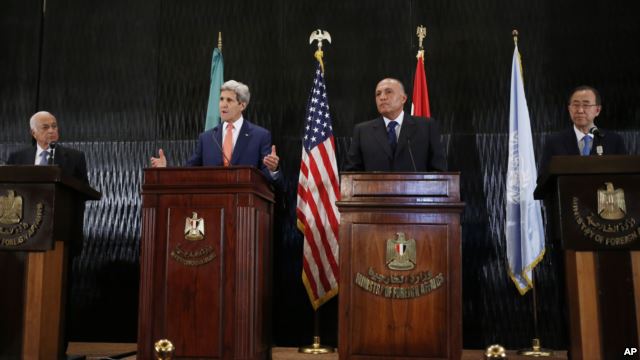 U.S. Secretary of State John Kerry, second left, with Secretary-General of the Arab League Nabil al-Araby, far left, Egypt’s Foreign Minister Sameh Shukri, second right, and U.N. Secretary-General Ban Ki-moon, speaks at a hotel in Cairo, Egypt, July 25, 2014
“None of us is stopping,” Kerry said, adding he will continue negotiations from Paris on Saturday.
Kerry described a broad timetable for continued talks and said there was “no formal proposal” presented to the Israeli cabinet for approval by vote. Kerry said Israeli Prime Minster Netanyahu has assured him that he wants to find a way forward.
U.S. Secretary of State John Kerry vowed to press on for a truce after Israel rejected a proposal for a cease-fire between Israel’s military and Hamas militants in the Gaza Strip.
Israeli public television said Prime Minister Benjamin Netanyahu’s security cabinet is seeking modifications before any agreement to end hostilities.
Kerry said late Friday that efforts will continue towards an agreement . He proposed a plan that would begin with a week-long cease-fire starting Sunday to stop two weeks of intense fighting that has sent the death toll soaring among Palestinian civilians.
“This is broad effort,” Kerry said, speaking to reporters alongside the Egyptian foreign minister in Cairo. “At this moment we are working toward a brief, seven-day cease-fire in honor of Eid.”
Kerry was referring to the days concluding the Muslim holy month of Ramadan.
Kerry’s proposal calls for prompt negotiations among Palestinian and Israeli officials on major economic, political and security issues. Representatives of other nations would attend the talks.
“None of us is stopping,” Kerry said, adding he will continue negotiations from Paris on Saturday.
Kerry described a broad timetable for continued talks and said there was “no formal proposal” presented to the Israeli cabinet for approval by vote. Kerry said Israeli Prime Minster Netanyahu has assured him that he wants to find a way forward.
Kerry met for hours in Cairo with Egypt’s foreign minister, Sameh Shukri, and the United Nations’ chief, Secretary-General Ban Ki-moon.
“The people of Gaza have bled enough,” Ban told reporters in Cairo, appearing with Kerry. “First, stop the fighting…Second start talking. There is no military solution.”
Ban has decried the conflict’s impact on civilians.
On Friday, five Palestinians were killed in the West Bank as the conflict in Gaza spread. The death toll rose to more than 800 Palestinians – mostly civilians – 35 Israelis and one foreign worker in Israel.
Egypt has mediated previous conflicts between Israel and Hamas, including a 2012 cease-fire. The United States, Israel’s closest ally, does not negotiate directly with the militant Palestinian group, which it has branded a terrorist organization.
Israeli security cabinet meeting
Netanyahu convened his security cabinet on Friday and Israeli media said the cabinet continued to meet into the night.
An Israeli official said the Netanyahu government envisaged an initial halt to the fighting lasting seven days, during which the army would keep digging up tunnels on Gaza’s eastern frontier.
According to Western and Palestinian officials, once a humanitarian lull takes hold, delegations from Israel and Hamas would arrive in Cairo for indirect talks that could lead to a lasting truce.
“First Israel wants to hear Hamas’s response to the [Kerry] proposals,” the official said, adding that some members of the security cabinet also sought assurances that Gaza would be stripped of its remaining rockets under any extended cease-fire.
Hamas had no immediate comment. On Wednesday, its leader Khaled Meshaal voiced support for a humanitarian truce, but only if Israel eased restrictions on Gaza’s 1.8 million people.
Hamas wants Egypt to open up its border with Gaza, too, and has demanded that Israel release hundreds of prisoners rounded up by Israel in a sweep of the West Bank last month following the kidnap and killing of three Jewish teenagers.
Calls for a cease-fire have escalated, especially since Thursday, the 18-day-old conflict’s deadliest day, when more than 100 Palestinians were killed.
The U.N. secretary-general said he was “appalled” by Thursday’s shelling of a United Nations-run school being used as a shelter from the violence. The victims included “women and children, as well as U.N. staff,” Ban said.
The U.S. State Department said it was “deeply concerned,” though it did not explicitly blame Israel for the shelling.
Israel’s military, which has hit two other U.N. shelters in recent days, did not say it was behind the attack, but acknowledged fighting in the area Thursday.
The military said it warned civilians to vacate the area, but blamed Hamas for not allowing them to leave before the deadline.
Palestinian protesters have clashed with Israeli troops in the West Bank and East Jerusalem.
Palestinian medics say five Palestinians died in the West Bank during protests Friday. Demonstrators in the Palestinian territory marched in solidarity with Gaza in the northern village of Hawara. Thousands also demonstrated overnight, in what many observers are calling the West Bank’s biggest protest in a decade.
In East Jerusalem, dozens of Palestinian protesters hurled rocks and threw Molotov cocktails at an Israeli army checkpoint.
In Iran, government-run broadcasts said “millions” of people joined rallies nationwide to mark solidarity with Palestinians on Friday for its annual al-Quds Day event. Quds is the Arabic word for Jerusalem, one of the most important cities in the Muslim faith. The yearly show of support occurs on the last Friday of Ramadan.
Clashes continue
On Friday, dozens of Palestinian youths clashed with Israeli police near Jerusalem’s Old City and clashes erupted in other parts of the West Bank near Hebron and Nablus.
Police in Jerusalem barred entrance to the al-Aqsa mosque to men younger than 50 years. But many gathered on streets outside the barricades to hold prayers on the last Friday of Ramadan.
The Palestinians were staging what they called a day of rage against the Israeli military operation in the Gaza Strip.
In addition to killing hundreds, the conflict has wounded thousands and destroyed thousands of homes and a dozen hospitals and clinics.
Hebrew University Professor Moshe Ma’oz said the outbreak of violence was inevitable due to rising tensions after the collapse of a nine-month effort to revive peace talks between Israel and the Palestinians.
“It’s a vicious cycle of struggles and conflict,” Ma’oz said. There are no saints in the Middle East and certainly not on this issue. Everybody contributed to it.”
The collapse led to a reconciliation agreement between Hamas, which controls Gaza, and Fatah which dominates the Palestinian Authority in the West Bank.
The accord angered the Israeli government, which considers Hamas a terrorist organization. Some Israeli officials have called for the operation in Gaza to continue until Hamas is destroyed.
Hamas invincible?
The head of East Jerusalem’s International Peace and Cooperation Center, Rami Nasrallah, it isn’t possible to destroy Hamas.
“I mean, we’re not talking about a gang of 10 or 200 people,” Nasrallah said. “We’re talking about a major social, political power within the Palestinian society, whether in Gaza or in the West Bank.”
He said the Israeli strikes in Gaza rather have strengthened support for Hamas among Palestinians and obliged Palestinian Authority President Mahmoud Abbas to express public support for the demands of Hamas.
Explore posts in the same categories: Uncategorized WarSclerotic
Leave a comment