Obama Rejected Iraqi Request for Air Strikes on Al Qaeda
Obama Rejected Iraqi Request for Air Strikes on Al Qaeda, Front Page Magazine,
(But see this Stratfor article, speculating that the U.S. will send “vital equipment such as helicopter gunships, Hellfire missiles, communications equipment, large volumes of small arms and ammunition.” — DM)
Obama has two agendas.
1. He does not in any way, shape or form want to be associated with the Iraq War
2. He does not want to offend Muslims, especially the Islamist groups that he has been courting.
Obama . . . claims that conflicts can be ended unilaterally, no matter how much the other side wants to continue them.
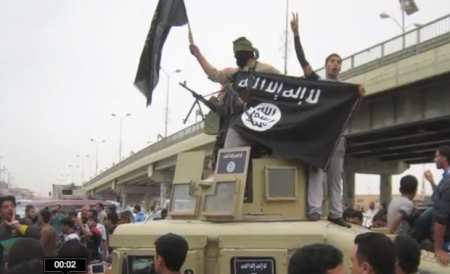
I can understand why putting boots on the ground would be unappealing, but air strikes against a terrorist group are low risk and high reward. Obama had no problem signing off on air strikes against Gaddafi. He was contemplating air strikes against Assad.
Both of those were much more high risk, much less legal and much less in our national interest.
On the other hand we are at war with Al Qaeda and this is an Al Qaeda affiliate that we had been directly fighting. There’s no legal issue here, and unlike Syria, it’s not likely to pose a threat to air power. And using drones is on the table.
Why can we use drones against Al Qaeda leaders in Yemen, but not Iraq?
If ISIS manages to set up its own Emirate out of pieces of Iraq and Syria, we’re going to have to end up being dragged into the conflict anyway. It now has a large enemy force. It’s going to come after us. It would be smart to weaken it now.
It would have been smarter to carry out air strikes against it in Syria, instead of talking about bombing the Syrian government.
But Obama has two agendas.
1. He does not in any way, shape or form want to be associated with the Iraq War
2. He does not want to offend Muslims, especially the Islamist groups that he has been courting.
So…
As the threat from Sunni militants in western Iraq escalated last month, Prime Minister Nuri Kamal al-Maliki secretly asked the Obama administration to consider carrying out airstrikes against extremist staging areas, according to Iraqi and American officials.
But Iraq’s appeals for a military response have so far been rebuffed by the White House, which has been reluctant to open a new chapter in a conflict that President Obama has insisted was over when the United States withdrew the last of its forces from Iraq in 2011.
Obama said it’s over, so it’s over. Never mind reality.
Al Qaeda’s attacks grew much worse after the pullout, but Obama kept moving forward and ignoring the problem. And here we are.
ISIS is now taking over major Iraqi cities. But it’s “over”. And Obama, like most liberals, claims that conflicts can be ended unilaterally, no matter how much the other side wants to continue them.
The Obama administration has carried out drone strikes against militants in Yemen and Pakistan, where it fears terrorists have been hatching plans to attack the United States. But despite the fact that Sunni militants have been making steady advances and may be carving out new havens from which they could carry out attacks against the West, administration spokesmen have insisted that the United States is not actively considering using warplanes or armed drones to strike them.
Hoshyar Zebari, Iraq’s foreign minister, last year floated the idea that armed American-operated Predator or Reaper drones might be used to respond to the expanding militant network in Iraq. American officials dismissed that suggestion at the time, saying that the request had not come from Mr. Maliki.
By March, however, American experts who visited Baghdad were being told that Iraq’s top leaders were hoping that American air power could be used to strike the militants’ staging and training areas inside Iraq, and help Iraq’s beleaguered forces stop them from crossing into Iraq from Syria.
“Iraqi officials at the highest level said they had requested manned and unmanned U.S. airstrikes this year against ISIS camps in the Jazira desert,” said Kenneth M. Pollack, a former C.I.A. analyst and National Security Council official, who is a senior fellow at the Brookings Institution and who visited Baghdad in early March. ISIS is the acronym for the Islamic State in Iraq and Syria, as the militant group is known.
As the Sunni insurgents have grown in strength those requests have persisted. In a May 11 meeting with American diplomats and Gen. Lloyd J. Austin III, the head of the Central Command, which oversees American military operations in the Middle East, Mr. Maliki said he would like the United States to provide Iraq with the ability to operate drones. But if the United States was not willing to do that, Mr. Maliki indicated he was prepared to allow the United States to carry out strikes using warplanes or drones.
In a May 16 phone call with Vice President Joseph R. Biden Jr., Mr. Maliki again suggested that the United States consider using American air power. A written request repeating that point was submitted soon afterward, officials said.
So we have clear requests for military aid that the administration has simply been ignoring. Again drone attacks would put no American lives at risk and would undermine ISIS’ momentum by slowing them down and taking out top leaders.
There’s no reason not to do it except the two reasons mentioned above.
But so far, the administration has signaled that it is not interested in such a direct American military role.
“Ultimately, this is for the Iraqi security forces, and the Iraqi government to deal with,” Rear Adm. John F. Kirby, the Pentagon spokesman, said Tuesday.
Except they’re not dealing with it too well, so we’re going to end up having to deal with it.
We waited until Al Qaeda has its own small country with half a billion in money, helicopters, armored vehicles and a huge population. How much longer does Obama want to wait?
Explore posts in the same categories: Uncategorized
 WarSclerotic
Leave a comment