US urges Israel, Palestinians to refrain from unilateral steps
US urges Israel, Palestinians to refrain from unilateral steps, Jerusalem Post, May 24, 2014
(How about pushing Iran instead of Israel? Is resumption of a peace process in Israel more important? Or do Kerry et al think that the world is the way they wish it were rather than the way it is? Unicorn stew may be hearty, but it is indigestible. — DM)
Harf said the US “would like to resume peace negotiations” and was urging both sides to refrain from actions that would undermine the groundwork for restarting the talks that broke down in late April.
“There is an emerging consensus that we don’t have a partner who can challenge constituencies, do something unpopular, do something that is difficult. Abbas has not done anything to challenge the prevailing Palestinian consensus. In fact, he’s doing the opposite: the Hamas reconciliation, internationalizing the conflict, not giving one iota on the right of return, not giving an iota on the Jewish state. He wouldn’t deal with Kerry’s framework,” Netanyahu said.
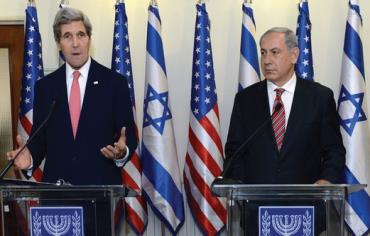 BB and Kerry dec 5 Photo: MATTY STERN / US EMBASSY / FLASH 90
The United State reiterated its opposition to any unilateral step made by either Israel or the Palestinians amid the absence of peace negotiations, State Department spokeswoman Marie Harf said on Friday in response to remarks made by Prime Minister Binyamin Netanyahu in a BloombergView interview earlier Friday.
Harf said the US “would like to resume peace negotiations” and was urging both sides to refrain from actions that would undermine the groundwork for restarting the talks that broke down in late April.
She state[d] that: “we don’t think either side should do anything to complicate efforts right now to build the trust necessary to resume negotiations.”
The State Department’s comments came following Netanyahu’s comments in the interview dismissing the possibility of unilateral territorial withdrawals and appeared open to annexation plans for portions of the West Bank in the absence of a peace process.
“The idea of taking unilateral steps is gaining ground, from the center-left to the center-right,” Netanyahu said in the interview with Jeffrey Goldberg.
“Many Israelis are asking themselves if there are certain unilateral steps that could theoretically make sense,” he added.
But Netanyahu appeared to dismissed left-wing ideas of territorial withdrawal from portions of the West Bank as one possible unilateral option.
He explained that Israel’s 2005 disengagement from Gaza, a unilateral plan designed to rescue a frozen peace process, had strengthened terrorist groups bent on destroying Israel and had failed to bring peace.
“People also recognize that the unilateral withdrawal from Gaza didn’t improve the situation or advance peace — it created Hamastan, from which thousands of rockets have been fired at our cities,” Netanyahu said.
There are some points of consensus in Israel around the peace process with the Palestinians and the nation’s future, he said.
“The first point of consensus is that we don’t want a binational state. Another point of consensus is that we don’t want an Iranian proxy in territories we vacate.
“We want a demilitarized Palestinian state that recognizes the nation-state of the Jews. How do you get that if you can’t get it through negotiations? “The Palestinians don’t agree to recognizing Israel as the Jewish nation-state, and it’s not clear to me that they’ll agree to elements of demilitarization that are required in any conceivable plan that works,” Netanyahu said.
The problem with a negotiated solution he said, is that at present there is no ground for consensus with the Palestinians.
“The minimal set of conditions that any Israeli government would need cannot be met by the Palestinians,” Netanyahu said.
He spoke with Goldberg, after a nine-month US led negotiating process ended on April 29th, with no tangible results. Initially when nine-month negotiating period began, the US had hoped to arrive at a final status agreement, but then downgraded that expectation to a framework document of agreed upon principles. Israelis and Palestinians were unable to even agree on those principles. Discussion about simply renewing negotiations came to a screeching halt, however, when Fatah announced that it planned to unite with Hamas to form one government.
In response, Israel suspended talks with Fatah and said that it could not negotiate with an entity that aligned itself with a terrorist group bent on Israel’s destruction. Netanyahu explained that he preferred to solve the issue through negotiations, but did not think that it was possible at this time.
“No matter what the spin is about blaming Israel, do we actually expect Abbas, who seems to be embracing Hamas, to give a negotiated deal? In all likelihood, no. I hope he does, but I’m not sure he’s going to do it,” Netanyahu said.
“There is an emerging consensus that we don’t have a partner who can challenge constituencies, do something unpopular, do something that is difficult. Abbas has not done anything to challenge the prevailing Palestinian consensus. In fact, he’s doing the opposite: the Hamas reconciliation, internationalizing the conflict, not giving one iota on the right of return, not giving an iota on the Jewish state. He wouldn’t deal with Kerry’s framework,” Netanyahu said.
Explore posts in the same categories: Uncategorized WarSclerotic
Leave a comment