Letter From a Tehran Jail
Letter From a Tehran Jail, Wall Street Journal, April 25, 2014
(Nevertheless, political prisoners in Iranian prisons are treated humanely. Unlike some political prisoners in Israeli prisons, they are permitted, even encouraged, to collect postage stamps efficiently. To suggest otherwise could be Islamophobic, anti-peace process and even anti-Iranian; probably even “racist.” — DM)
Political prisoners report savage beatings at Evin prison last week.
Perhaps a regime, and a president, that can brutalize political dissidents as a matter of routine can prove reasonable at the nuclear negotiating table. We wouldn’t count on it, and neither should the West.
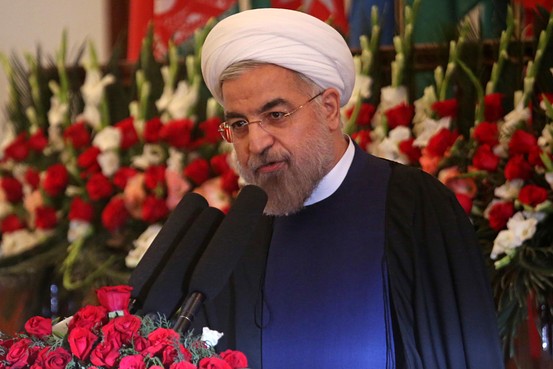
Ward 350 of Tehran’s Evin prison houses some of Iran’s most prominent dissidents, including human-rights lawyers, labor leaders and opposition bloggers. The Islamic Revolutionary Guard Corps and the intelligence ministry raided the ward last week and administered a mass beating to its residents, landing dozens of prisoners in the hospital.
That’s according to family members of the prisoners and news accounts from Kalame, a website associated with opposition leader Mir Hossein Mousavi. Kalame on Tuesday published what it claimed was a firsthand account of the assault on Ward 350 written by Emad Bahavar, a supporter of the opposition Green movement serving a 10-year sentence.
Mr. Bahavar’s letter, sent from Evin, is worth quoting at length for the portrait it paints of a supposedly reforming Iran. “It feels as though pain has engulfed my entire body,” Mr. Bahavar writes. “They covered our eyes and cuffed our wrists. . . . They lined us up in the Ward 350 corridor, our faces to the wall. I could hear some crying in pain. . . . They started beating our backs very severely with batons. The screaming and crying got louder.”
The security forces next formed a “tunnel” running from the ward’s main entrance to a minibus outside, according to Mr. Bahavar. The guards, some uniformed and some in civilian clothes, beat the prisoners as they ran down this tunnel. The whole route “was covered in blood,” Mr. Bahavar reports. The minibus drove some prisoners away, while others like Mr. Bahavar were returned to the ward and eventually allowed to see a prison medic.
Mr. Bahavar, like many Green-movement supporters, initially embraced Hasan Rouhani’s candidacy for president: “Rouhani came, and we thought we’d forgive what had happened to us if he improves the people’s condition.” But the beating he and the other inmates received last week convinced Mr. Bahavar that “the hatred in their black hearts is much greater than the Greens’ kindness and forbearance.”
Western governments have treated President Rouhani as the great moderate hope—an Iranian version of China’s Deng Xiaoping. They forget that Mr. Rouhani has been a lifelong security apparatchik, having helped engineer the regime’s bloody 1999 crackdown on Iran’s student movement. His government also bans TwitterTWTR -7.16% (except for public officials) and is setting modern records for the number of public executions. And unlike Deng, whom Mao purged, Mr. Rouhani has always been part of the regime’s inner circle.
Perhaps a regime, and a president, that can brutalize political dissidents as a matter of routine can prove reasonable at the nuclear negotiating table. We wouldn’t count on it, and neither should the West.
Explore posts in the same categories: Uncategorized WarSclerotic
Leave a comment