Top EU diplomat floats extending Iran talks before they begin
Top EU diplomat floats extending Iran talks before they begin Jerusalem Post, February 4, 2014
(The longer it takes beyond the agreed upon remaining five months to reach a “deal,” the longer the sanctions relief will continue regardless of the outcome and the more difficult it will become to restore should no “deal” be reached — DM)
Ashton discussing extension, given high stakes of failure if comprehensive agreement on nuclear program not reached.
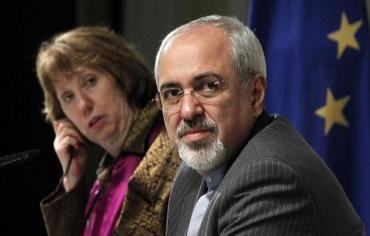 EU foreign policy chief Catherine Ashton (L) and Iranian FM Mohammad Javad Zarif. Photo: REUTERS
WASHINGTON – Comprehensive negotiations between world powers and Iran over its nuclear program officially begin in Vienna on February 18, at which point diplomats will have just over five months to reach an accord to end the long-standing impasse once and for all.
That cutoff was agreed upon, and is self-imposed, by the parties directly involved in the talks. Yet given the stakes of failure, Catherine Ashton, the European Union’s chief diplomat, is already discussing an extension of that deadline.
“Everyone will say to you, and rightly so, this is extremely difficult,” Ashton told The Wall Street Journal at a strategic conference in Munich on Sunday. “We have no guarantees in this and we will take the time that is necessary to get this to be the right agreement.”
Asked about Ashton’s comments on Monday, State Department spokeswoman Jen Psaki reminded reporters that the Joint Plan of Action allowed for an additional six month extension of talks “upon mutual consent.”
“The comprehensive talks have not even begun yet,” Psaki said. “So we are not at a decision-making phase, we’re not predicting, we don’t know that they would be extended, and that’s certainly not the baseline we’re going on.”
“From our standpoint, that position hasn’t been determined yet, and that simply is a statement of what’s allowed for in the JPOA,” she added.
Speaking under condition of anonymity – given the sensitivity of the negotiations – US officials told The Jerusalem Post they, too, fear the talks will require more time than has been officially acknowledged.
Iran and the P5+1– the US, United Kingdom, France, Russia, China and Germany – agreed to the six-month time frame in an interim deal that essentially capped Iran’s most strategically significant nuclear work in exchange for sanctions relief, creating an environment for the parties to negotiate in earnest.
In that first-step deal, formally known as the Joint Plan of Action, the parties gave themselves the option of extending the deadline by an additional six months – for up to a full year’s worth of negotiations.
Speaking to the Munich Security Conference over the weekend, Iranian Foreign Minister Mohammad Javad Zarif said that failure to reach a deal – or an abrupt end to negotiations – would spell “disaster.”
American officials have echoed that sentiment in recent days.
Asked by the Post on Friday whether war or additional sanctions were more likely should talks fail, State Department deputy spokeswoman Marie Harf said that US alternatives to diplomacy are limited and are “likely to involve military action.”
“I’m not predicting that we would take military action right away,” Harf said. “It’s more of a broad statement that, look, if we can’t get this done diplomatically in six months or a year or at any time, we will – we are committed to resolving it. And that involves less durable and, quite frankly, riskier actions.”
Explore posts in the same categories: Uncategorized WarSclerotic
February 4, 2014 at 6:50 PM
I have to look up just exactly how many years Iran has been leading Europe or America through round after round of talks. If it wasn’t so sad it would be hilarious.
February 4, 2014 at 9:08 PM
You can bet it started back in 1979 when our cowardly POTUS Jimmy Carter let the Ayatollah hold our embassy personnel hostage for 444 days.
” The negotiations resulted in the “Algiers Accords”[14] of January 19, 1981. The Algiers Accords called for Iran’s immediate freeing of the hostages, the unfreezing of $7.9 billion of Iranian assets and immunity from lawsuits Iran might have faced in America, and a pledge by the United States that “it is and from now on will be the policy of the United States not to intervene, directly or indirectly, politically or militarily, in Iran’s internal affairs”. The Accords also created the Iran – United States Claims Tribunal, and Iran deposited $1 billion in an escrow account to satisfy claims adjudicated by the Tribunal in favor of American businesses that had lost assets after the hostage takeover. The Tribunal closed to new claims by private individuals on January 19, 1982. In total, it received approximately 4,700 private U.S. claims. The Tribunal has ordered payments by Iran to U.S. nationals totaling over $2.5 billion. Almost all private claims have now been resolved; but several intergovernmental claims are still before the Tribunal.”
The rest, shall we say, is history.